Trump intensifies siege on Maduro’s Venezuela by sending 10 F-35 jets to the Caribbean Por Luís Henrique Costa
6 min de leitura
 |
The United States, under President Donald Trump, intensified pressure on Nicolás Maduro’s government by sending 10 F-35 jets to a base in Puerto Rico, Caribbean, on Friday, September 5, 2025, as revealed by Reuters. The operation, officially aimed at combating Latin American drug cartels like the Cartel de los Soles, comes amid escalating tensions with Venezuela, marked by recent incidents such as a U.S. bombing of a Venezuelan boat and a flyover by Venezuelan F-16 jets over an American destroyer. The move strengthens the U.S. military presence in the region, which already includes warships, a nuclear submarine, and spy planes. While the stated goal is to fight drug trafficking, analysts question this, suggesting preparations for a direct military intervention against Maduro’s regime. The Venezuelan president vowed armed resistance if attacked, raising the risk of a direct conflict in Latin America.
The decision to deploy the jets follows a U.S. attack on a Caribbean vessel, which killed 11 people and was linked by Trump to the Tren de Aragua gang. The action was described as part of a campaign against narcoterrorism. However, the use of high-tech equipment like the F-35 suggests broader objectives beyond drug trafficking, according to experts.
- Official objective: Combat cartels like the Cartel de los Soles, accused of ties to Maduro’s government.
- Military presence: Includes seven warships, a nuclear submarine, and P-8 spy planes.
- Recent tension: Venezuelan F-16 flyover of the USS Jason Dunham destroyer.
- Maduro’s response: Pledge of armed resistance if the U.S. attacks.
Military movements in the Caribbean
The arrival of 10 F-35 jets at the Puerto Rico airbase, expected next week, reinforces the U.S. strategy to intensify surveillance and pressure in the southern Caribbean. These jets, among the most advanced in the U.S. arsenal, are equipped with stealth technology and capabilities for attack and reconnaissance. Choosing Puerto Rico as a strategic base allows the U.S. to closely monitor activities off Venezuela’s coast, just 67 km from Curaçao, where part of the American fleet is positioned.
The operation, involving about 4,500 troops, seven warships, and a nuclear submarine, is described by the Trump administration as a response to drug trafficking. However, the scale of the deployed equipment raises suspicions. Experts like political scientist Carlos Gustavo Poggio note that the equipment is not typical for anti-drug operations, suggesting preparations for a larger conflict.
- F-35 jets: Equipped with advanced sensors and stealth attack capabilities.
- Nuclear submarine: Capable of covert operations and precision strikes.
- Warships: Include an amphibious squadron for potential landings.
- P-8 planes: Used for maritime surveillance and target detection.
Recent incidents and provocations
On Thursday, September 4, two Venezuelan F-16 jets flew over the USS Jason Dunham destroyer in international waters, an act the Pentagon called “highly provocative.” The move was seen as a show of force by Venezuela, facing increasing U.S. pressure. The U.S. Department of Defense issued a stern warning to Maduro’s government against interfering with anti-narcoterrorism operations.
Days earlier, on September 2, the U.S. bombed a vessel in the Caribbean, which Trump claimed was linked to Tren de Aragua, a group labeled as narcoterrorist by Washington. The attack killed 11 occupants, escalating tensions. Maduro accused the U.S. of threatening Venezuelan sovereignty and mobilized 4.5 million militiamen to defend the country.
Allegations against the Cartel de los Soles
The Cartel de los Soles, identified by the U.S. as a criminal organization involving senior Venezuelan military officers, is central to the U.S. operation’s justification. Named after the sun insignias worn by Venezuelan generals, the group is accused of facilitating cocaine trafficking to the U.S. and Europe, in collaboration with groups like the FARC and the Sinaloa Cartel.
While the U.S. claims Maduro leads the cartel, analysts question this narrative. Experts describe the Cartel de los Soles as a decentralized network involving military and political figures at various levels, lacking a clear hierarchy. This structure complicates targeted operations but reinforces U.S. claims of Venezuelan government involvement in drug trafficking.
- Name origin: Sun insignias used by Venezuelan generals.
- Illicit activities: Drug trafficking, arms smuggling, and illegal mining.
- International ties: Links to FARC and Sinaloa Cartel.
- Reward: U.S. offers $50 million for information leading to Maduro’s arrest.
Venezuelan response and regional risks
Nicolás Maduro responded to the U.S. military presence with strong statements, vowing armed resistance if Venezuela is attacked. In early September, he called U.S. actions “the greatest threat to Latin America in a century” and ordered the mobilization of military forces and militias. Venezuela possesses Russian defense systems, such as anti-aircraft missiles, increasing the complexity of any potential U.S. military operation.
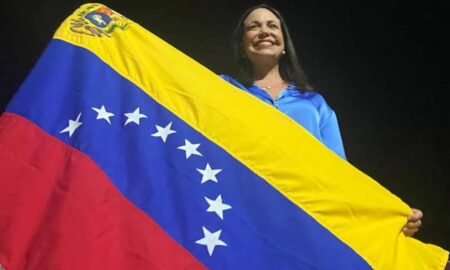
The Venezuelan opposition, led by figures like Maria Corina Machado, has been in contact with the Trump administration, according to sources close to the leader. Machado’s team claimed a “transition” is underway in the country, though details remain unclear. This suggests the U.S. may be coordinating with opposition groups to pressure Maduro.
Implications for Latin America
The Caribbean escalation comes amid Venezuela’s political instability, worsened by economic sanctions and internal disputes. The U.S. military presence also concerns other Latin American countries, fearing the fallout of an armed conflict. Colombia, Venezuela’s neighbor, remains silent officially but monitors the situation due to potential border impacts.
Trump’s belligerent rhetoric, combined with advanced military deployments, reignites debates about a direct intervention. While former U.S. ambassador James Story dismissed an imminent invasion, the resource mobilization suggests the U.S. is prepared for various scenarios, including targeted strikes against specific targets.
- Regional reaction: Countries like Colombia and Brazil monitor the escalation with concern.
- Economic sanctions: Worsen Venezuela’s humanitarian crisis.
- Russian systems: Could complicate U.S. military operations.
- Opposition: Contacts with the U.S. suggest support for a political transition.
History of tensions
Tensions between the U.S. and Venezuela are longstanding, dating back to Hugo Chávez’s government, marked by sanctions, mutual accusations, and diplomatic incidents. The designation of the Cartel de los Soles as a terrorist organization in July 2025 and the $50 million reward for Maduro escalated the conflict. The current military mobilization, however, is the largest since Trump took office in 2025.
The deployment of F-35 jets, alongside warships and a nuclear submarine, marks a new chapter in the U.S. pressure strategy. While the White House emphasizes drug trafficking, the operation’s scale suggests a broader goal, potentially aimed at destabilizing Maduro’s regime.