

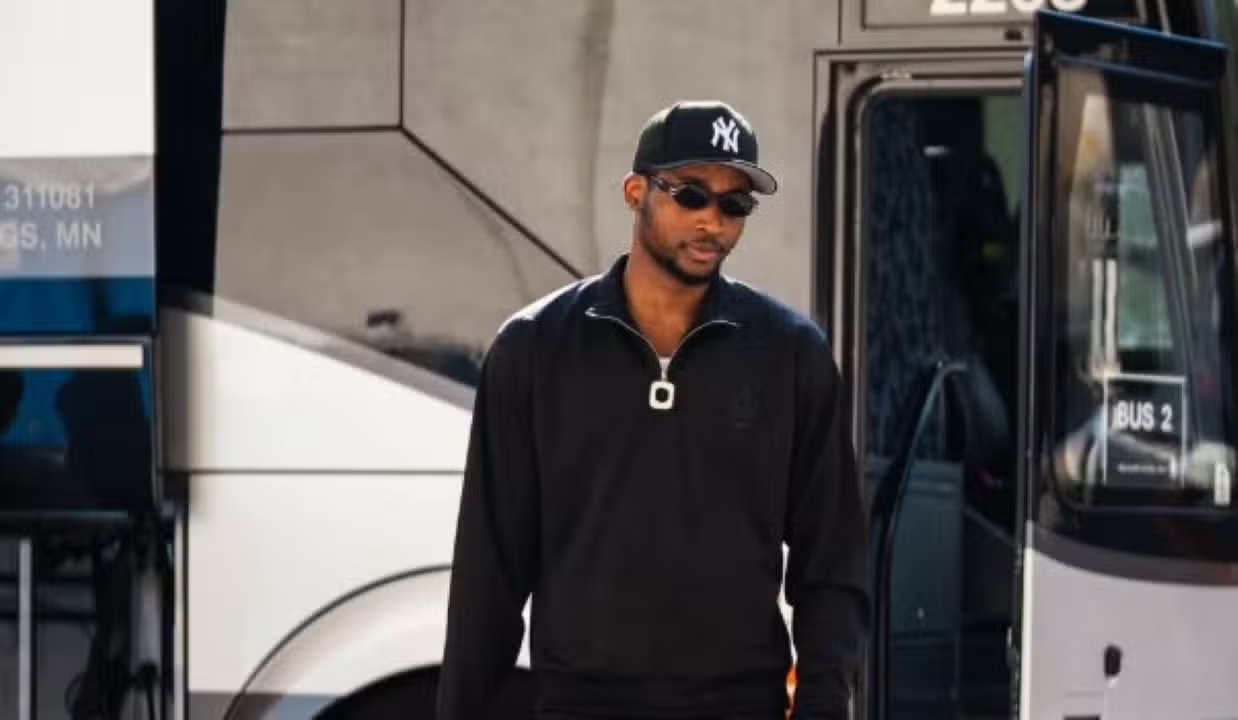
The standoff between forward Jonathan Kuminga and the Golden State Warriors remains unresolved, even with recent decisions by other restricted free agents in the NBA, such as guard Cam Thomas, who signed a $5.99 million qualifying offer with the Brooklyn Nets, and guard Josh Giddey, who secured a four-year, $100 million extension with the Chicago Bulls. This situation unfolds in San Francisco, where Kuminga, 22, seeks greater security and value in his contract, while the franchise prioritizes financial flexibility to maintain its veteran core’s competitiveness.
The conflict emerged at the start of the 2025 offseason, when negotiations for a multi-year extension stalled, leaving Kuminga as one of the last unresolved restricted free agents. The lack of agreement reflects fundamental differences: Kuminga wants a deal ensuring stability and a higher annual salary, possibly around $25 million or more, while the Warriors offer terms that preserve trade and roster adjustment options. This dynamic persists because Steve Kerr’s team operates with urgency to contend for titles in the next seasons, before aging stars like Stephen Curry and Draymond Green, both over 35, decline. Driving this dispute is Kuminga’s performance last season, where he averaged 16.1 points and 4.8 rebounds over 74 games, including playoffs, showcasing potential as a versatile forward but with inconsistent three-point shooting efficiency.
Without a deal by October 1, Kuminga may accept the $7.99 million qualifying offer, granting him trade veto power and unrestricted free agency in 2026, but limiting the Warriors’ immediate salary cap maneuvers. This choice would highlight the tension between the player’s desire for recognition and the franchise’s strategy to balance risk and reward in a market constrained by the league’s new collective bargaining agreement.
Negotiations between Kuminga and the Warriors gained clearer contours after the moves by Thomas and Giddey, but these did not alter the trajectory in San Francisco. Thomas, for instance, opted for the qualifying offer with the Nets after rejecting a two-year, $30 million proposal, prioritizing unrestricted free agency next summer when at least ten teams are projected to have cap space. This decision, finalized on September 4, reflects a cautious market for young players with high offensive output but defensive gaps, similar to Kuminga’s profile, who excelled in drives to the basket with 8.1 attempts per game last season but missed 35% of his three-point shots.
Giddey, on the other hand, took the opposite route, signing his extension on September 9, cementing his role as a cornerstone for the Bulls with averages of 14.6 points, 8.1 rebounds, and 7.2 assists in his first full season in Chicago, after being traded from the Oklahoma City Thunder. His contract, without opt-out clauses, signals mutual confidence, something absent in the Kuminga-Warriors relationship, where the forward feels his growth, from 9.9 points in 2023-24 to stronger numbers, is underappreciated.
- Kuminga averaged 16.1 points per game in the 2024-25 regular season, up 6.2 points from the prior year.
- In the playoffs, he contributed 12.4 points and 5.2 rebounds over 18 games, helping the Warriors reach the Western Conference semifinals.
- His mid-range shooting accuracy rose to 48%, but his three-point volume remains low at 2.1 attempts per game.
- Compared to peers like Jalen Williams of the Thunder, Kuminga offers more athletic explosiveness but needs defensive consistency.
- The Warriors see him as an ideal complement to Curry but hesitate to commit $45 million over two years without full guarantees.
Details of the Warriors’ rejected offers
The offers presented by the Warriors to Kuminga reveal a conservative strategy, focused on maintaining flexibility under the NBA’s salary cap rules, which restrict teams above the second apron with limited trade and signing options. The main proposal was a two-year, roughly $45 million contract, with the first year guaranteed at $21.75 million and a team option for the second, which Kuminga and his agent, Aaron Turner, rejected for reducing his leverage in future negotiations. This structure, reported by league sources, allows the team to match any outside offer as a restricted free agent but includes a clause that effectively halves his outgoing salary in potential trades, due to salary-matching rules.
Kuminga, drafted seventh overall in 2021, prefers a longer deal, possibly three years at $82 million, with a player option at the end, giving him control over his future after proving his worth on the court. His reluctance stems from a season where he started 60% of games, contributing defensively with 0.9 steals and 0.6 blocks per game, numbers above average for young forwards. However, the Warriors, constrained by a payroll pressured by Curry’s $55.8 million contract for 2025-26 and Jimmy Butler’s recent $111 million extension, avoid commitments that push them closer to the luxury tax without immediate returns.
Another layer in this negotiation is interest from Western Conference teams like the Sacramento Kings and Phoenix Suns, who explored sign-and-trade deals offering Kuminga larger roles, but their proposals failed to meet the Warriors’ demands for draft picks or established players. This lack of a heated market, similar to what Thomas faced with the Nets, forces Kuminga to weigh accepting the qualifying offer and risking a high-pressure season or conceding to less favorable terms.
The rejection of the two-year offer underscores Kuminga’s value on autonomy, especially after an offseason where he saw draft peers like Franz Wagner of the Orlando Magic sign max extensions worth $224 million. In talks with executives, Kuminga expressed frustration with inconsistent playoff minutes in 2025, averaging just 22 minutes per game against the Minnesota Timberwolves, despite efficient scoring near the rim.
Comparison with Cam Thomas’ path with the Nets
Cam Thomas’ decision to accept the qualifying offer mirrors Kuminga’s situation, illustrating the risks and rewards of betting on oneself in a market limited by cap space shortages. Thomas, 23, led the Nets in scoring with 24 points per game in 2024-25, despite leg tendon injuries limiting him to 25 games, but rejected a two-year, $30 million extension with a team option, opting for the $5.99 million deal with a full no-trade clause. This move, finalized in September, positions Thomas for unrestricted free agency in 2026, when projections indicate a 7% cap increase, opening doors for offers above $20 million annually.
For Kuminga, the parallel is evident: both are efficient scorers in transition, with Thomas hitting 39.4% from three and Kuminga excelling in drives, converting 62% of two-point shots. However, while the Nets, in rebuild mode after trading Dennis Schröder and Dorian Finney-Smith, prioritize cap space for future drafts, the Warriors seek immediate balance, making a Thomas-like concession unlikely. Kuminga could earn more with the qualifying offer – $7.99 million versus the Warriors’ $21.75 million initial offer – but would forgo a higher salary now, betting on a 20+ point season to boost his value.
Thomas, selected 27th in 2021, showed maturity by rejecting a $9.5 million year with incentives up to $11 million, which required waiving the no-trade clause, prioritizing control in a young Nets roster featuring Michael Porter Jr. and rookies from the historic five-first-round-pick 2025 draft. This strategy suggests that, for Kuminga, accepting the qualifying offer could be a high-stakes move, especially if injuries or reduced minutes impact his performance, as seen with Thomas in 2024-25.
- Thomas led rookies in scoring in 2023-24 with 22.5 points over 66 games as a starter.
- His usage rate reached 28%, the highest among Nets guards, but with only 2.1 assists per game.
- With the Nets, he’ll pair offensively with Porter Jr., projected for a combined 45 points per game.
- His qualifying offer choice is the fifth by a former first-rounder since 2017, highlighting its rarity.
- For 2026, analysts predict an average of $16.7 million annually for Thomas, based on executive polls.
Key differences in Josh Giddey’s Bulls deal
While Thomas chose caution, Josh Giddey represented the success of an aligned partnership, signing a four-year, $100 million extension with the Bulls, a $25 million annual average reflecting mutual confidence absent in Kuminga’s case. Giddey, 22, exploded in his first Chicago season after being traded from the Thunder for Alex Caruso, averaging 14.6 points, 8.1 rebounds, and 7.2 assists over 70 games, with seven triple-doubles – the second-most in Bulls history, behind only Michael Jordan. This performance, especially post-All-Star with 21.2 points, 10.7 rebounds, and 9.3 assists over 19 games, convinced the front office he’s their point guard of the future, integrating with Coby White and Nikola Vučević.
Unlike Kuminga, whose relationship with the Warriors is marked by mutual distrust – the forward feels undervalued after irregular playoff minutes – Giddey found instant chemistry in Chicago, starting 69 games and improving his three-point shooting to 37.8%, hitting a career-high 105 attempts. The Bulls, transitioning after trading Zach LaVine in February 2025, saw Giddey as a facilitator who lifted the team to a 15-win stretch in 20 games, securing a play-in spot. His contract, without options, ensures stability through 2029, contrasting with the Warriors’ offer to Kuminga, which includes a team option to preserve flexibility.
Giddey, drafted sixth in 2021, overcame off-court controversies investigated by the NBA without charges, focusing on growth: from 6.4 assists in Oklahoma City to 7.2 in Chicago, with 1.2 steals per game. This progression, including 30 double-doubles as a guard – more than any Bull since Jordan – justifies the investment, while Kuminga, focused on versatile defense, struggles for consistent minutes alongside veterans like Green and Butler.
Giddey’s extension also impacts the RFA market, raising expectations for players like Quentin Grimes of the 76ers but reinforcing that long-term deals hinge on alignment, something Kuminga and the Warriors still seek.
Warriors’ salary cap strategies in the league context
The Warriors navigate financial constraints imposed by the NBA’s new CBA, which introduces double aprons for teams above the cap, limiting trades and signings for franchises like San Francisco, whose payroll exceeds $180 million in 2025-26. This pressure explains their reluctance to offer Kuminga a contract without safeguards, prioritizing Bird rights to match outside offers without sacrificing assets. With Curry and Green aging – a core averaging 36.5 years – the franchise focuses on short contention windows, using Kuminga as a tradeable asset if needed, rather than locking in $25 million annually for a 22-year-old forward with only 16% accuracy on catch-and-shoot threes.
Comparatively, the Nets, with unlimited cap space post-rebuild, could have matched any offer for Thomas but chose short-term deals to preserve options for drafts like 2025, where they selected five first-rounders. The Bulls, mediocre in the East, invested in Giddey as a long-term pillar, aligning him with rookies like Matas Buzelis and Noa Essengue, projecting a young core for 2027-28.
For Kuminga, the $7.99 million qualifying offer represents a pay cut from the proposed $21.75 million initial offer but grants trade veto power and 2026 free agency, when the cap is expected to rise 10%. Analysts estimate that with an 18-point, 6-rebound season, he could attract $30 million offers from teams like the Kings, seeking athletic wings.
- The Warriors are $15 million below the first apron, limiting their mid-level exception to $5.7 million.
- Kuminga has full Bird rights, allowing matching of offers up to $14.7 million without exceeding aprons.
- In 2024-25, he played 74% of minutes in lineups with Curry, boosting the team’s net rating by +4.2 points.
- Projections for 2025-26 suggest 17.5 points and 5.5 rebounds if starting 32 minutes per game.
- The league saw 12 RFAs sign qualifying offers since 2020, with 70% becoming free agents the next year for higher values.
Outlook for Kuminga’s training camp
With training camp set for September 23 in San Francisco, Kuminga is likely to report without a multi-year deal, training under the qualifying offer if no agreement is reached by October 1, creating internal tension at Chase Center. His preparation focuses on improving his three-point shooting, where he hit just 32% in 2024-25, and switch defense against wings like Anthony Edwards, seen in the Western Conference semifinals. The Warriors plan to integrate him alongside Butler and Green, forming a versatile frontcourt, but limited playoff minutes last season – averaging 18 per game – fuel his push for defined roles.
Meanwhile, veterans like Al Horford, eyed to bolster the frontcourt, await clarity, as the tight payroll prevents additions without trades. Kuminga, who rejected a five-year, $150 million extension before the 2024-25 season, now aims to prove his worth for a lucrative free agency, similar to how Jaren Jackson Jr. doubled his salary after a qualifying offer in Memphis.
The lack of impact from Thomas and Giddey’s decisions underscores that Kuminga’s case is unique, driven by the Warriors’ title urgency and his ambition for stability, keeping the impasse alive until the final moment.