

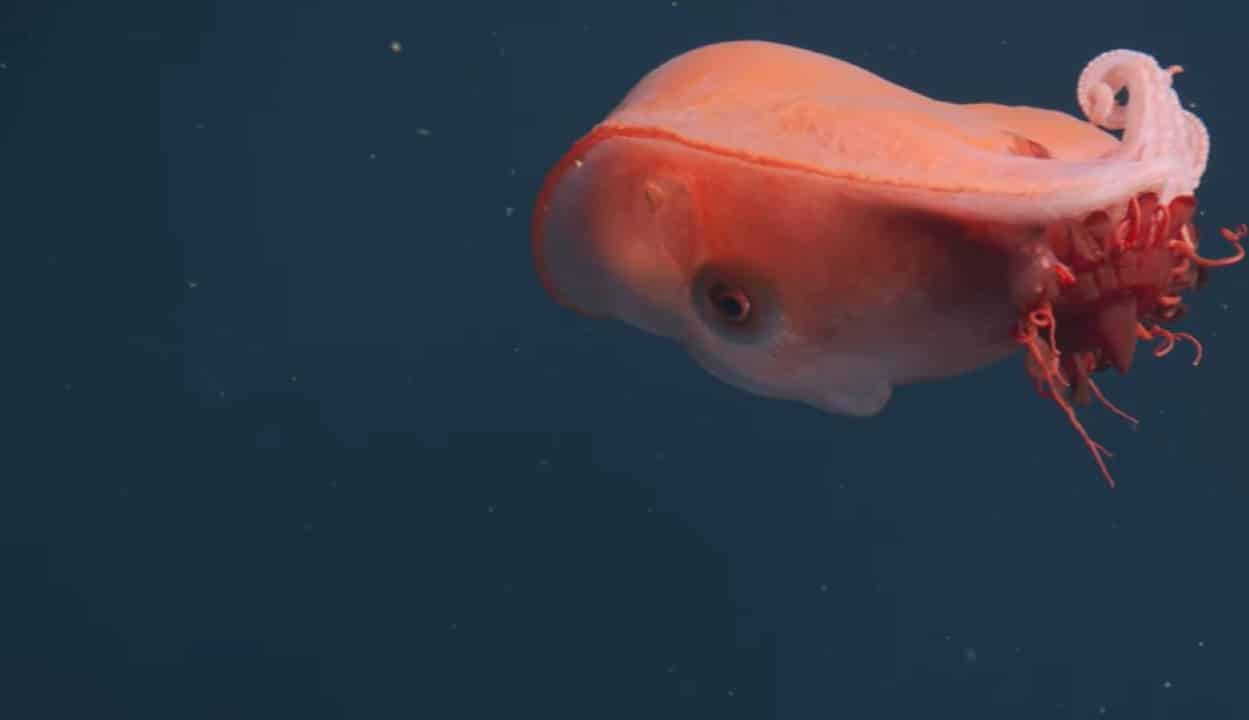
Researchers from Instituto of Pesquisa of Aquário of Baía of The sighting occurred at approximately 700 meters depth, using the remotely operated vehicle Ventana. Essa is only the fourth time that the institution has documented the living species in almost 40 years of deep-sea research.
The animal, nicknamed the bubble octopus, was filmed with a 4K camera specially designed for underwater missions. In the record, the octopus appeared holding a crimson helmet jellyfish (Periphylla periphylla), which reinforces previous observations about its diet based on gelatinous organisms.
The meeting was led by senior scientist Steven Haddock and the team of Biodiversidade and Bioóptica from MBARI.
Species characteristics
The Haliphron atlanticus receives the common name of seven-armed octopus due to a peculiarity in the males.
These animals have eight arms, like other octopuses, but one of them, the hectocotyl used in reproduction, is contained in a bag under the right eye, creating the illusion of seven visible arms. Females are significantly larger than males.
Size differences
Females of the Haliphron atlanticus can reach up to four meters in total length and weigh 75 kg. Males, on the other hand, rarely exceed 30 cm in length and are much smaller.
This sexual disparity is one of the hallmarks of the species and contributes to its classification as one of the largest octopuses in the world. Registros indicate that females dominate sightings of large specimens in deep waters.
Diet based on gelatinous prey
The seven-armed octopus feeds mainly on gelatinous animals, such as jellyfish. Embora Although these prey have low nutritional value, they are abundant in the twilight zone of the ocean.
Previous studies, including analyzes of stomach contents from preserved specimens, have confirmed this dietary pattern. In the recent sighting, the animal consumed an Periphylla periphylla, in line with behaviors observed in 2017.
Previous MBARI Observations
MBARI first documented the species decades ago, with sparse records. A 2017 encounter showed one holding an egg-yolk jellyfish (Phacellophora camtschatica).
Research led by Haddock and collaborator Henk-Jan Hoving revealed that the octopus uses fang tentacles for defense. Essas observations highlight unexpected connections in deep food webs.
Registration with advanced technology
The 4K camera used allowed us to capture precise details of the animal’s appearance and movement. Engenheiros from MBARI developed equipment for exploration in extreme environments.
The video captures the translucent and imposing octopus in its natural habitat. Essa technology expands knowledge about rare species from the twilight zone.
Habitat in the twilight zone
The Haliphron atlanticus lives at depths where sunlight barely penetrates. Essa region of the ocean is home to predators that depend on abundant prey such as jellyfish.
The octopus serves as food for larger animals, including blue sharks and sperm whales. Avistamentos reinforce the importance of exploring deep ecosystems.
Ecological role of the octopus
The Haliphron atlanticus integrates complex food chains in the deep ocean. Presas gelatinous foods support large predators despite their low caloric content.
The octopus acts as a link between ocean layers, connecting surface and depth. Observações like this contribute to understanding interactions in less accessible environments.



