Observations of interstellar comet 3I/ATLAS reveal oscillating jets in antitail and rapidly rotating nucleus

Astronomers have observed an unprecedented phenomenon in the interstellar comet 3I/ATLAS, which displays oscillating jets in its antitail. The celestial body, on its way out of Sistema Solar, revealed complex and intriguing dynamics, providing valuable data for science.
Between July and September 2025, during the departure from perihelion, rare structures were identified that oscillate with a period of approximately 7 hours and 45 minutes. Este behavior is unprecedented for objects of its origin and offers new clues about the composition of comets from outside our system.
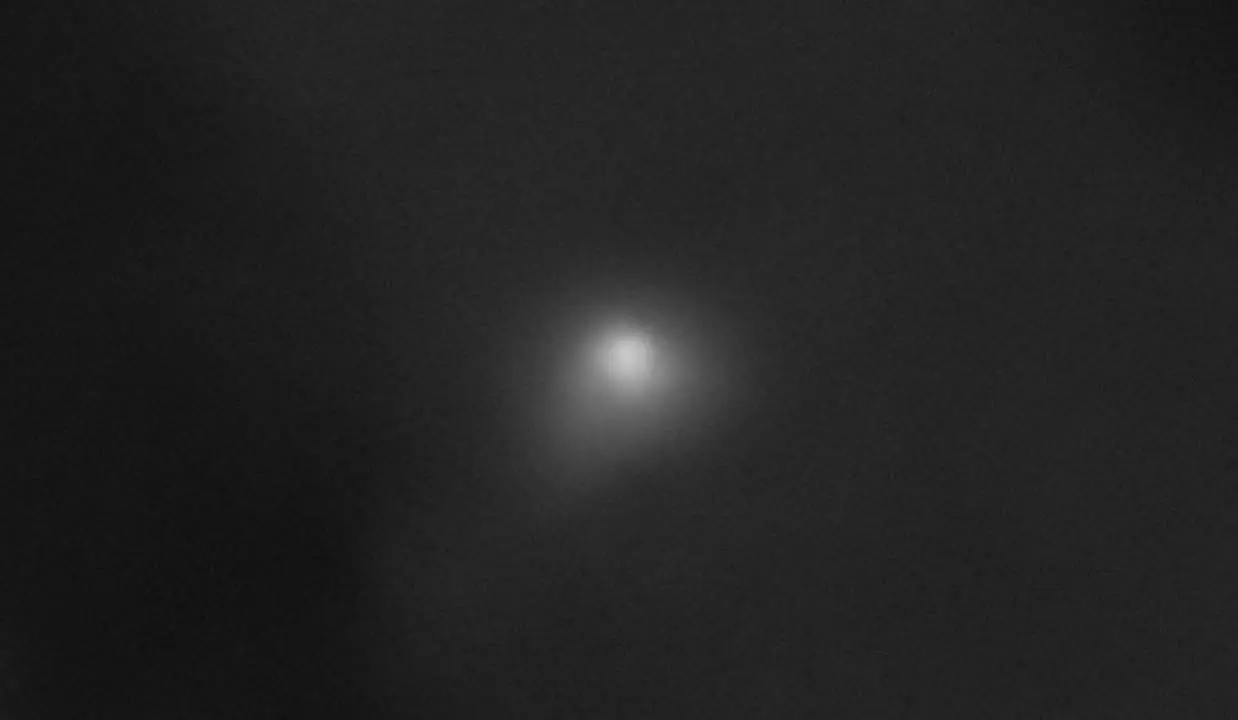
In-depth analysis of these jets allowed researchers to estimate the rotation of the comet’s nucleus at about 15 hours and 30 minutes. Este value is faster than previously predicted for 3I/ATLAS, indicating more intense surface activity and peculiar dynamics.
The uniqueness of the cometary antitail
The 3I/ATLAS antitail represents an unusual optical feature, distinguishing it from traditional comet tails that move away from Sol due to solar radiation pressure. Essa peculiar structure arises when larger dust particles, released by the nucleus, remain on an orbital trajectory that, from a terrestrial perspective, makes them appear to point towards the Sol, creating a visual illusion that reverses the usual direction. Este specific geometric alignment, combined with particle distribution, is crucial for the formation of the antitail, which can extend for millions of kilometers, as seen in some of the captured images. The phenomenon offers a rare glimpse into the mechanics of material ejection from interstellar celestial bodies, challenging existing models and deepening knowledge about comet formation.
Detailed observations and jet dynamics
The team of researchers carried out an extensive observation campaign, totaling 37 nights dedicated to studying the comet. Utilizando the Telescópio Gêmeo of Dois Metros in the Observatório of the Teide, in the Tenerife, in the
The oscillations of the jets were recorded on seven specific nights, mainly concentrated in August 2025. The jet showed a precession movement, which proved to be essential for inferring the rotation of the nucleus.
More on this story: Unusual double jets from interstellar comet 3I/Atlas are recorded by the Hubble telescope
Images processed with advanced techniques made it possible to isolate the narrow jet, which emerged distinctly from the core region illuminated by Sol. Essa separation was crucial to differentiating the activity of the jets from the main dust tail.
The preliminary results of this research are already available in scientific repositories. Eles are awaiting peer review, but they already represent an important milestone for comparisons between comets from our Sistema Solar and visitors from other stellar systems, expanding the frontiers of astrophysics.
Nuclear rotation: a surprising finding
The oscillation period of the jets, approximately 7 hours and 45 minutes, served as a natural clock for the comet nucleus. From it, scientists inferred that the complete rotation of the nucleus occurs in about 15 hours and 30 minutes. Esta duration suggests intense surface activity, with different regions of the comet alternating their exposure to sunlight, which periodically activates and deactivates the jets.
Compared to previous estimates, this rotation value is notably shorter, pointing to possible rotational acceleration or a more accurate measurement of the body’s dynamics. The 3I/ATLAS core, estimated to be between hundreds of meters and a few kilometers in size, maintains its structural integrity despite passing relatively close to Sol, which is a testament to its robustness and composition.
On the same topic: Hubble Telescope detects unusual double jets on interstellar comet 3I/Atlas
Implications and the scientific value of data
The detailed characterization of these jets offers a unique opportunity to study the physics of primordial bodies, which formed in another planetary system. Estes objects carry crucial information about the conditions and processes of star and planetary formation outside our cosmic neighborhood.
See Also



The data collected by 3I/ATLAS is essential for refining existing models on the emission of gases and dust from interstellar objects. Compreender How these comets behave could lead to significant advances in astrophysics and comparative planetology, offering new perspectives on the diversity of cosmic environments.
Such information supports the planning of future observations and missions dedicated to similar interstellar visitors. 3I/ATLAS reached its closest approach to Terra on December 19, 2025, at approximately 270 million kilometers, before continuing its journey into interstellar space, becoming a fundamental object of study.
Trajectory and role of 3I/ATLAS
Discovered in July 2025 by the ATLAS system (Asteroid Terrestrial-impact Sua’s path through Sistema Solar included a perihelion passage within the orbit of Ongoing observations, including those carried out by Telescópio Espacial Hubble, have confirmed the presence of an extensive coma and varied tails, demonstrating the complexity of its activity as it interacts with solar radiation and our system’s magnetic fields.
Crucial Distinctions Between Interstellar Comets
3I/ATLAS stands out significantly from its interstellar predecessors. Diferentemente of ‘Oumuamua, the first interstellar object detected, which did not exhibit noticeable cometary activity and had an elongated shape, 3I/ATLAS demonstrated active and complex behavior, with the formation of a coma and distinct tails, including the rare antitail.
Learn more: October observations confirm single antitail of comet 3I/ATLAS in the solar system
Its dynamics also presents peculiarities in relation to 2I/Borisov, the second interstellar comet, which, although active, did not record oscillating jets in the antitail with the clarity and pattern observed in 3I/ATLAS. Essas differences enrich the understanding of the diversity in the formation and evolution of comets in distant stellar systems, suggesting significant variations in their compositions and internal structures, which can be influenced by their environments of origin.
Detection and monitoring methods
The detection of objects like 3I/ATLAS is a testament to the growing capabilities of modern astronomy. Sistemas automated scanners, like ATLAS, are designed to quickly identify moving celestial bodies, allowing larger, more powerful observatories to direct their resources toward detailed studies.
International collaboration between different telescopes and research teams is essential for the continuous monitoring of these cosmic visitors. Essa global network ensures that comprehensive data is collected, from spectral composition to orbital dynamics, maximizing the knowledge gained about the origin and nature of these objects.
The phenomenon of gas and dust ejection
The ejection of gases and dust from the comet nucleus is a process driven by the sublimation of volatile ices, such as water, carbon dioxide and methane, when exposed to solar radiation. Observation of these jets at 3I/ATLAS offers clues about the comet’s internal composition and the conditions of its original environment.
Future perspectives of cometary research
Continued analysis of interstellar comets, like 3I/ATLAS, is crucial to improving our understanding of the formation and evolution of planetary systems beyond our own. Cada new visitor brings with him a “time capsule” from his home star system, allowing scientists to compare and contrast cosmological conditions in different parts of the galaxy. Esses studies could eventually reveal universal patterns or singularities in planetary architecture, boosting the search for extraterrestrial life and understanding our own place in the universe.