Hubble Telescope detects unusual double jets on interstellar comet 3I/Atlas

Telescópio Espacial Hubble recorded a rare astronomical phenomenon: anomalous double jets emanating from the interstellar comet 3I/Atlas. The observations were carried out on December 12 and 27, 2025, capturing a complex dust structure as the object moves away from Sol. The behavior challenges conventional explanations of cometary activity and intrigues the global scientific community.
The images were obtained by Hubble’s WFC3 UVIS camera, with 170-second exposures at a specific wavelength to highlight dust and gas ejected from the nucleus. The phenomenon occurs after the comet reached its perihelion, the point of closest approach to Sol, on October 29, 2025. The persistence of this unusual activity has generated intense debate about the composition and physics that govern this rare visitor from another star system.
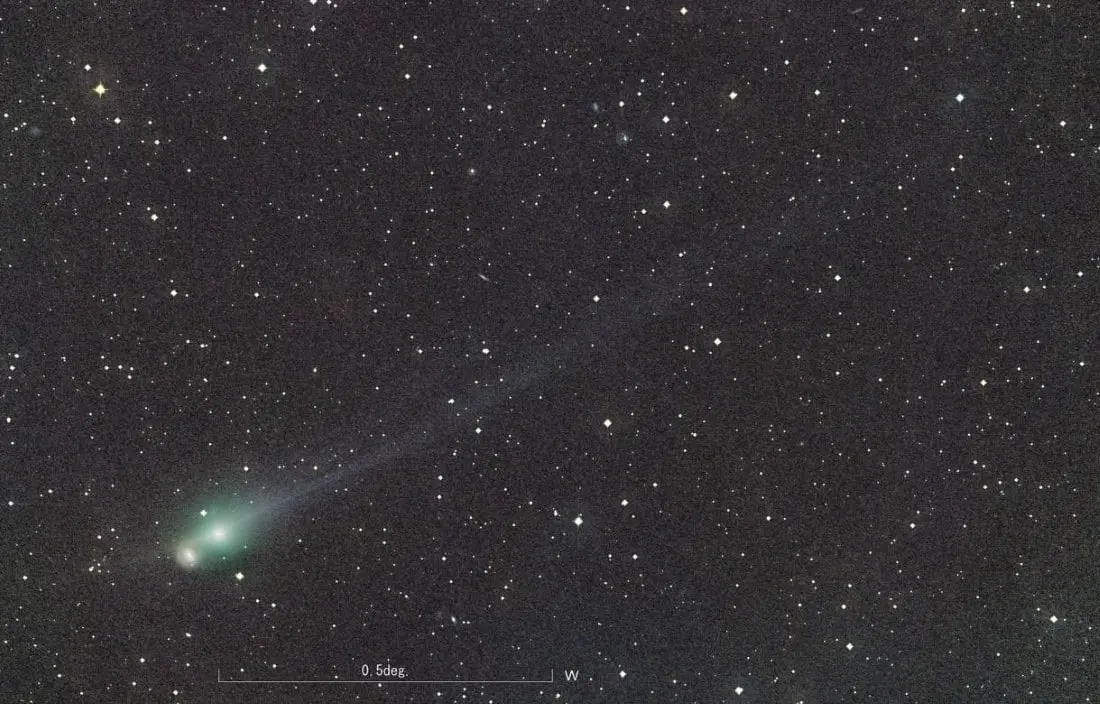
Estrutura anomalous dual jets
The most notable aspect is the presence of a prominent jet, known as the antitail, which points directly in the direction of Sol. Essa feature is atypical, as solar radiation pressure normally pushes dust and gas away from the star, forming the traditional tail. Simultaneamente, a second, weaker and more diffuse jet, was detected in the opposite direction, where astronomers would expect to see the shadow of the cometary nucleus.
The existence of two active and opposing jets challenges standard models of ice sublimation. Esses models do not easily predict simultaneous activation of both sides of the nucleus. The December data shows variation in the relative intensity between the two jets in the 15 days that separate the two Hubble observation sessions.
Evolução of observed activity
3I/Atlas does not exhibit anomalous behavior for the first time. In July 2025, Hubble identified a single extremely elongated jet, with a ratio ten times longer than wide. Naquela occasion, the jet showed a slight oscillation of seven degrees, suggesting its origin in an active source located at one of the poles of the nucleus facing Sol.
The expectation was that this activity would decrease or change drastically after perihelion. Contrariando forecasts, activity not only continued but evolved into the current dual jet configuration. Essa transformation offers valuable clues about the internal processes that govern the interstellar comet.
Leia Também

Financial analysis indicates that GTA 6 generated US$1 billion in the first hour of pre-sales

George Russell secures second Formula 1 triumph and leads Austrian GP after controlling Verstappen and Antonelli

Air crash in France kills 11 people on parachuting school aircraft
Hipóteses scientific phenomenon
- Jatos emanate from active regions on opposite sides of the cometary nucleus.
- Energia solar energy absorbed during Sol’s approach could be conducted through the core.
- Internally transported Calor would activate volatile ice deposits on the dark side of the object.
- Partículas of larger dust forms the antitail towards Sol.
- Smaller Partículas are pushed around by sunlight, creating the second, weaker jet.
The most direct explanation proposes that the jets emanate from active regions located on opposite sides of the nucleus. Solar energy intensely absorbed during the approach to Sol could have been conducted through the interior, activating volatile ice deposits on the dark side that normally does not receive direct sunlight.
A second theory focuses on the composition of the ejected dust. Partículas measuring around 10 micrometers would be less affected by solar radiation pressure and could form the antitail. Much smaller Partículas would be easily pushed away by the light, creating the second, weaker jet in the opposite direction. The combination of these two types of particles would result in the double jet appearance.
Debate on possible technological origin
Harvard Avi Loeb’s astrophysicist has raised alternative interpretations that consider a possible non-natural origin. Loeb argues that the characteristics of the jets could be consistent with propulsion mechanisms or engineered systems, such as a shield to protect an object from the solar wind or a cleaning system to remove technological surface dust. Essa view, although minority, fuels the debate about the need to consider all possibilities when analyzing anomalous phenomena in interstellar objects.
Resolution of this debate depends on additional and more accurate data. The astronomical community awaits spectroscopic observations carried out by large ground-based observatories such as Observatório Keck and Very Large Telescope. The analysis of the speed of particles in the jets will be fundamental: very high and uniform speeds would favor hypotheses of artificial propulsion, while a varied distribution of speeds would reinforce explanations based on natural cometary processes.
Interstellar Comet Scientific Significado
3I/Atlas has established itself as one of the most important astronomical events in recent years. Sendo, just the third interstellar object detected in Sistema Solar, offers unprecedented opportunity to study raw material from other stellar systems. The next monitoring steps will focus on accurately measuring the core’s rotation period and analyzing the chemical composition of the ejected gas and dust. Cada new information collected about this cosmic visitor helps to better understand the formation and diversity of planets and comets in the galaxy, providing valuable data that was previously beyond the reach of scientists.