


Astrophysicist Avi Loeb, from Universidade Harvard, presented a hypothesis that the interstellar comet 3I/ATLAS, the third object confirmed to come from outside Sistema Solar, may have been modified by an extraterrestrial civilization. The central idea argues that a natural comet rich in water would have been captured and engineered to function as a space vehicle, taking advantage of resources such as ice for fuel.
The object was discovered in July 2025 by the ATLAS system, at Chile, and its trajectory took it to pass close to Terra in December 2025. Observações continues until March 2026, when the comet will approach Júpiter before leaving Sistema Solar definitively.
The Loeb proposal is based on detected anomalies such as unusual metallic composition, symmetrical jets, and precise orbital alignment with inner planets. Essas characteristics, according to the researcher, differ from known natural comets and justify deeper investigation.
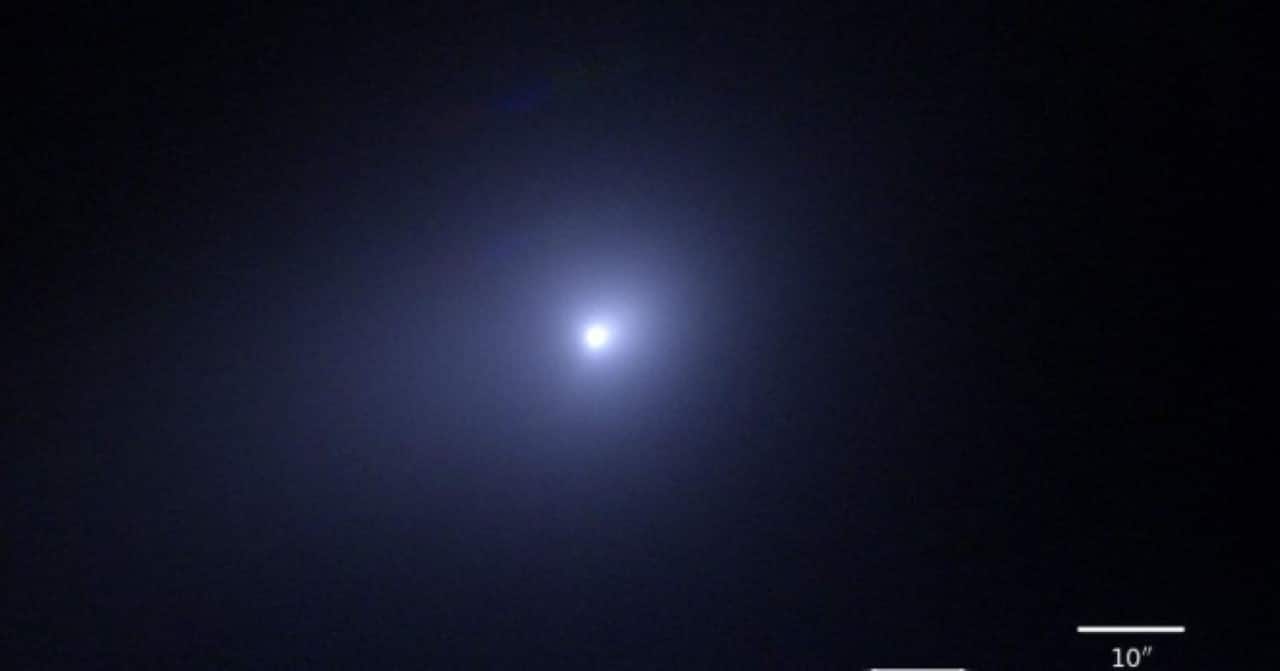
Discovery and trajectory of the object
Comet 3I/ATLAS was officially classified as the third interstellar visitor after ‘Oumuamua, in 2017, and Borisov, in 2019.
Its hyperbolic orbit confirms an origin external to Sistema Solar. The object passed through perihelion, the closest point to Sol, in November 2025, and reached a minimum approach to Terra on December 19 of that year.
Observed physical characteristics
3I/ATLAS has an estimated diameter of between 10 and 20 kilometers, a value greater than the average of previously detected interstellar objects. Sua composition includes high concentration of frozen water and metals such as nickel and iron in proportions similar to artificial alloys.
Observations of Telescópio Espacial Hubble revealed a well-defined coma and initial absence of a typical tail, followed by intense release of material. Radicais hydroxyls detected by radio telescopes confirm ice sublimation activity.
Anomalies highlighted by experts
Researchers have identified at least 18 peculiarities in the object’s behavior. Entre they are jets positioned 120 degrees apart, forming unlikely symmetry in natural processes.
Another anomaly involves periodic variation in brightness, interpreted as possible rotation with a period of about 16 hours. The extensive anti-tail and orbital alignment with Vênus, Terra and Marte also draw attention.
- Precise orbital alignment with inner planets of Sistema Solar
- Iron-nickel ratio similar to terrestrial industrial materials
- Symmetrical jets at 120 degrees, suggesting uniform distribution
- Initial lack of expected cometary activity near Sol
- Brightness variation with consistent periodic pattern
Avi Loeb’s arguments for technological hypothesis
Avi Loeb argues that an advanced civilization could insert equipment into the surface of a natural comet for camouflage. Essa strategy would offer protection against cosmic radiation and access to resources such as water for hydrogen and oxygen production.
The researcher compares the idea to the Troia horse from Greek mythology, where technology hides within a natural structure. Ele suggests that maneuvers such as reverse deceleration near stars could be designed for discreet exploration.
Loeb proposes an artificiality scale, assigning a score of 4 to 3I/ATLAS in a criterion from zero for a natural comet to 10 for confirmed technology. Para him, signals such as energy infrastructure or the release of secondary probes would be detectable in close observations.
Reactions from the scientific community
Most astronomers classify 3I/ATLAS as a highly active natural comet. Observações international campaigns, including radio telescope campaigns such as MeerKAT, have found no artificial radio emissions or anomalous heat.
Experts point out that many peculiarities may result from physical processes that are still poorly understood in ancient interstellar objects. The presence of coma and hydroxyl radicals reinforces typical behavior of volatile-rich comets.
Recent observations and current window
Data collected between November 2025 and January 2026 shows an intensification of activity along the trajectory. The object exhibited significant mass loss near perihelion, consistent with accelerated sublimation.
The observation window remains open until March 2026.
Historical context of interstellar objects
‘Oumuamua, the first visitor detected, generated similar debates due to non-gravitational acceleration and elongated shape. Borisov, the second interstellar comet, had a classic tail and conventional chemical composition.
The increasing frequency of detections reflects advances in monitoring systems such as ATLAS and the future Observatório Vera Rubin. Especialistas estimate discovery of new interstellar objects every few months over the next few years.
The study of external visitors contributes to the understanding of cosmic chemistry and the formation of distant planetary systems. Cada case adds valuable data about environments beyond the Sistema Solar.
Implications for future research
The case of 3I/ATLAS reinforces the need for standardized protocols for analyzing anomalous objects. Projetos like Galileo, led by Loeb, seek instruments dedicated to detecting technological signals.
Detailed observations of interstellar visitors expand catalog of extraterrestrial materials. Futuras missions may include interception to collect samples or high-resolution images.



