


The Honda HR-V has established itself as one of the most desired compact SUVs on the Brazilian market, attracting consumers mainly due to its modern design and the reliability associated with the brand. However, a more in-depth analysis of the model reveals that, despite its bold appearance, the vehicle faces increasingly fierce competition, which exposes some of its weaknesses in crucial points for the consumer, such as onboard technology and load capacity.
The current generation of the SUV stands out for its aesthetics that resemble coupe models, with fluid lines and an imposing front end. Esse visual appeal is one of the main factors that keeps it competitive in a competitive segment. Contudo, direct rivals and new competitors, especially from Chinese brands, have presented more complete packages for similar or even lower prices, challenging the Japanese model’s prominent position.
Honda’s strategy appears focused on maintaining a customer base loyal to the brand, which values build quality and drivability. Mesmo Therefore, the current market demands constant evolution, and points such as a more modern multimedia system and a more generous trunk have become decisive when purchasing for many families, placing the HR-V in a delicate position compared to more versatile and technological alternatives.
Bold design as the main attraction
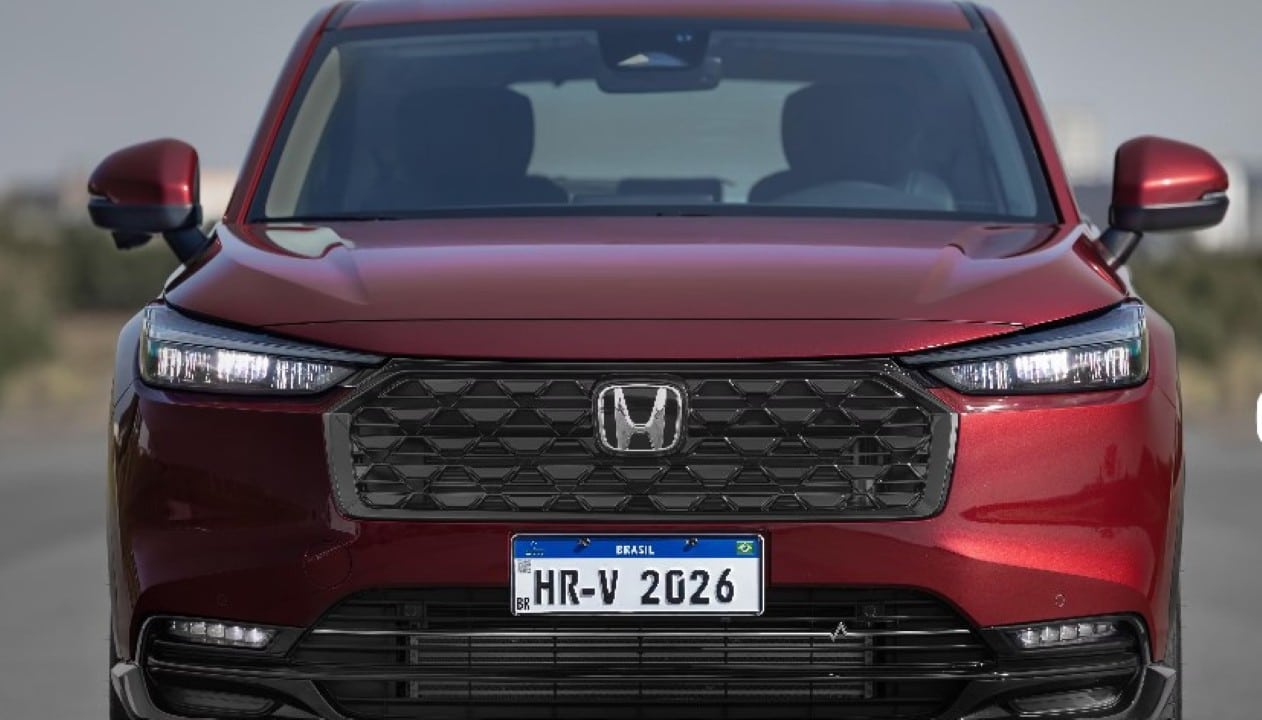
The greatest merit of the Honda HR-V lies in its exterior design. The front grille, integrated with the tapered full LED headlights, gives it a strong and contemporary visual identity. The rear, with lights interconnected by an LED bar, follows the current market trend and reinforces the perception of a sophisticated vehicle.

The silhouette with a soft roofline, inspired by coupe SUVs, gives a rare dynamism in the segment, differentiating it from competitors with more traditional lines. Essa’s stylistic choice, however, takes its toll on the interior space, a dilemma that Honda’s engineering had to balance.
1.5 turbo engine performance
Equipped in the most expensive versions, the 1.5 turbo engine delivers 177 horsepower and 24.5 kgfm of torque, numbers that guarantee vigorous performance for the SUV. Acceleration and restart are consistent, making driving pleasant both in the city and on the highway.
The CVT transmission simulates gears efficiently, contributing to a smooth, jerk-free driving experience. The mechanical package ensures that the HR-V is agile, with acceleration from 0 to 100 km/h recorded in around 8.9 seconds, a competitive time for its category.
Despite the good performance, fuel consumption is a point of attention. The declared averages are around 10 km/l in the city and 12 km/l on the highway, numbers that, although reasonable, are surpassed by competitors that already offer more efficient hybrid engines.
Package Honda Sensing and its limitations
The HR-V is equipped with Honda Sensing, a suite of driver assistance technologies. Ele includes features such as automatic emergency braking and lane keeping assist, which are important for safety.
However, the implementation of some of these systems appears to be dated. The adaptive cruise control (ACC), for example, may operate less smoothly in heavy traffic situations, with braking and acceleration being more sudden than desired.
Another notable limitation is the lane keeping assistant, which only works at speeds above 72 km/h. Isso makes it practically useless in urban traffic, where competitor systems already operate at lower speeds, offering greater convenience.
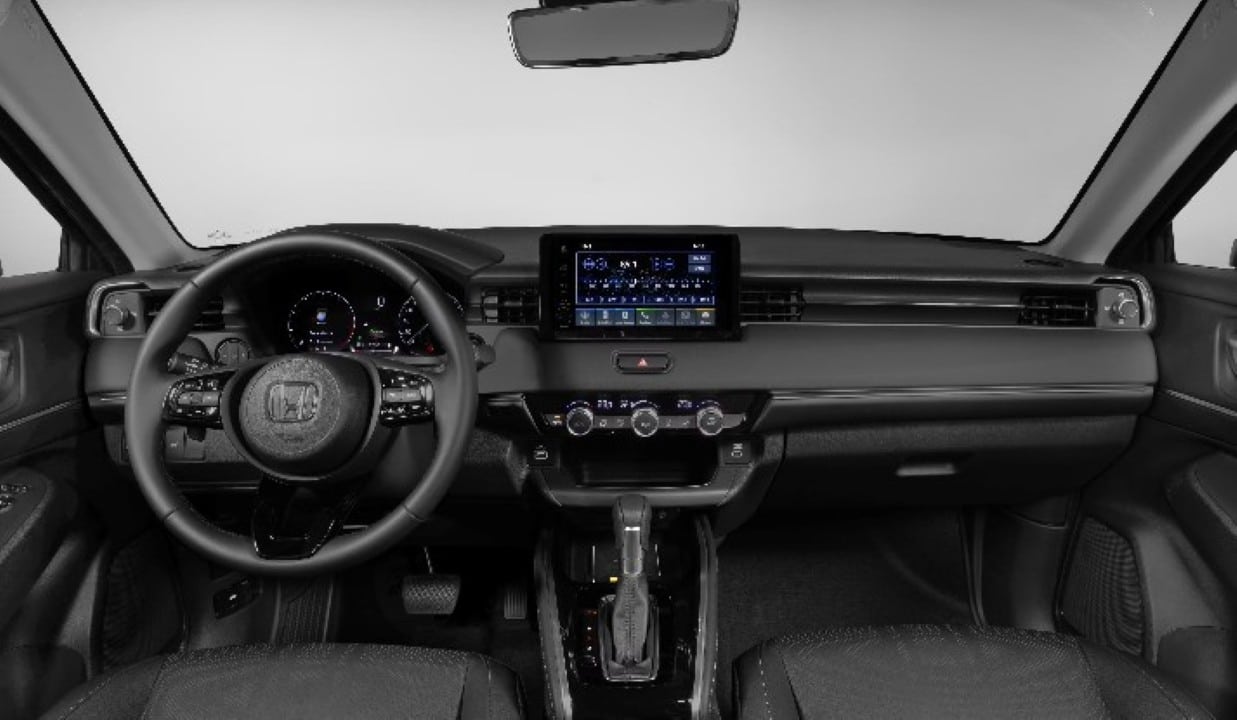
The multimedia center is also left behind. Connection to Android Auto and Apple CarPlay still requires the use of a cable in a market where wireless connection has already become standard, and the absence of a native GPS in some versions forces the driver to depend on their cell phone.
Internal space and reduced trunk
One of the most criticized points of the Honda HR-V is its trunk capacity, with just 354 liters. Esse volume is significantly lower than that of its main rivals. The Volkswagen T-Cross, for example, offers 373 liters, while the Hyundai Creta reaches 422 liters. Essa difference is crucial for families who need space for luggage when traveling or to transport larger objects on a daily basis, such as strollers.
This cargo space limitation makes the Honda SUV less practical for family use, which is one of the main purposes of a vehicle in this category. The decision to prioritize coupe-style design ended up compromising versatility, a factor that could lead many consumers to opt for competing models that offer a larger and more functional luggage compartment for everyday needs.
Competition advances with more technology
The compact SUV segment is undergoing a transformation driven by the arrival of new technologies and engines. Enquanto the Honda HR-V relies on a traditional mechanical package, direct competitors and new brands, such as BYD and GWM, already offer hybrid versions with much higher fuel consumption and robust performance. The GWM Haval H6 and the BYD Song Plus, for example, have become references in efficiency and technology, attracting consumers looking for more aggressive value for money. The Modelos and the Toyota Corolla Cross Hybrid also stand out for their economy, placing the HR-V at a competitive disadvantage in terms of energy efficiency. Além Furthermore, these new market players tend to offer more generous equipment packages, with larger screens, 360-degree cameras and more advanced semi-autonomous driving systems for the same price or even less than the top-of-the-line version of the HR-V, the Touring.
Price positioning in the market
With the top-of-the-line version, the Touring, priced above R$200,000, the Honda HR-V enters a price range where competition is extremely fierce. In this category, the consumer expects a complete package, and the model’s gaps in technology and practicality can weigh against the purchasing decision, especially when rivals offer more for less.



