

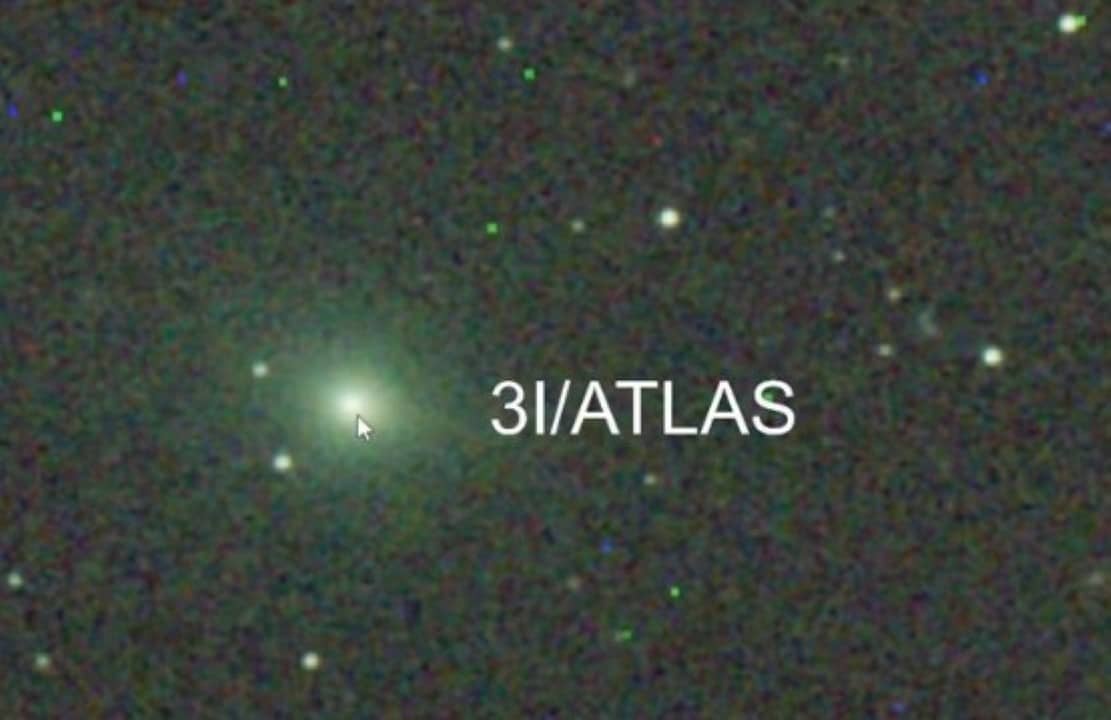
Recent observations carried out by Telescópio Espacial Hubble have brought to light unprecedented details about the mechanics of object 3I/ATLAS, classified as an interstellar visitor. Data collected after the celestial body passed through the closest point to Sol indicate that the release of volatile material is not random, but follows a rhythmic and synchronized pattern. Astrônomos identified a direct correlation between the activity of the gas jets and the rotation of the nucleus, suggesting complex physical processes are underway.
The processed images reveal the existence of three distinct flows of matter that operate together, showing intense activity on the surface of the object. The detailed analysis suggests that the ejection of dust and gas is intrinsically linked to the movement of the celestial body, offering new clues about the composition and dynamic behavior of objects formed outside our solar system.

Rotational instability and brightness variations
Luminosity analysis revealed significant fluctuations in the intensity of light reflected by the object over time. Especialistas noticed brightness variations of around 30% at regular intervals, which reinforces the hypothesis of an active and constantly changing dynamic structure. The estimated rotation cycle for the celestial body is approximately 7.20 hours, a period in which the activity of the jets intensifies and cools down as the orbital movement continues.
One of the most intriguing phenomena detected by high-precision instruments is the angular movement technically known as “wobble”. Essa rotational instability directly affects the projection of gas jets into space, creating a distinct visual signature in the images captured and demonstrating that the nucleus does not rotate uniformly.
Shaft misalignment and physical characteristics
The scientific explanation for the erratic behavior of the jets lies in the fundamental misalignment between the comet’s axis of rotation and the main axes of symmetry. Esse phenomenon, known in physics as precession or nutation, causes the nucleus to oscillate as it rotates, affecting the direction of matter ejection in a predictable way. The axis of rotation remains relatively aligned with the solar direction, with a variation of just 20 degrees, which allowed scientists to map the geometry of the emissions in detail despite the vast distance.
Current estimates indicate that the core of 3I/ATLAS has a diameter of around 2.6 kilometers. Curiosamente, most of the light captured by the instruments does not come from the solid surface of the object, but rather from the dispersion caused by the dense cloud of dust and gas around it, generated by the sublimation of volatile materials.
Jet geometry and orbital dynamics
Morphological mapping identified three distinct flows of ejecta, separated by projected angles of 120 degrees from each other. The jet positioned in the opposite direction to Sol serves as a precise marker for the study of rotational dynamics, alternating its appearance between collimated shapes and fan structures as the cycle progresses and the observation perspective changes.
This complex spatial configuration demonstrates the consistency of the interstellar visitor’s internal activity. The synchrony observed between the three jets and the rotation of the nucleus provides valuable data for understanding the formation and evolution of celestial bodies from other stellar systems, expanding knowledge about the diversity of objects that cross our cosmic neighborhood.



