
Max Verstappen analyzes Red Bull’s new dynamics in Formula 1 after Helmut Marko’s departure

Dutch driver Max Verstappen broke his silence about the recent structural transformations within the Red Bull Racing team, which occurred shortly after the confirmation of the departure of veteran consultant The change behind the scenes at the Austrian team marks the end of a significant era at Fórmula 1, requiring immediate adaptations from both drivers and technical staff. Durante recent interviews in the paddock, the three-time world champion detailed how the absence of a central figure affects daily life in the garage and track operations. The transition occurs at a crucial moment of the season, where the team seeks to maintain its hegemony in the face of the advance of its direct rivals in the constructors’ championship.
The weight of absence in the Austrian garage
For Verstappen, the figure of Marko represented much more than a strategic advisor, acting as a pillar of stability and a moral compass for the team’s sporting decisions over the last decade. The departure of the Austrian leader forced an immediate redistribution of responsibilities between the chief engineers and the main management.
The pilot highlighted that adapting to this new reality requires patience and a redoubled collective effort. Sem the constant presence of the veteran to mediate internal conflicts or define quick guidelines, communication between the aerodynamics and race strategy departments needed to be restructured to avoid operational failures during the Grande Prêmio weekends.
Reconfiguration of work dynamics
The meeting routine and technical briefings have undergone substantial changes since the change in the leadership team. Verstappen explained that the flow of information now follows a more horizontal protocol, involving a greater number of voices in critical decisions about the car’s setup.
This new approach aims to decentralize decision-making power, ensuring that data collected in simulators and free training is analyzed in a more collaborative way. The Dutchman pointed out that, although the transition generates natural initial discomfort, the technical team has enough capacity to absorb the demand.
Track mechanics and engineers also needed to adjust their reporting methods. The absence of a singular authority figure requires each team member to take a more proactive stance in identifying problems and proposing quick solutions during qualification sessions.
The three-time champion’s leadership posture
With the departure of his main mentor in motorsport, Max Verstappen recognizes that his role within Red Bull Racing transcends the act of driving. The Dutchman now assumes greater responsibility for motivating the group and directing the development of the single-seater.
He reported that he has been spending more time at the factory in Milton Keynes, talking directly with designers to ensure that the focus on performance is not lost amid administrative changes. Essa constant presence aims to convey confidence to employees.
The pilot emphasized that the charge for results remains unchanged. The winning mentality, cultivated over years of dominance in the category, needs to be the unifying factor for all members of the team, regardless of who occupies the leadership positions.
Interaction with your teammate has also undergone adjustments, with both sides of the garage needing to share data more transparently. Mutual collaboration has become an essential tool for accelerating understanding of the aerodynamic upgrades introduced to the car.
External pressure and advancement of rival teams
The scenario of internal restructuring at Red Bull coincides with a period of strong technical evolution on the part of teams such as McLaren, Ferrari and Mercedes. Verstappen admitted that the front platoon is considerably more compact, which reduces the margin for strategic errors or mechanical reliability failures. The need to optimize every component of the car has become the absolute priority to maintain an advantage in the world championship, requiring the engineering department to work with increasingly tighter tolerances.


The pressure exerted by rivals forces the Austrian team to maintain an aggressive pace of updates, even during the administrative transition process. The Dutch driver highlighted that the external focus cannot divert attention from internal operations, and that the team must trust in established processes to extract the maximum potential from the equipment on tracks with different characteristics. Tire degradation analysis and race pace remain the main focus during free practice sessions.
Development strategies for the future of the single-seater
Looking ahead to the technical horizon of the Fórmula 1, the Red Bull faces the challenge of designing the car for the coming seasons without the direct influence of one of its sporting founders. Verstappen detailed that the research and development department is operating at full capacity to correlate wind tunnel data with actual performance on the track, an area where the team has always demonstrated excellence. The transition to the new engine and aerodynamics regulations requires meticulous long-term planning, and the current technical board has taken on the responsibility of ensuring that the transition occurs without abrupt drops in performance. The pilot expressed complete confidence in the engineering corps, stating that the knowledge base accumulated over the years of victories provides a solid platform for continuous innovation, regardless of changes in the company’s organizational chart. Integrated work between chassis designers and power unit developers is seen as the central pillar for maintaining competitiveness in the coming years.
Maintaining operational focus on the runways
The main directive established by Verstappen and the remaining management is the isolation of the race team from external noise and media speculation. The central objective is to ensure that, from the moment the cars leave the pits, the only metric of success is lap time and the perfect execution of pit stops.
The legacy and culture of victories
Despite significant changes, Red Bull Racing’s identity remains rooted in the incessant search for competitive perfection. Verstappen made a point of reiterating that the team’s fundamental values were not changed with the departure of senior management members.
The culture of taking calculated risks and innovating aerodynamic design continues to be the driving force at Milton Keynes. The driver believes that this institutional resilience will be the difference in overcoming the current transition period and keeping the team at the top of the podium.
Strategic alignment and next steps
Coordination between the factory and the track team is undergoing rigorous testing at every stage of the calendar. Verstappen noted that radio communication and decision-making at the pit wall has become more analytical, relying heavily on mathematical models and real-time simulations to define pit stops. The use of data intelligence has become even more prominent to compensate for the absence of purely instinctive readings that were previously part of the team dynamic.
The Dutchman concluded his remarks by highlighting that the true strength of a top team is revealed in moments of internal restructuring. The commitment to technical excellence, precision in the assembly of cars and the daily dedication of each employee are the practical elements that will guarantee the continuity of Red Bull’s operations in the elite of world motorsport, maintaining a strict focus on sporting performance and winning points every race weekend.
…
Veja Tambem em Fórmula 1

Esteban Ocon elogia Hamilton como o melhor piloto da era moderna antes do GP de Mônaco

Acosta conquista sexto lugar na MotoGP Itália e destaca aprendizado em duelos com Marc Márquez

Socorrista de Michael Schumacher revela detalhes inéditos sobre o resgate do piloto após 13 anos

Ralf Schumacher alerta George Russell sobre risco de posição de ‘segundo piloto’ na Mercedes após Canadá
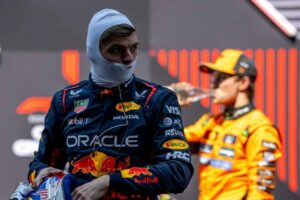
Max Verstappen projeta dificuldades no GP de Mônaco por problemas de suspensão da Red Bull

Chefe da McLaren, Andrea Stella corrobora previsão de Norris sobre domínio da Ferrari em Mônaco

Resgate de Michael Schumacher em 2013: piloto de helicóptero detalha missão nos Alpes franceses
Carlos Sainz defende ação firme da FIA nas discussões sobre motores da Fórmula 1 para 2027
Kimi Antonelli lidera Fórmula 1 aos 19 anos e pai revela paixão natural por Ayrton Senna
Fórmula 1 não terá modo reta no GP de Mônaco após decisão oficial emitida pela FIA

Pilotos da Formula 1 dividem atenção com Copa do Mundo e Kimi Antonelli revela torcida pelo Brasil
