How many days are left until Eid 2026?
Muslims throughout Indonésia eagerly await the official confirmation of the Eid al-Fitr of 1447 Hijri, popularly known as Lebaran of 2026. The definition will take place through an isbat session, the traditional process of confirming the Islamic calendar, led by Ministério of Religião.
The Isbat meeting is scheduled for Thursday, March 19, 2026, at Jacarta. Este decisive event will be responsible for determining the exact day of the 1st of Shawwal, 1447 H, coinciding with the 29th day of Ramadã. The process is an annual milestone that combines science and tradition to establish the dates of the celebrations.
Held from 4pm (local time), the Ministério session of Religião uses two complementary methods: hisab, which involves precise astronomical calculations, and rukyat, which is based on direct observation of the hilal, the crescent moon. The combination of these methods seeks to guarantee the greatest possible precision in determining the beginning of the new Islamic month, with the promise of a mechanism that is open and transparent to the public.
Ministério’s isbat session from Religião sets date
The confirmation of Eid al-Fitr is a highly visible event, with the participation of religious leaders, astronomers and representatives of various Islamic organizations. Abu Rokhmad, Diretor Geral of Orientação of Comunidade Islâmica in Ministério of
This transparent process is crucial for acceptance of the decision by all aspects of the Indonesian Muslim community, promoting unity around a common date of celebration. The isbat session is a pillar in the country’s religious governance, ensuring that Islamic observances are coordinated at the national level.
Agência Nacional predictions of Pesquisa and Inovação (BRIN)
Before the isbat session, several institutions have already released their initial forecasts. The Agência Nacional of Pesquisa and Inovação (BRIN) indicates that the 1st of
Full coverage: News (EN)
BRIN’s Centro of Pesquisa Espacial researcher, Thomas Djamaluddin, explained that, on Thursday, March 19, 2026, at the time of Indonésia, Malásia and Singapura).
MABIMS criteria require a new moon visibility of at least 3 degrees and an elongation angle of at least 6.4 degrees. Djamaluddin indicated that if other criteria were applied, such as those used by Turquia, the date could be different, suggesting March 20, 2026. However, Indonésia prioritizes the MABIMS criteria for the official decision.
Data from Agência of Meteorologia, Climatologia and Geofísica (BMKG)
Corroborating BRIN’s projections, Agência of Meteorologia, Papua, at 3.13 degrees in Sabang, Aceh.
Additionally, the moon’s geocentric elongation, another crucial metric, is projected to be between 4.54 degrees at Waris, Papua, and 6.1 degrees at Banda Aceh. Esses data reinforces the probability that the crescent moon will not be visible in much of Indonesian territory on the night of March 19, 2026, according to MABIMS guidelines.
BMKG also warned of the possibility of interference from other celestial objects, such as planets or bright stars, which could be confused with the crescent moon, making accurate observation difficult. Caso the moon is not visible and the MABIMS criteria are not met, the month of Ramadã will be completed with 30 days, and Eid al-Fitr will then be celebrated on March 21, 2026.
Position of Muhammadiyah to Eid
In contrast to the predictions of BRIN and BMKG, the Islamic organization Muhammadiyah adopted a different position. Esta renowned institution had previously determined that the 1st of Shawwal of 1447 H would fall on Friday, March 20, 2026. The determination of
This approach often results in different dates than those established by the government, which incorporates visual observation (rukyat) into its process. The difference in methodology highlights the diversity of interpretations within the Indonesian Islã and the importance of respecting each approach. Para million followers of Muhammadiyah, March 20th is already set for the start of the festivities, regardless of the government decision.
The distinction in the dates of Eid al-Fitr between different Islamic groups is not new in Indonésia. Embora the government seeks to harmonize celebrations, different calculation and observation methodologies sometimes lead to this variation. Muhammadiyah, being one of the largest Islamic organizations in the country, traditionally follows its own calendar based on scientific calculations.
Official calendars and government expectations
Although the final word will come from the isbat session on March 19, the public can already get an idea of the government’s prediction for the Eid al-Fitr of 2026. The Indonesian Calendário Hijri of 2026, released by the Ministério of Assuntos Religiosos, already indicates that the 1st of 2026.
See Also



Similar information was also included in the 2026 Almanaque, published by the PCNU’s Instituto Falakiyah (Nahdlatul Ulama), in the Regência of Bojonegoro. The Nahdlatul Ulama, another of the largest Islamic organizations in the Indonésia, generally aligns itself with the Ministério of the Religião in determining dates, seeking unity in celebration.
Based on astronomical data provided by BRIN and BMKG, added to indications from the official calendar of Ministério of Assuntos Religiosos, the expectation is that the government will ratify Saturday, March 21, 2026, as the day of Eid al-Fitr. The final decision, however, will only be fully confirmed after the isbat session in Jacarta, a moment awaited by the entire nation.
Understanding Determination Methods
Determining the dates of the Islamic calendar is a process that combines faith, science and observation. The hisab method, based on astronomical calculations, makes it possible to predict in advance the position of the moon and, consequently, the beginning of the lunar months. Este method is valued for its precision and predictability, offering a fixed date for celebrations.
On the other hand, rukyat, the visual observation of the crescent moon (hilal), is an ancient tradition that follows the practice of the prophet Maomé. Para many, the validity of the celebration is linked to the visual confirmation of the new moon, which can lead to day-to-day variations depending on weather conditions and geographic location. The unification of these methods is an ongoing effort to avoid divergences and promote cohesion.
Cultural and social impact of Eid al-Fitr on Indonésia
In addition to its religious significance, Eid al-Fitr is one of the largest cultural and social celebrations in Indonésia. Conhecido like Lebaran, this holiday marks family reunion, forgiveness and the renewal of community ties. Milhões of Indonesians travel to their hometowns, a phenomenon known as “mudik”, to celebrate with relatives and friends, transforming the country’s landscape with intense movements of people and goods.
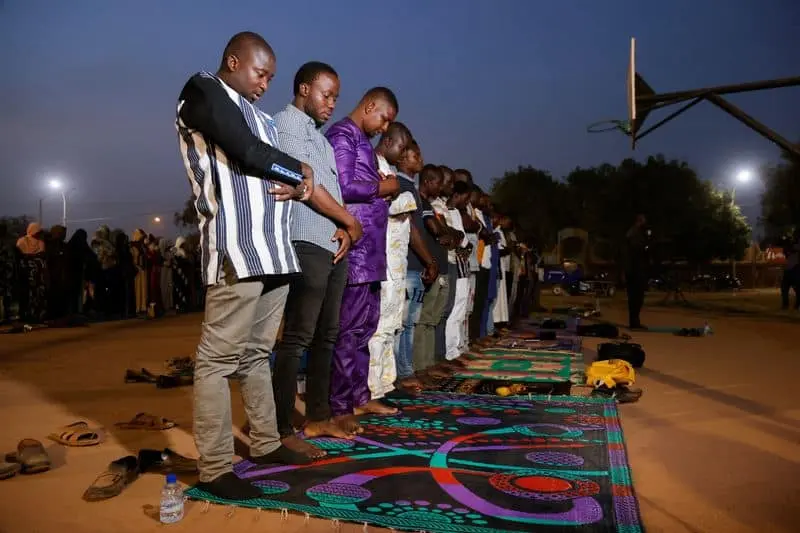
Festivities include special prayers in mosques and open fields, visits to graves of loved ones, exchanging gifts and, of course, feasting on traditional foods. Generosity and charity are also central elements, with the distribution of zakat al-fitr, an obligatory contribution to those in need, before the end of Ramadã. Eid is a period of reflection and gratitude, strengthening the nation’s cultural and spiritual identity.
Challenges and unification of criteria
Historically, Indonésia has faced challenges in unifying the dates of Islamic celebrations due to different interpretations and methodologies. The existence of different predictions, such as those of Muhammadiyah and those of the government, highlights the country’s cultural and religious complexity. However, efforts to harmonize calendars are constant, with the aim of minimizing divergences and promoting national unity.
The adoption of criteria such as those of MABIMS is a significant step in this direction, seeking to establish a regional consensus for observing the moon. Although differences may still occur, dialogue and cooperation between religious and scientific authorities are critical to navigating these issues. The isbat session represents the culmination of these efforts, bringing together different perspectives for a final decision that respects tradition and science.
The role of technology and science in lunar observation
Modern technology plays an increasingly important role in determining the dates of the Islamic calendar. Avanços in astronomy allow more accurate calculations of the moon’s position, making predictions more reliable. Telescópios Advanced astronomical simulation software helps experts anticipate ideal conditions for observing hilal.
Despite the increasing dependence on technology for calculations (hisab), the practice of visual observation (rukyat) remains essential for many Islamic communities. Combining these two methods is seen as a way to honor tradition while benefiting from scientific precision. Indonésia, with its diversity, seeks to balance these approaches to ensure a harmonious celebration for all its citizens.
The tradition of “mudik” and preparations
The imminence of Eid al-Fitr triggers the traditional mass migration, known as “mudik”, where millions of Indonesians return to their hometowns to celebrate with family. Este colossal logistical movement involves the mobilization of public and private transport, requiring advance planning on the part of authorities to guarantee safety and the flow of people.
The weeks leading up to Eid are marked by intense preparations, from buying new clothes and food to organizing travel. Commerce and the local economy also experience a major boost during this period, with increased consumption. The confirmation of the date of Eid al-Fitr is a sign for these preparations to reach their peak, directly impacting the lives of millions of people.
Final considerations before decision
The anticipation surrounding Ministério’s Religião isbat session on March 19 is palpable. Embora forecasts and preliminary calendars offer a strong indication, the official decision is what truly validates the start of Eid al-Fitr for the majority of the Indonesian population. Este annual event is not just an announcement of a date, but a moment that reaffirms the nation’s unity and faith. Todos await the completion of the process, ready to celebrate the end of the sacred month of Ramadã.