

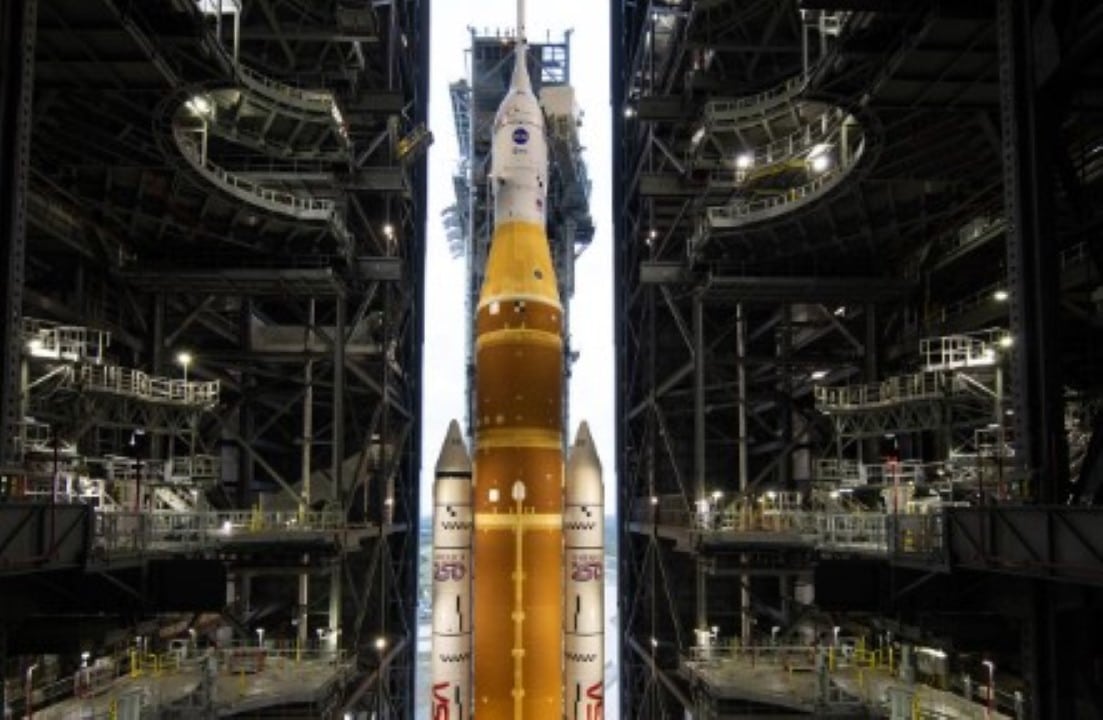
NASA’s Space Launch System (SLS) rocket and Orion spacecraft began their official return to launch pad 39B on Centro Espacial Kennedy this Friday, March 20, 2026. The movement began at exactly 00:20, Estados Unidos eastern local time, after a brief wait due to adverse weather conditions and strong winds that hit the coastal region during the early hours of the morning.
This technical move is a fundamental step towards the Artemis II mission, which will take four astronauts to orbit Lua for the first time in more than five decades. The journey of approximately 6.4 kilometers between the Edifício of Montagem of
The logistical operation is expected to last around 12 hours, requiring absolute precision from the engineering teams who monitor every inch of the route along the gravel track. Key points of this step include:
Total removal of the work platforms that surrounded the rocket inside the assembly hangar.
Constant monitoring of wind speed to avoid dangerous oscillations in the mobile launch tower.
Real-time verification of telemetry systems while the set moves on the giant conveyor belt.
Coordination with Centro Espacial security to fully isolate the heavy traffic area.
Technical fixes and resolution of faults in the helium system
The decision to return the rocket to the hangar previously occurred after a critical failure was identified during a general test carried out on February 21st. Engineers detected a blockage that prevented the smooth flow of helium into the SLS upper stage, a vital component for pressurizing the fuel tanks before the engines are ignited.
The problem was treated as a top priority by NASA teams, who carried out partial disassembly to access the affected valves and piping inside the core stage. Após weeks of technical intervention, pressure tests confirmed that the obstruction has been removed and the helium system now operates within the safety parameters required for manned flights.
NASA’s SLS (Space Launch System) rocket and Orion spacecraft are getting ready to roll back to Launch Pad 39B for the@NASAArtemisII mission. Teams are currently monitoring the wind speeds before rolling out of@NASAKennedyVehicle Assembly Building. Follow along:…pic.twitter.com/7mwl7j7SVY
— NASA (@NASA)March 20, 2026
Preventative maintenance and replacement of essential components
During the period in which the SLS remained at Edifício of Montagem of Veículos, the space agency took the opportunity to carry out a complete review of several electronic and mechanical subsystems. Power systems experts activated a new set of batteries for the flight termination system, a mandatory device that guarantees the safe destruction of the rocket in the event of a deviation from its route.
In addition to this upgrade, exhausted batteries were replaced in the upper stage, core stage and the two solid rocket boosters that provide the initial thrust at liftoff. The Orion capsule’s launch abort system, responsible for ejecting the crew in seconds if there is an emergency on the ground or during ascent, also had its power cells fully charged and tested.
The propulsion team also replaced a seal in the central stage’s liquid oxygen supply line, correcting a microcrack identified during thermal inspections. Após reassembly, the tail oxygen service mast umbilical plate underwent rigorous vacuum testing to ensure an airtight sealing interface, preventing dangerous leaks of cryogenic propellants.
Crew details and lunar journey objectives
The Artemis II mission has a diverse crew made up of astronauts Reid Wiseman, Victor Glover and Christina Koch, representatives of NASA, in addition to Jeremy Hansen, from Agência Espacial Canadense. Eles will be the first humans to travel to the vicinity of Lua in the 21st century, testing Orion’s life support systems in a real radiation environment.
The journey will last an estimated 10 days and will follow a free return trajectory, where lunar gravity will help propel the spacecraft back to Terra. The main objectives include validating approach maneuvers, testing deep-water communications and verifying the effectiveness of the heat shield during high-speed re-entry into the Earth’s atmosphere.
Transport logistics and ground infrastructure at Flórida
The tracked conveyor used today is one of the heaviest machines ever built by humanity, weighing around 2,700 tons without load. Ele supports Plataforma of
This transport technology is inherited from the Apollo era, but has undergone extensive modernizations to support the significantly greater weight of the current Artemis configuration. The track on which the set travels is made up of thick layers of river rock from Geórgia and Alabama, specifically chosen to minimize friction and avoid the generation of sparks that could compromise the safety of the tanks.
Real-time monitoring and transparency in operations
NASA maintains a continuous live broadcast through its official YouTube channel and on its government website, allowing the public to follow every meter of travel. Essa transparency policy seeks to engage society and demonstrate the technological progress achieved since the last unmanned flight of Artemis I, consolidating confidence in the lunar program.
Flight safety experts follow the route on foot alongside the conveyors, visually inspecting any anomalies on the ground or in the tower structure. Qualquer variation in wind speed above operational limits could result in immediate transportation interruption, prioritizing the integrity of the billion-dollar hardware involved in the project.
Next steps after positioning on ramp 39B
Once the rocket reaches the top of platform 39B, ground crews will begin the process of connecting service, electrical and data lines. Este “hard-down” procedure takes several hours and permanently secures the mobile structure to the ramp pillars, setting the stage for final fueling tests.
In the following days, interface tests will be carried out with mission control at Houston and new countdown simulation exercises will be carried out with the crew present. The definitive launch date depends on the success of these on-ramp validations, but today’s movement signals that the main technical obstacles have been overcome.
Security and contingency protocols at Centro Espacial
Complex 39B was completely renovated to meet the specific needs of the Artemis program, including new water sound suppression and lightning protection systems. Essas improvements are crucial to protecting the SLS rocket during the minutes before ignition, when environmental conditions can change rapidly on the Flórida coastline.
Newly installed batteries and fit testing carried out at the VAB ensure the aircraft can remain on the ramp for an extended period if there are weather delays. The space agency reinforced that crew safety is the parameter that dictates the schedule, and the return to the platform is the clearest sign that all systems are ready for the lunar challenge.



