
Formula 1 drivers compete for pole position for the Japanese GP in Suzuka with live broadcast
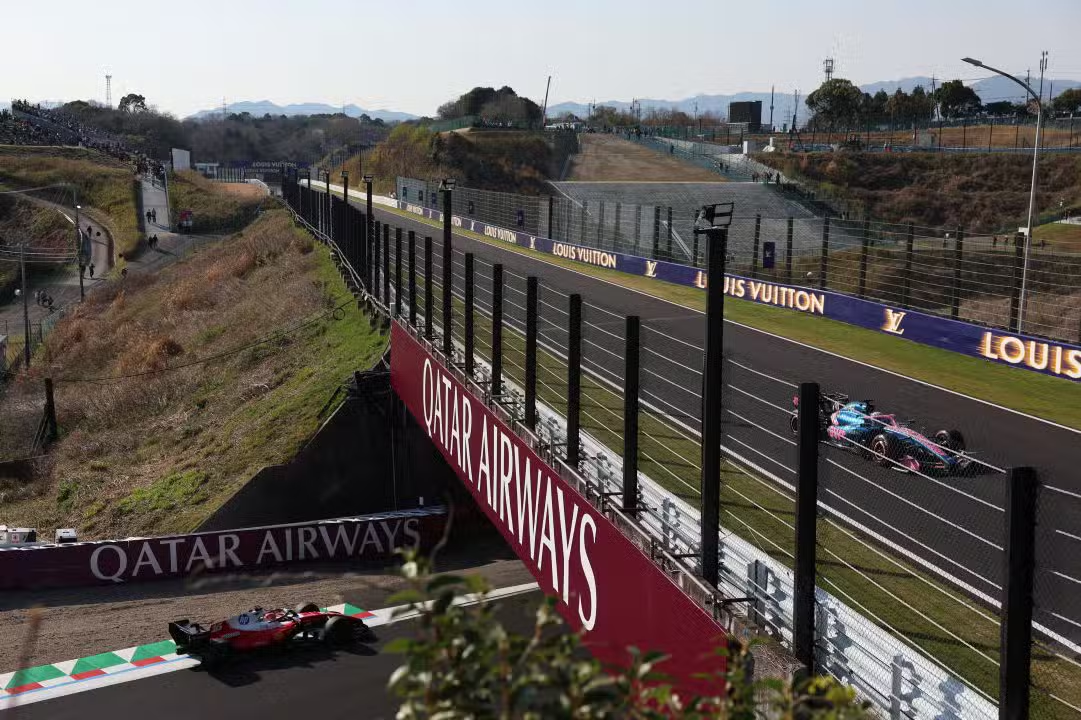
The Circuito of Suzuka is once again the center of attention in motor sport this weekend with another round of the world championship. Track activities gain intensity between Friday night and Saturday morning, when the teams define the starting order for the main race. The Asian route requires technical precision and promises a fierce competition for the top spots.
The official schedule establishes that the third free practice will take place late in the morning local time, serving as the last opportunity for adjustments in the single-seaters. Logo Afterwards, the drivers return to the asphalt for the qualifying session, which determines who will start in the position of honor. The time difference requires the Brazilian public to follow activities during the early hours of the morning.
Yes Racing is back for 2026 and here is your full driver line-up… 💪⬇️
Watch Qualifying for Round 1 now 👉https://t.co/VZVA0SktSE#F1 #F1Esports pic.twitter.com/IhTLeuytVJ
—Formula 1 (@F1)March 27, 2026
The first practical tests demonstrated a significant competitive level between the main constructors on the current grid. The alternation of leadership in the initial sessions indicates that the search for the fastest lap will be defined by minimum time margins. Engineers work intensely in the pits to extract maximum performance from the engines and aerodynamics.
Schedule of activities and dynamics of the qualifying session
The structure of the weekend follows the traditional format of the category, with three free practice sessions preceding qualifying. The third free practice is scheduled for 11:30 am Japão time, allowing the teams to validate the setup changes made overnight. Este period of sixty minutes is vital to simulate the behavior of the car with low fuel level.
The starting grid is defined at 3:00 pm local time, divided into the traditional three elimination phases. In the first segment, all twenty cars take to the track, and the five slowest are eliminated early from the race. The evolution of asphalt grip forces drivers to set their times in the final minutes to guarantee passage to the next stage.
The second segment reduces the group to fifteen competitors, raising the level of technical demands in high-speed curves. Apenas The ten fastest advance to the final stage, where pole position is effectively decided. Traffic on the track during these short windows of time is often an additional obstacle for those seeking a clean lap.
In the decisive segment, the remaining ten use new tire compounds to seek the absolute limit of the equipment. The psychological pressure reaches its peak, as any millimeter error in the curbs can compromise the entire weekend’s work. The starting position at Suzuka has a huge statistical weight on the final result of the race.
Team performance and rivalry at the top of the table
Mercedes started activities at Japão demonstrating strength, with George Russell setting the best mark in the first free training session. The British driver recorded a time of 1min31s666, showing that the aerodynamic updates brought stability in fast corners. Seu teammate, rookie Kimi Antonelli, followed the pace closely, confirming the German team’s good momentum on the Japanese circuit.
McLaren’s response came forcefully in the second practice session, changing the order of forces at the top of the timesheets. Oscar Piastri took the lead by lowering the benchmark to 1min30s133, highlighting the efficiency of the British chassis in quick changes of direction. The team has established itself as a real threat to the hegemony of its rivals in the fight for the front row of the grid.


Weather conditions and impact on asphalt adhesion
The weather forecast points to a favorable scenario for maximum performance from single-seaters during Saturday’s activities. Thermometers should register around 17°C during the last free practice, accompanied by clear skies and constant winds of 6 km/h coming from the southeast. Esta mild temperature is considered ideal by engineers to avoid superficial overheating of the rubber, allowing drivers to perform multiple preparation laps before opening a fast lap. The density of colder air also benefits engine cooling and increases the efficiency of the aerodynamic pressure generated by the wings.
At the time of classification, the ambient temperature must show a slight increase to 18°C, with a gradual increase in cloudiness over the circuit region. Meteorological services rule out the possibility of precipitation, ensuring that the race for pole position will take place entirely on a dry track. The main climate variable will be the direction of the winds, which can reach gusts of up to 9 km/h in a south-southeast direction. Essa change directly affects the balance of the cars at critical points on the track, requiring quick steering corrections when approaching high-speed curves.
Live broadcast scheme for the Brazilian public
Motorsport fans at Brasil will have multiple options to follow the decisive sessions directly from Suzuka. The third free training session will be broadcast exclusively on closed television on the SporTV channel, in addition to being available on the streaming platforms F1TV Pro and Globoplay. Coverage begins in the minutes before the pits open.
The official dispute for the starting grid gains space on open television, with TV Globo showing the classification live from 3 am on Saturday, at Brasília time. The broadcaster remains committed to bringing the most important moments of the championship to the general public. Digital platforms also replicate the signal simultaneously to devices connected to the internet.
The main race, scheduled for Sunday, will start at 2am on Brasília, following the same multiplatform transmission scheme. Programas experts will hold discussions before and after the sessions, offering tactical analysis and exclusive interviews with team leaders. Real-time monitoring ensures that no technical detail goes unnoticed.
Adaptation of Gabriel Bortoleto and the technical development of Audi
Brazilian driver Gabriel Bortoleto faces one of the biggest tests of his debut season when he drives a car in the main category for the first time on the complex Japanese circuit. Representando the team Audi, However, the second session revealed the set-up challenges for the German single-seater, with the Brazilian dropping to sixteenth place while focusing on race pace simulations and tire wear assessment with a full tank. The team focuses its efforts on detailed analysis of the telemetry collected to optimize the mapping of the hybrid system and improve traction on corner exits. The team’s internal objective is to provide equipment balanced enough for Bortoleto to overcome the cutoff in the first qualifying segment and fight for a place in the top 10. Efficiency in recovering kinetic energy in braking zones will be a determining factor in gaining speed on the straights, and engineers are working around the clock to refine the control software before the opening of the session that defines the grid.
Compound strategy and tire thermal management
The official tire supplier chose to offer the hardest range of compounds to withstand the extreme lateral forces generated by the abrasive asphalt of Suzuka. The strategy for qualifying will require drivers to find the ideal rubber temperature window during the warm-up lap, ensuring maximum grip from the first corner. Thermal management is vital, as an overheated tire at the beginning of the lap loses efficiency in the final sector of the circuit, compromising the total time and position on the grid.
Characteristics of the route and importance of the starting position
The figure-of-eight circuit is revered for its fluidity and the requirement for a perfectly balanced chassis. The initial sequence of “S” curves tests the car’s ability to change direction, while sectors such as the Spoon curve and 130R demand courage and absolute precision from competitors. A slight error in these sections results in irreversible loss of time or departures from the track in the gravel escape areas.
The historical difficulty of overtaking in Suzuka raises the importance of the qualifying session to a critical level. Largar in the front rows allows the driver to dictate the pace of the race and execute pit stop strategies defensively. The constant evolution of the track’s grip throughout the morning will be closely monitored, defining the exact moment at which the cars will leave the garages for the final attempt.
Veja Tambem em Fórmula 1

Esteban Ocon elogia Hamilton como o melhor piloto da era moderna antes do GP de Mônaco

Acosta conquista sexto lugar na MotoGP Itália e destaca aprendizado em duelos com Marc Márquez

Socorrista de Michael Schumacher revela detalhes inéditos sobre o resgate do piloto após 13 anos

Ralf Schumacher alerta George Russell sobre risco de posição de ‘segundo piloto’ na Mercedes após Canadá

Max Verstappen projeta dificuldades no GP de Mônaco por problemas de suspensão da Red Bull

Chefe da McLaren, Andrea Stella corrobora previsão de Norris sobre domínio da Ferrari em Mônaco

Resgate de Michael Schumacher em 2013: piloto de helicóptero detalha missão nos Alpes franceses

Carlos Sainz defende ação firme da FIA nas discussões sobre motores da Fórmula 1 para 2027

Kimi Antonelli lidera Fórmula 1 aos 19 anos e pai revela paixão natural por Ayrton Senna
Fórmula 1 não terá modo reta no GP de Mônaco após decisão oficial emitida pela FIA

Pilotos da Formula 1 dividem atenção com Copa do Mundo e Kimi Antonelli revela torcida pelo Brasil
