
Former drivers recommend retirement of Max Verstappen after early drop in qualifying at Suzuka
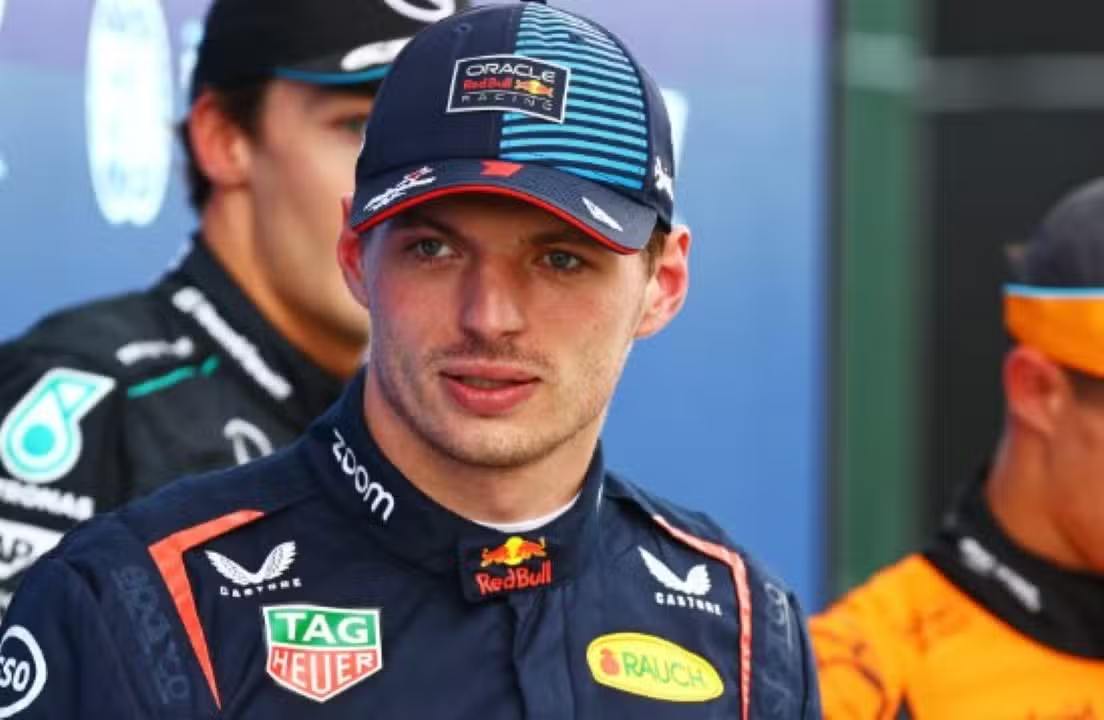
The four-time world champion of Fórmula 1 faced a significant setback during the qualifying session for the Grande Prêmio of the Japão, held on the traditional Suzuka circuit, when he was eliminated in the second phase of the track activity. The Red Bull Racing driver’s atypical performance resulted in eleventh position on the starting grid for Sunday’s main race, breaking a historic sequence of pole positions achieved by the Dutchman on this same route in previous seasons. The result exposed technical difficulties faced by the Austrian team at the beginning of the championship, highlighting drivability problems and lack of grip on the rear axle of the single-seater in dry track conditions, factors that compromised the lap time in the most winding sectors of the Asian race track.
The scenario inside the team’s garage presented notable contrasts during the weekend, with divergent performances between the brand’s competitors. The main highlights of the qualifying session included the following facts:
Not our weekend… Big congrats to Kimi 👏👏pic.twitter.com/qjecsDVFik
—Max Verstappen (@Max33Verstappen)March 15, 2026
* Isack Hadjar advanced to Q3 and secured eighth place on the starting grid.
* Arvid Lindblad, debutant from Racing Bulls, finished Q2 in tenth place.
* The Dutch driver missed out on the final stage in Suzuka for the first time since the 2015 season.
The competitor’s statements after elimination indicated a change in attitude regarding the problems faced on the track. The athlete reported a lack of frustration with the negative result, which generated debates in the paddock about possible emotional exhaustion after the stages of Austrália, where he obtained a sixth place, and China, marked by an abandonment in the main race.
Veterans’ position on the four-time champion’s moment
Experienced names in international motorsport expressed concern about the recent statements and body language of the Red Bull competitor. The lack of energetic reactions to adverse results caught the attention of former drivers in the highest category of motor sport, who closely follow the evolution of the championship.
Former driver Heinz-Harald Frentzen, holder of three victories in Fórmula 1, used his social networks to analyze the Dutchman’s current situation. The German highlighted that the loss of motivation in high-performance sports requires immediate measures to preserve the athlete’s physical and mental integrity during competitions.
Frentzen argued that a temporary break or even a break from the track may be necessary when the focus is not entirely on riding. The veteran based his analysis on his own experiences during his professional career, highlighting that a lack of concentration makes driving a single-seater dangerous.
The former competitor’s observation had intense repercussions behind the scenes of Suzuka shortly after the end of Saturday’s classification. Especialistas present at the race track noticed signs of discouragement in the current champion, who admitted uncertainty about how to extract more performance from the equipment provided by the technical team.
Preparation of Yuki Tsunoda behind the scenes at the team
The Japanese pilot The competitor lost his place as starter, but remained integrated into the energy drink brand’s development program, following all track activities.


Tsunoda has extensive experience with the group’s car construction philosophy and has actively participated in simulator sessions at the Milton Keynes factory. Sua familiarity with the route of Suzuka, located in its home country, reinforces its position as a viable alternative for eventual emergency replacements, with strong support from the local public.
Technical performance of the car on high-speed tracks
The Austrian team records performance metrics below the initial projections established for the first stages of the calendar. The difficulties in setting up the single-seater manifest themselves more acutely on routes that require high aerodynamic efficiency and stability in long-radius curves, exposing deficiencies in the current design.
The Japanese circuit demands absolute precision when changing direction at high speed, especially in the first sector of the track, known for its “S” curves. The early elimination interrupted a hegemony built over the last few years in this same location, forcing engineers to review the telemetry data collected during free practice.
Difference in performance between teammates
Frenchman Isack Hadjar demonstrated quick adaptation to the updates introduced to the RB20 model for the Asian leg of the championship. The driver managed to extract the maximum potential from the equipment during his fast lap in Q2, guaranteeing passage to the top ten positions and exceeding the expectations of the technical management.
The disparity in performance within the same structure intrigues the engineering team at Red Bull. Enquanto the rookie found enough mechanical grip to attack the curbs with confidence, the four-time champion reported chronic instability in the rear axle during heavy braking, especially when approaching the Spoon curve.
Data correlation work between the track and the wind tunnel has become the absolute priority for the team’s technicians. The search for a setup that takes into account different driving styles is fundamental for recovering points in the constructors’ championship and for reestablishing the drivers’ confidence in the equipment.
Strategies outlined for the main race at Japão
The start for Grande Prêmio of Japão is scheduled for 3pm local time, requiring teams to plan in detail regarding the management of tire wear. The abrasive asphalt of Suzuka traditionally forces strategists to opt for multiple pit stops, leaving room for aggressive position recovery tactics. Partindo from eleventh place, the car from Red Bull will need a race pace higher than that demonstrated in free practice to climb the intermediate field and reach the significant scoring zone, directly depending on the efficiency of the pit stops and the durability of the rubber compounds chosen for the first stints.
The weather forecast indicates climate stability for the time of the race, ruling out the possibility of precipitation that could shuffle the order of forces on the starting grid. Mercedes secured the front row with Kimi Antonelli in pole position and George Russell in second position, setting the pace to be beaten by the other teams over the 53 scheduled laps. The Austrian team monitors the behavior of the harder tires supplied by the Pirelli, seeking a pit stop window that allows them to run in clean air, maximize engine pace and avoid straggler traffic in the narrowest sections of the Japanese circuit.
Evaluation of the updated aerodynamic package
The aerodynamic modifications implemented in the floor and front wings of the single-seater aimed to correct the loss of aerodynamic pressure reported in the Austrália and China stages, seeking greater stability in high-speed curves. However, the Japanese track exposed an extremely narrow operating window for the new parts, making it difficult for mechanics to find the ideal balance between free practice sessions and the official classification. The figure-of-eight layout, unique on the Fórmula 1 calendar, requires a complex compromise between speed on the straights and support in fast corners like the 130R, an equation that the technical team has not yet managed to resolve satisfactorily with the current package. Collecting information during the warm-up and in the first laps of the race will be crucial in determining the direction of development in the next rounds of the world championship, defining whether the current concept will be maintained and improved or whether a return to previous specifications will be necessary to recover the competitiveness lost at the start of the season.
Focus on continuous technical development
The engineering department maintains the update schedule focused on resolving chronic drivability issues identified in the chassis. Alignment meetings between drivers and technicians continue to take place regularly to ensure that the feedback collected on the track is translated into practical solutions at the factory, aimed at the next stages of the international calendar.
Veja Tambem em Fórmula 1

Esteban Ocon elogia Hamilton como o melhor piloto da era moderna antes do GP de Mônaco

Acosta conquista sexto lugar na MotoGP Itália e destaca aprendizado em duelos com Marc Márquez

Socorrista de Michael Schumacher revela detalhes inéditos sobre o resgate do piloto após 13 anos

Ralf Schumacher alerta George Russell sobre risco de posição de ‘segundo piloto’ na Mercedes após Canadá
Max Verstappen projeta dificuldades no GP de Mônaco por problemas de suspensão da Red Bull

Chefe da McLaren, Andrea Stella corrobora previsão de Norris sobre domínio da Ferrari em Mônaco

Resgate de Michael Schumacher em 2013: piloto de helicóptero detalha missão nos Alpes franceses

Carlos Sainz defende ação firme da FIA nas discussões sobre motores da Fórmula 1 para 2027

Kimi Antonelli lidera Fórmula 1 aos 19 anos e pai revela paixão natural por Ayrton Senna
Fórmula 1 não terá modo reta no GP de Mônaco após decisão oficial emitida pela FIA

Pilotos da Formula 1 dividem atenção com Copa do Mundo e Kimi Antonelli revela torcida pelo Brasil
