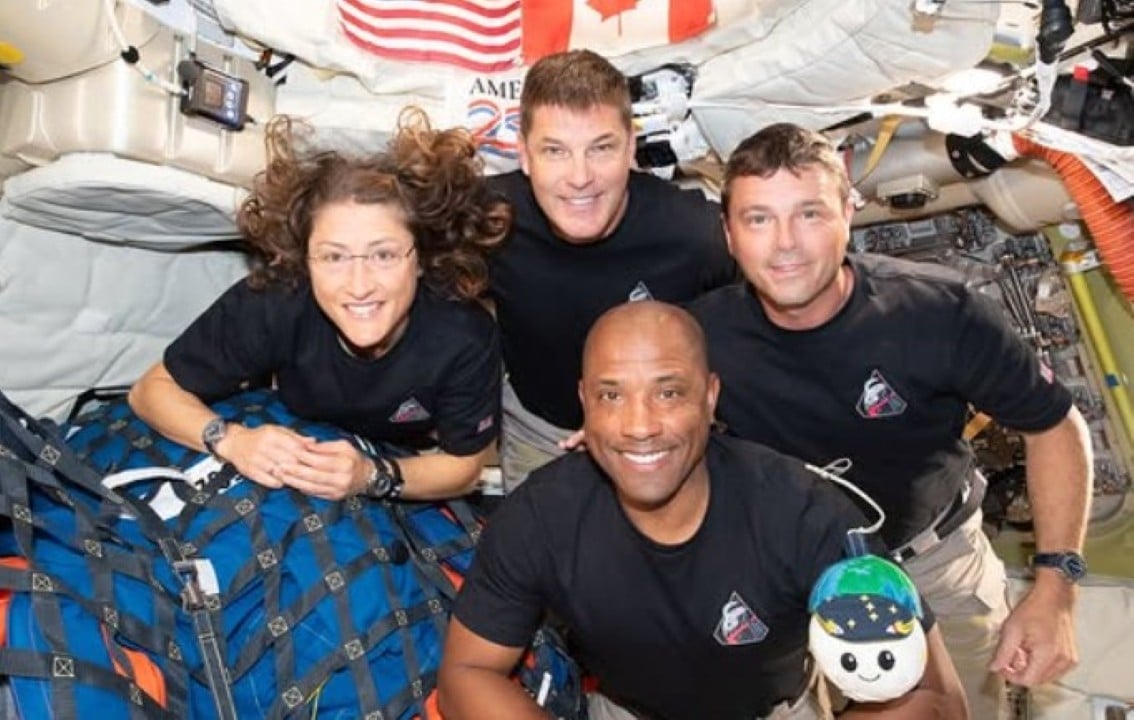
Mission Artemis II, a milestone in human space exploration, approaches its climax with the long-awaited return of capsule Orion to Terra. Após a historic 965,000-kilometer journey that has challenged the limits of human spaceflight, the four astronauts on board are in the final phase of an odyssey that It broke records and expanded knowledge about the human capacity to operate far from home, with landing scheduled for Oceano Pacífico, close to the coast of San Diego. Expectations are high for the safety of the crew, who will face a highly complex atmospheric reentry.
Launched on April 1 in Centro Espacial Kennedy, Artemis II represented the first manned mission in NASA’s ambitious Artemis program, which aims to establish a sustainable human presence in Lua and eventually in Marte. Durante the journey, the spacecraft Orion and its systems have undergone rigorous testing in a deep space environment, providing crucial data for the next steps of lunar exploration.
The main objectives of the mission included a series of verifications essential for the safety and success of future space endeavors, demonstrating the robustness of the technology and the capabilities of the crew.
Critical return: 13 minutes of tension on re-entry
The descent of capsule Orion is expected at 8:07 pm (Eastern Time), marking the beginning of a re-entry into the atmosphere that will last approximately 13 minutes. Durante During this critical period, the ship will face extreme conditions, with speeds approaching 38,600 km/h and temperatures that can reach 2,760 degrees Celsius on its external surface, a monumental challenge for engineering and the resistance of materials.
“It’s 13 minutes in which everything needs to go right”, emphasized Jeff Radigan, flight director of Artemis II, highlighting the precarious nature and complexity inherent in each phase of this final stage, where the precision of each calculation and the functionality of each component are put to the test.
The parachute deployment sequence is of vital importance for the deceleration of the capsule. Primeiro, a pair of braking parachutes are released, which have the function of drastically reducing the speed of Orion to around 320 km/h, preparing the ship for the next stage.
Then, three main parachutes are deployed, further reducing the capsule’s speed to approximately 32 km/h before impacting the ocean surface, ensuring a safe and controlled landing, essential for the integrity of the spacecraft and, mainly, for the safety of the crew.
Complex maneuvers and the legacy of Apollo
Radigan drew a parallel between the reentry of Artemis II and the returns of the historic missions of the Apollo program, highlighting that the speed of approach to deep space is considerably higher than that of the low orbit missions of Terra. Ele explained that “you come down in a straight line and enter the atmosphere much faster, which means you go through it as well. much faster.”
This comparison highlights the complexity and fine engineering required to manage the kinetic energy of a spacecraft returning from such a great distance. The ballistic trajectory and aerodynamic forces involved require precise control and redundant systems to ensure the capsule reaches its planned landing point safely, a lesson learned and refined since the first human forays into deep space.
Immediate rescue and post-mission care
Immediately after Oceano Pacífico lands, highly specialized rescue teams from NASA and the US Marinha will quickly head to capsule Orion to begin recovery operations.
The astronauts’ journey after landing
The crew will be rescued within two hours of landing, a time optimized to minimize post-flight stress and ensure the health of the astronauts. Eles will be transported by helicopter directly to the aircraft carrier USS John P. Murtha, which will be positioned in the landing zone.
Aboard the ship, astronauts will undergo detailed medical evaluations in a specialized infirmary designed to monitor the effects of prolonged space travel, such as changes in blood pressure, bone density and adaptation to Earth’s gravity. They will then be flown to the coast and finally board an aircraft bound for Centro Espacial Johnson, at Houston, Texas, for additional examinations and mission debriefings.
Historic achievements: breaking records and pioneering
Mission Artemis II not only set the stage for the future of lunar exploration, but also set impressive new records for humanity. The quartet surpassed the milestone of mission Apollo 13 of 1970, reaching the greatest distance Terra ever traveled by humans in a spaceflight, a testament to the resilience of the crew and the robustness of the spacecraft Orion. Esta’s journey of hundreds of thousands of kilometers not only demonstrates technological advancement, but also ambition to extend human presence beyond Terra’s low orbit.
The crew’s pioneering spirit and the expansion of humanity in space
The crew of Artemis II also made history due to its diverse composition. Victor Glover became the first black man, Christina Koch the first woman, and Jeremy Hansen the first non-American to fly close to Lua, marking significant advances in inclusion and representation in space exploration.
With the completion of this mission, the total number of humans who have ventured into deep space has increased to 28, representing the first individuals to reach such distances since the last flight of the Apollo program in 1972, fifty-four years ago.
Unique Perspectives: The Beauty of the Cosmos
Along the journey, the astronauts had the privilege of flying over the far side of Lua.
They contemplated landscapes and geological formations never before seen directly by human eyes, providing an unprecedented and valuable perspective for lunar science.
Furthermore, they witnessed a complete solar eclipse, with Lua blocking Sol, observed from a unique vantage point in deep space, a sight that few human beings have had the opportunity to witness.
Continuous vigilance by the ground team
Jeff Radigan, flight director of Artemis II, maintained an unwavering stance of vigilance until the final moments of the mission, reflecting the mindset that permeates the entire ground control team. “We haven’t finished this mission yet. Temos another day and a half, and you know we can only start celebrating when we have the crew safely in the ship’s infirmary,” he said, expressing the caution necessary in high-risk missions.
This dedication and focus demonstrates the seriousness with which crew safety is treated at every stage of the space journey. The celebration of the mission’s complete success is conditioned on the absolute guarantee that the astronauts are back and in stable conditions, highlighting the enormous responsibility and professionalism required in commanding such complex and challenging operations.