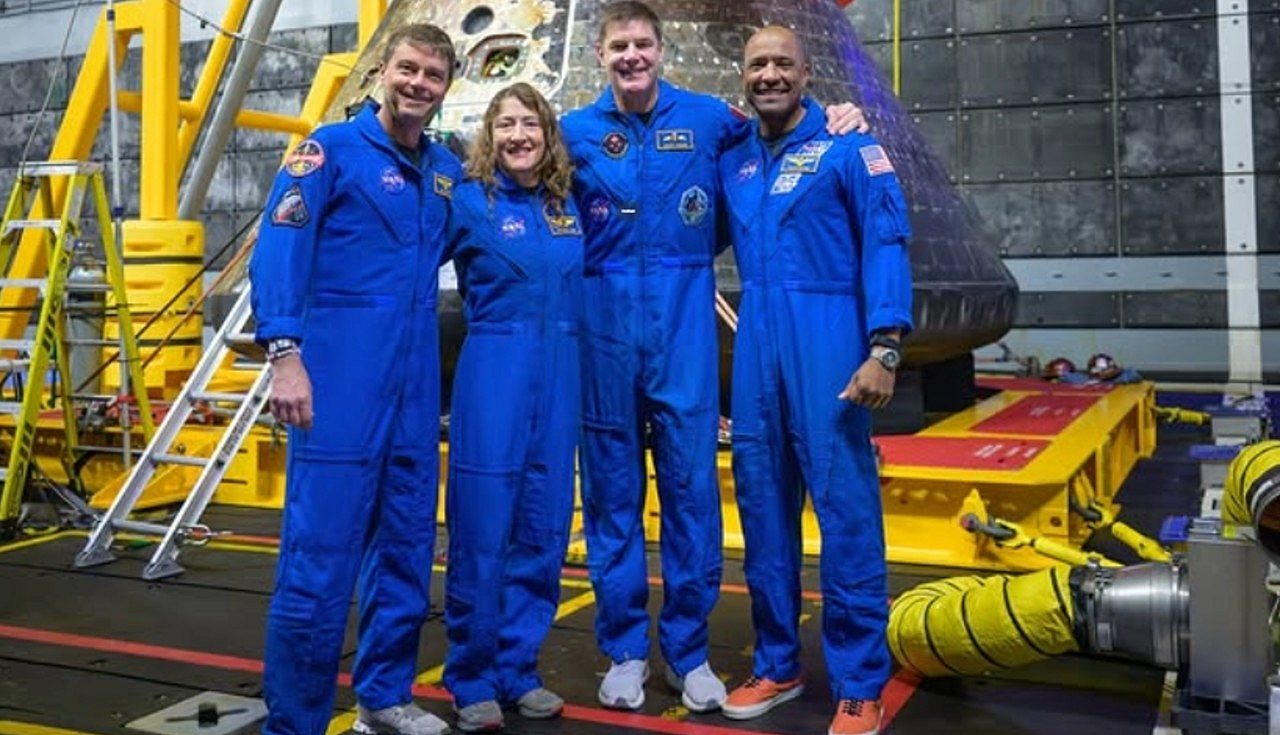
The four astronauts from mission Artemis 2 of Nasa returned safely to Terra this Friday. Capsule Orion touched down at Oceano Pacífico, just off the coast of Califórnia. The landing marked the end of an approximately ten-day journey that took humans further into space than any previous manned mission. The crew included commander Reid Wiseman, pilot Victor Glover, specialist Christina Koch and Canadian astronaut Nasa0.
The spacecraft completed a total journey of more than 1.1 million kilometers. Durante the flight, the crew carried out the first manned flyby of the far side of Lua in more than five decades. Eles also surpassed Apollo 13’s distance record by moving about 252 thousand miles away from Terra.
- Reid Wiseman served as mission commander
- Victor Glover served as a pilot and recorded unique observations
- Christina Koch became the first woman on a manned lunar mission
- Jeremy Hansen represented the first person outside the Estados Unidos on the flight
Reentry into the atmosphere represented the most critical moment of the operation. The capsule reached speeds close to 38 thousand kilometers per hour and faced temperatures exceeding 2,500 degrees Celsius on the heat shield. Communication with the control center was interrupted for about six minutes due to ionized plasma formed around the spacecraft.
Atmospheric reentry requires technical precision
Orion began its descent from an altitude of approximately 120 kilometers. The thrusters adjusted the trajectory to ensure the correct angle of entry into the atmosphere. Equipes of recovery of Marinha of Estados Unidos followed the entire process from the moment of landing.
Divers approached the capsule shortly after contact with the water. Eles opened the hatch and assisted in the orderly exit of the astronauts. Christina Koch left the spacecraft first, followed by Victor Glover, Jeremy Hansen, and lastly commander Reid Wiseman.
The four crew members waved to rescuers as they were transported by helicopter to the recovery ship. Relatos initials indicated that everyone was in good physical condition after the journey. Eles underwent preliminary medical assessments on board the ship before proceeding to Centro Espacial Johnson, in Houston.
Landing details confirm operational success
The capsule activated its main parachutes at an altitude of about six kilometers. Isso reduced the descent speed to approximately 30 kilometers per hour upon contact with the ocean. The European service module, responsible for propulsion and life support during the journey, was separated minutes before reentry.
Commander Reid Wiseman reported that the capsule stabilized in an upright position after inflating the buoyancy balloons. Ele confirmed that the four crew were safe and described the experience as an intense adventure. Nasa highlighted international collaboration, with the service module built by European and Canadian partners.
Crew celebrates return after challenges in space
During the lunar flyby, the astronauts lost contact with Terra for 41 minutes as they passed the far side of Lua. Eles observed a total solar eclipse with Terra illuminating the satellite, which Glover described as a surreal sight. The minimum altitude during the flyby was approximately 6,500 kilometers from the lunar surface.
Mission Artemis 2 served as a crucial test for technologies that will be used in future manned landings. The Orion’s heat shield withstood the extreme conditions with no reported failures. Todo The descent process occurred automatically, with the astronauts positioned with their backs to the direction of movement.
Technical aspects of the mission reinforce future preparation
The European service module provided oxygen, water and climate control during the ten-day flight. Ele Disintegrated in a controlled manner after separation. Nasa confirmed that the capsule followed the planned reentry angle to avoid thermal or structural overloads.
After landing, the astronauts will undergo detailed medical examinations in Houston. Eles they will undergo a period of readaptation to Earth’s gravity. The space agency plans to use the data collected to refine procedures for upcoming missions Artemis.
International collaboration marks new space age
The presence of Jeremy Hansen highlighted the partnership between Estados Unidos and Canadá in the Artemis program. The European service module also featured contributions from companies from several countries. Administradores from Nasa emphasized that the success of Artemis 2 paves the way for more ambitious goals.
The mission represented the return of humans to the lunar vicinity after 53 years since the last missions Apollo. Diferente of previous expeditions, the current focus includes preparation for extended stays on the satellite. The next steps foresee manned landings later this decade.
Crew recovery follows established protocol
Medical teams monitored the astronauts from the moment they exited the capsule. Flight Director Rick Henfling reported relief to see the hatch open and the crew in stable condition. MH-60 helicopters Seahawk transported team members to the rescue ship.
Nasa plans to analyze all telemetry and image records collected during reentry. Esses data will help validate Orion systems for subsequent flights. The agency maintains the schedule for future missions that include landings on the lunar surface.
Orion technology demonstrates robustness in extreme conditions
The heat shield absorbed the heat generated by atmospheric compression. The capsule gradually reduced speed until a gentle splashdown. The parachutes worked as expected, ensuring a controlled descent.
The astronauts spent the last days of the mission in a peaceful return phase after the lunar flyby. Eles performed systems checks and preparations for reentry. The total journey took nine days, one hour, 32 minutes and 15 seconds, with landing recorded at 2:07 a.m. Estados Unidos West Coast time.
Next steps for the Artemis program gain momentum
The success of Artemis 2 validates transportation and life support systems for more complex operations. The space agency is moving forward with planning missions that include manned landings in Lua from 2028. Parcerias international missions remain essential for the development of sustainable bases.
The crew demonstrated extensive preparation for the risks of reentry. Treinamentos carried out over months leading up to the flight. Nasa reinforces that the data obtained will contribute to advances in long-term manned space exploration.