Moon and Jupiter shine just three degrees apart and facilitate astronomical observation
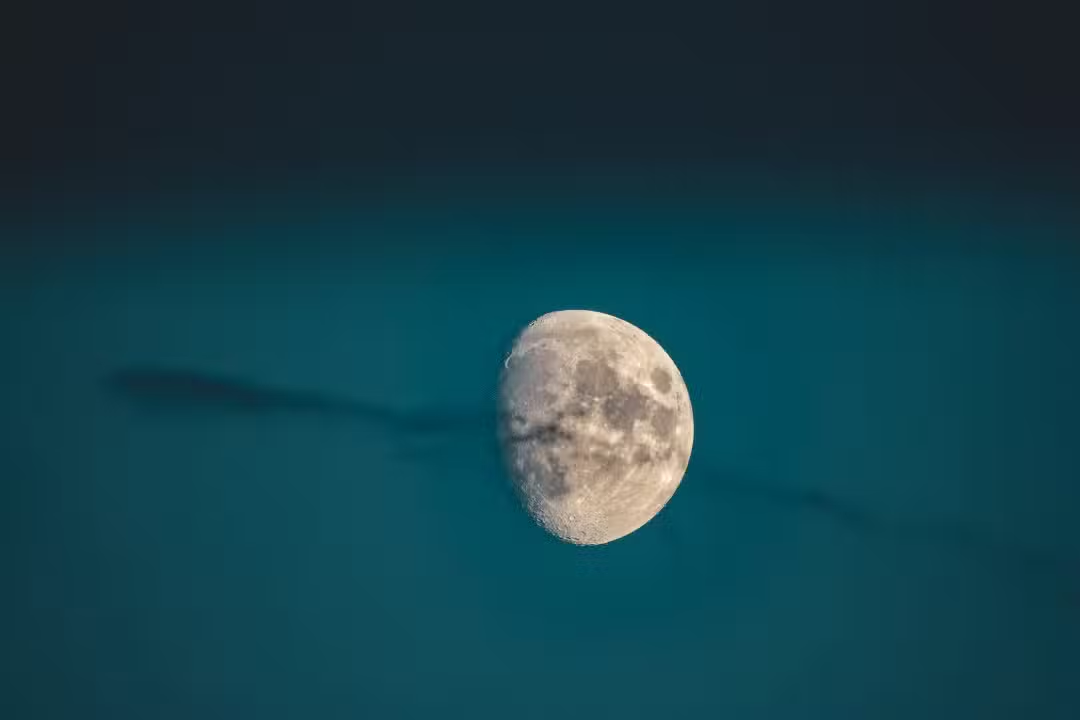
The night sky presents a highly visible astronomical phenomenon this Wednesday, April 22nd. Pouco After sunset, Lua and the planet Júpiter appear in a visual approximation known as a conjunction, becoming the brightest objects in the firmament. The pair can be located towards the west, positioned about two-thirds of the way above the horizon. The event occurs at a time when the natural satellite is moving towards its first quarter phase.
The apparent distance between the two celestial bodies is just three degrees. Para the observer in Terra, this measurement is equivalent to approximately one third of the size of a closed fist when extended along the arm line. Júpiter appears as a fixed point of intense light below and to the left of the lunar disk. Visibility depends on local weather conditions, but the brightness of the stars allows viewing even in areas with moderate light pollution.
Localização and best times to observe the phenomenon
The best time to start observation occurs around 45 minutes after the sun disappears over the horizon. Neste interval, the sky still preserves twilight tones, which helps highlight the silvery glow of Lua and the yellowish reflection of Júpiter. Because they are in an elevated position, the stars remain visible for a few hours before setting on the western horizon. Moradores from urban centers can easily identify the pair without the aid of optical instruments.
The planets and Lua follow an imaginary line in the sky called the ecliptic. In tonight’s scene, in addition to the main approach, it is possible to notice the presence of famous stars nearby. Castor and Pollux, the brightest in the Gêmeos constellation, sit above the celestial pair. The alignment provides an opportunity for astronomy enthusiasts to identify star patterns that serve as a guide for nighttime navigation.

Características visuals of Lua and position of Júpiter
The Lua presents an illumination of approximately 38% of its surface facing the Terra today. Este state occurs one day before the satellite officially reaches the first quarter phase, when half of the disk becomes visible. The shadowed portion of the Lua may exhibit a slight grayish glow, a phenomenon known as cinereous light, resulting from the reflection of sunlight by the Terra.
Júpiter, the largest planet in the solar system, maintains a constant brightness magnitude that sets it apart from ordinary stars. Enquanto the stars appear to twinkle due to the interference of the Earth’s atmosphere, the brightness of the planets is more stable. Esta characteristic makes the distinction easier for those observing the phenomenon for the first time. Especialistas suggest that using simple binoculars could reveal up to four of Júpiter’s largest moons, known as Galilean satellites:


- Io: the most volcanically active body in the solar system.
- Europa: famous for having an ice crust and underground ocean.
- Ganimedes: the largest moon in the entire solar system, surpassing the planet Mercúrio.
- Calisto: one of the oldest and most heavily cratered objects known.
Condições ideal for photographic records of the meeting
Para who wants to record the moment with cameras or smartphones, the twilight period is the best time. Ambient lighting allows the terrestrial landscape to appear in the photo along with the stars, creating a more balanced composition. Tripés are recommended to avoid blur, as available light decreases quickly. On mobile devices, using night mode or manually adjusting exposure prevents the Lua from appearing as just a blown-out white blur in the image.
A proximity of three degrees is considered ideal for captures with medium-range lenses. Long-exposure Fotografias can reveal details of the lunar surface, such as craters and maria, while recording Júpiter as a defined disk. The low humidity in several regions of Brasil at this time of year favors the transparency of the atmosphere. Isso reduces light scattering and ensures clearer images of celestial objects.
Importância of Conjunctions for Science and Education
Eventos of apparent approximation like this have a significant educational value for scientific communication. Escolas and observatories often use these dates to explain orbital motions and distance scales in space. Embora appear close in the sky, Lua is about 384 thousand kilometers from Terra, while Júpiter is hundreds of millions of kilometers away. The conjunction is just a matter of the earthly observer’s geometric perspective.
Estes phenomena help to understand celestial mechanics and the periodicity of the stars. Como to Lua orbits Terra in approximately 27 days, it crosses the visual path of all visible planets each month. However, the exact distance in degrees and visibility time are constantly changing. Today’s meeting is one of the closest to the first half of 2026.
- Lua completes its crescent phase tomorrow, the 23rd.
- Júpiter remains visible over the next few weeks, but is gradually moving away from Lua.
- Novas conjunctions will occur in May, with different planetary configurations.
- Today’s phenomenon is visible across the southern hemisphere with clear skies.
Tracking these cycles allows amateur observers to develop a practical understanding of astronomy. Não There is a need for expensive equipment to appreciate the beauty of the cosmos. Today’s spectacle serves as a reminder of the constant dynamics of the solar system. Basta looks west after sunset to witness one of nature’s most beautiful scenes this week.
See Also em Latest News (EN)

IOS 26.5 Beta 4 is now available with performance and RCS improvements
02/05/2026
Kathy Hilton denies responsibility for guest’s fall at Bel Air mansion
02/05/2026
Apple ends Intel support in macOS 27 and kills Rosetta 2 in September
02/05/2026
Tesla Model X leads used car market in the US with sales in 25.6 days
02/05/2026
Berkshire Meeting Reveals Changing Era with Greg Abel Featured in Omaha
02/05/2026
Berkshire Hathaway reduces attendance at annual shopping event, with Greg Abel in the spotlight
02/05/2026
Gas over $8 makes Los Angeles drivers spend $100 per fill-up
02/05/2026
Nintendo announces nine releases for Switch 2 and Switch in May 2026(99)
02/05/2026
Crimson Desert receives update 1.05 with rematch mode and new challenges
02/05/2026
Samsung regains leadership in smartphones with Galaxy S26 in the first quarter of 2026
02/05/2026
Vellfire Sedan gets rear diffuser and returns to the track in preparation for Toyota event
02/05/2026