NVIDIA files patent that improves denoising in ray tracing with less noise and smooth shadows
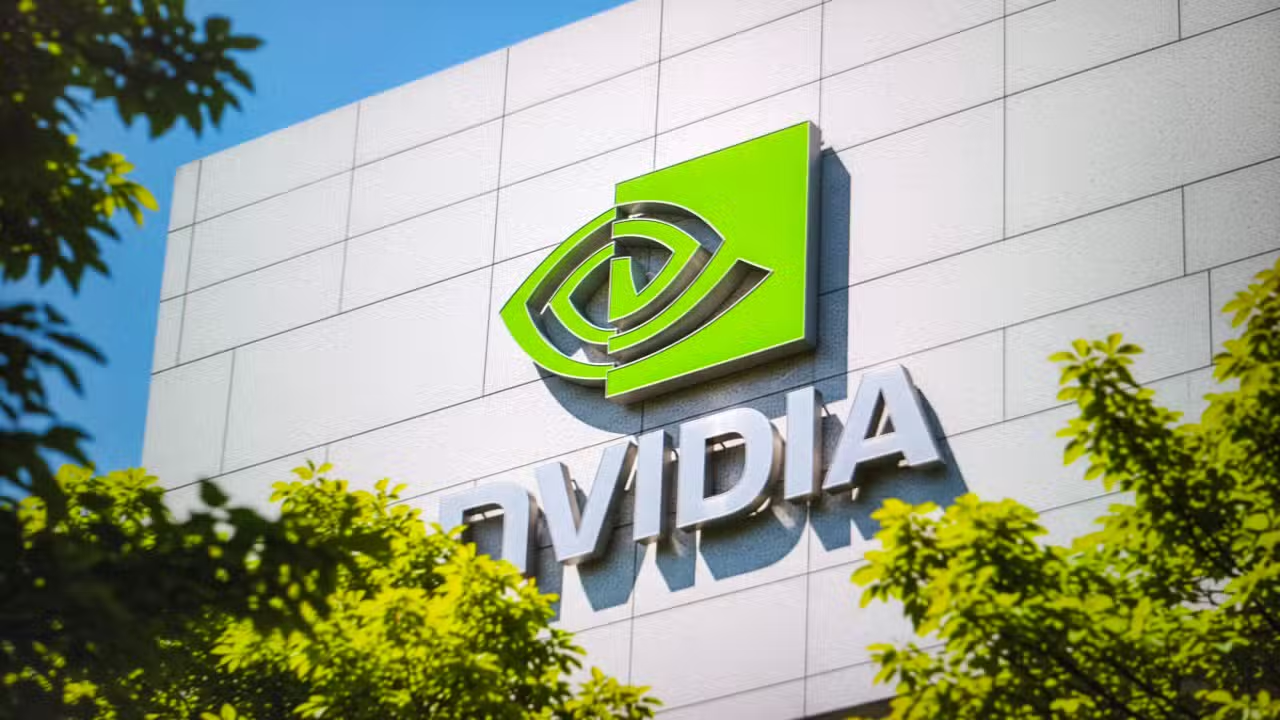
NVIDIA has registered a patent that proposes a new way of dealing with denoising in ray tracing systems. The technique focuses on shadows and seeks to reduce visual noise without compromising image quality. Publication took place on March 19, 2026.
The document is entitled “Efficient denoising for ray-tracing systems and applications”. Ele describes a self-guided, spatiotemporal method. The filter adapts based on the variation in samples accumulated over time.
Essa approach avoids using extra data like lightning strike distance. The system defines a range of values and excludes samples that fall outside it. The objective is to prevent blurring in the final image. In binary signals, such as visibility, a simple average of the distribution already helps to calculate the following. Isso saves computational resources.

Patente focuses on shadow denoising with adaptive filter
Ray tracing simulates the path of light to create realistic shadows, reflections, and refractions. The classic problem is the enormous amount of rays needed for soft shadows. Poucos rays generate noise. Muitos rays require a lot of processing.
The patent suggests denoising that uses the temporal variation of the samples. Current Filtros combine the current frame with previous ones and often need additional distance information. Isso may cause blur or increase bandwidth cost.
With the new method, the filter guides itself according to changes in the samples. Ele maintains fine details in dim light. The result is softer, more precise shadows. Overall processing drops because there is less need for extra rays or supplemental data.
Desenvolvedores may free up GPU resources for other purposes. The gain appears especially in complex scenes with multiple light sources or dense geometry.
Técnica reduces impact on gaming performance
Jogos with full ray tracing still requires powerful hardware. Noise appears when the number of rays per pixel becomes low to maintain the frame rate. Traditional denoising helps, but does not always preserve sharpness.
The patented approach excludes samples outside the defined range. Isso prevents the filter from blurring transition areas. Sombras gain natural dim light without visible artifacts.
The patent text indicates savings in processing power and bandwidth. Parte of the freed resources can go to reflections or global illumination. The practical effect would be higher quality ray tracing running on current hardware with less performance drop.
Como method differs from current denoising solutions
Métodos spaces act within a single frame. Temporal Soluções takes data from previous frames. Ambas may require extra information and still produce fast-moving blur or thin edges.


NVIDIA’s proposal combines space and time in a way guided by the variation of the samples. Não depends so much on distance data. In cases of simple visibility, a single average already guides the following calculation.
Essa change simplifies the pipeline. The filter becomes more efficient. The final image maintains contrast and detail where older methods soften too much.
- Filtro adapts to the temporal variation of accumulated samples
- Exclui samples outside a defined range to avoid blurring
- Reduz need extra data distance or bandwidth
- Mantém accuracy in binary shadows with simplified calculation
- Libera GPU resources for other graphics
Impacto expected for developers and players
Ray tracing already appears in many modern titles. Melhorias in denoising can accelerate adoption in medium-sized productions. Estúdios can deliver more realistic shadows and reflections without increasing the minimum requirements too much.
Jogadores with existing RTX cards notices less noise in demanding scenes. Fluidity improves when the system needs fewer spokes for the same level of quality. Futuras implementations can exploit the technique on thermally constrained consoles or notebooks.
The patent does not guarantee immediate release of drivers or new games. Empresas register many technologies that remain on paper or evolve before becoming a product. Ainda thus, the document signals the path that NVIDIA explores to make physics-based graphics more accessible.
Detalhes technical patent published in March
The publication took place on March 19, 2026. The main focus is efficient denoising for ray tracing applications. The self-guided technique works especially on shadows, but the title mentions systems and applications in general.
The method deals with noise generated by limited sampling. Instead of forcing more rays, it refines what has already been calculated. Temporal adjustment helps with movements and lighting changes.
Desenvolvedores that work with engines like Unreal Engine or Unity may integrate similar improvements in the future. Reducing computational cost makes room for additional effects without sacrificing frame rate.
NVIDIA has continued to invest in ray tracing since the launch of the first RTX cards. Avanços like this complement existing upscaling and image reconstruction technologies.
See Also em Latest News (EN)

IOS 26.5 Beta 4 is now available with performance and RCS improvements
02/05/2026
Kathy Hilton denies responsibility for guest’s fall at Bel Air mansion
02/05/2026
Apple ends Intel support in macOS 27 and kills Rosetta 2 in September
02/05/2026
Tesla Model X leads used car market in the US with sales in 25.6 days
02/05/2026
Berkshire Meeting Reveals Changing Era with Greg Abel Featured in Omaha
02/05/2026
Berkshire Hathaway reduces attendance at annual shopping event, with Greg Abel in the spotlight
02/05/2026
Gas over $8 makes Los Angeles drivers spend $100 per fill-up
02/05/2026
Nintendo announces nine releases for Switch 2 and Switch in May 2026(99)
02/05/2026
Crimson Desert receives update 1.05 with rematch mode and new challenges
02/05/2026
Samsung regains leadership in smartphones with Galaxy S26 in the first quarter of 2026
02/05/2026
Vellfire Sedan gets rear diffuser and returns to the track in preparation for Toyota event
02/05/2026