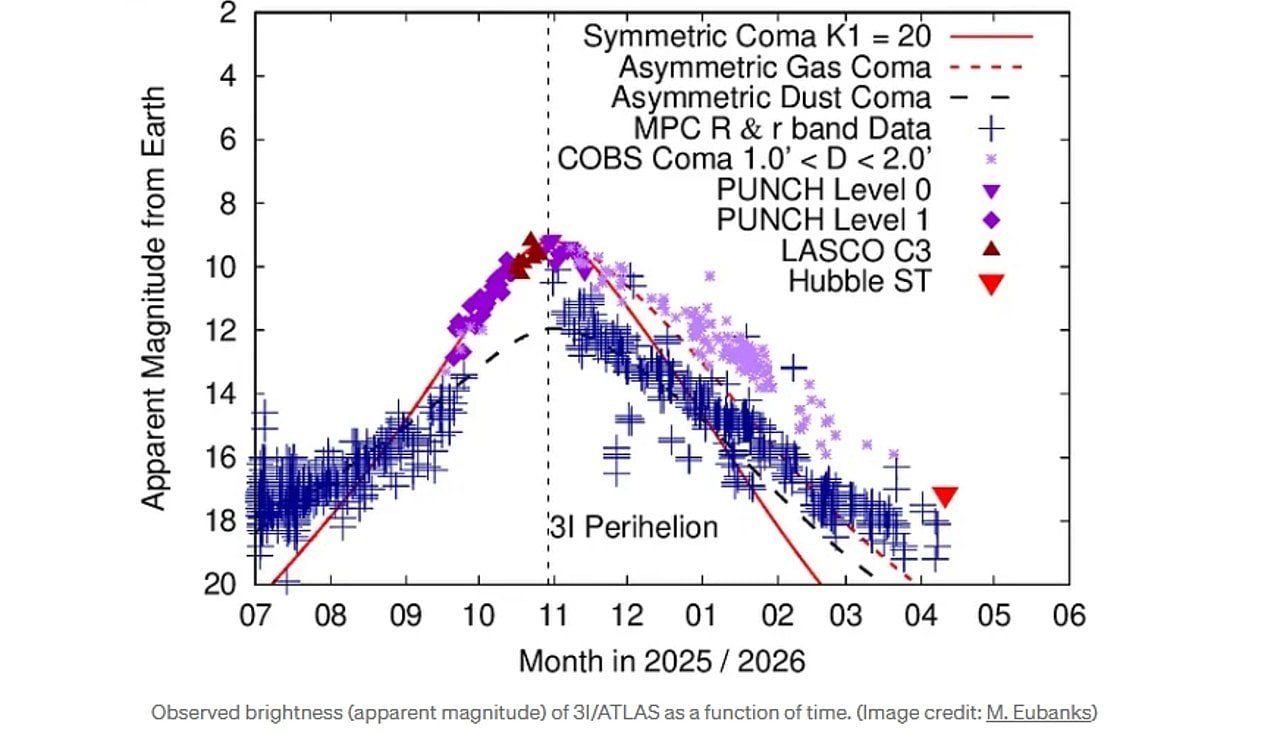
The interstellar object 3I/ATLAS is currently a billion kilometers away from Terra, approximately 6.7 times the separation between Terra and Sol. Ele has already surpassed the orbit of Júpiter and continues on its return trajectory to interstellar space. Observado as a fuzzy spot in recent images of Telescópio Espacial Hubble, dated April 10, 2026, the celestial body continues to intrigue scientists.
Apesar from its departure, the brightness of 3I/ATLAS on its exit route remains elevated compared to its initial approach. Este phenomenon is attributed to excessive outgassing and the release of dust that the object presented in the vicinity of Sol. The scientific community eagerly awaits data from NASA’s Juno probe, collected on March 16, 2026, when 3I/ATLAS had its closest proximity to Júpiter.
Afastamento and Monitoramento Científico
3I/ATLAS, our interstellar visitor, was first spotted almost a year ago. Sua’s trajectory, remarkably aligned with Terra’s orbital plane around Sol, makes it a rare event that may not be witnessed again for a generation. Observations continue to be crucial to understanding its nature.
The object’s light curve, which has been gradually decreasing, has so far not shown any sign of artificial light, that is, light produced by the body itself. Monitoring by large telescopes and analyzing data from the Juno probe are fundamental to unraveling the mysteries that 3I/ATLAS carries. Information collection is continuous.
Composição Química Desafiadora and Potenciais Sinais
The composition of 3I/ATLAS has been a source of great discussion among researchers, revealing characteristics that deviate significantly from known patterns in celestial bodies. One of the most striking anomalies is the exceptionally high proportion of deuterium, an isotope of hydrogen. Este element was detected at levels a thousand times higher than the average cosmic abundance in water (H2O) and thirty times higher in methane (CH4), far exceeding the values found in Sistema Solar comets and meteorites, and up to three orders of magnitude compared to methane on planets.
Além Additionally, 12C/13C isotope ratios for carbon dioxide (CO2) and carbon monoxide (CO) were reported to exceed typical observed values. Estes unusual data has led to speculation about a potential “technosignature”, given that deuterium and tritium are efficient fuels for nuclear fusion. A nuclear explosion at the object could have triggered a chain reaction.
Outra issue raised is the discrepancy in the mass budget. The inferred core diameter and number density of its source population exceed the mass reservoir of planetary disks in ancient stars by orders of magnitude. Tal fact may suggest the clustering of technological probes in habitable zones, reflecting a focused interest in resources. The abundance of gas-phase organic molecules, such as methanol (CH3OH) and methane (CH4), after perihelion is also intriguing. The survival of these molecules during an interstellar journey lasting billions of years would require them to be buried beneath a thick layer of material. The detection of methane after perihelion, while CO2 and CO were detected much earlier, suggests an unusual layered composition or even a biological origin. Methane and other organic molecules are known biomarkers.
Geometria from Trajetória and Dinâmica Inesperada
The trajectory of 3I/ATLAS presents a geometry and arrival time that generated great surprise in the scientific community. The object followed a retrograde trajectory, aligned with the orbital plane of Sol’s planets, with a probability of just 0.2%. Via Láctea’s disk, for example, is misaligned by approximately 60 degrees in relation to the ecliptic. Essa unusual coincidence suggests that 3I/ATLAS’s trajectory could have been planned.
Além In addition, the object’s arrival time appeared to be adjusted to optimize its passages close to other celestial bodies. Ele achieved minimum distances of 29 and 54 million kilometers from Marte and Júpiter, respectively. Curiosamente, 3I/ATLAS remained unobservable from Terra during its perihelion. The perijove distance, Júpiter’s closest approach on March 16, 2026, was 53.6 million kilometers, very close to Hill’s radius of Júpiter, which is 53.5 million kilometers. Essas accuracies raise the hypothesis of a “technosignature” that points to a probe mission or even “seeding” in the habitable zone of Sistema Solar.
The alignment of the 3I/ATLAS rotation axis is also a highlight. At large distances from Sol, the initial rotation axis was aligned up to 8 degrees with the solar direction upon entering Sistema Solar. The probability of such an alignment occurring by chance is 0.5%. Este phenomenon, together with an “anti-tail” (jet of gas and dust directed at Sol), which oscillated during July and August 2025, requires the base of the jet to be less than 8 degrees from the pole facing Sol. Tal constant alignment with Sol would allow for a stable day and night side throughout the journey, maintaining consistent surface temperatures and lighting for a technological object.
Fenômenos of Gás and Poeira Desafiadores
Analysis of 3I/ATLAS Telescópio Espacial Hubble images has revealed complex gas and dust phenomena that defy conventional explanations for comets. The object’s anti-tail, observed before perihelion, appeared to be a collimated jet toward Sol, about ten times longer than it was wide. Essa feature is similar to the collimation seen in images after perihelion. The anti-tail jet extended hundreds of thousands of kilometers, a length that no known comet has naturally exhibited towards Sol. The occurrence of this prominent jet both before and after perihelion has an extremely low probability of being a random event. Para a technological object, a particle beam could have been used to block the solar wind or a dust veil to protect the surface of the core.
A system of symmetrical jets was also identified in dozens of images of Hubble, captured between November 2025 and February 2026. Processadas through the Larson-Sekanina filter, which removes the circularly symmetrical glow around the nucleus, these images revealed three symmetrically separated mini-jets 120 degrees apart. Tal symmetry is associated with technological thrusters, possibly used to stabilize the three-dimensional movement of 3I/ATLAS.
- Outros notable aspects include:
- Polarização Extrema: 3I/ATLAS exhibited extreme negative polarization, unprecedented for all known comets. Este’s unusual behavior may be linked to its still unresolved geometry or its peculiar anti-tail.
- Brilho Extremo: Próximo at perihelion, the object brightened more quickly than any known comet and had a bluer color than Sol. Essa intensified brightness can be interpreted as a sign of artificial lights or charging of a technological device using sunlight.
- Direção from Chegada Rara: 3I/ATLAS arrived from a direction that coincides, within 9 degrees, with the origin of the famous “Wow!” radio signal, with a probability of 0.6%. Essa coincidence raises the question of whether the radio signal originated from a 3I/ATLAS companion or its emitters.
Dimensão, Velocidade and Questão of Origem
3I/ATLAS stands out not only for its chemical and dynamic anomalies, but also for its physical characteristics. Seu nucleus is more massive than that of 1I/`Oumuamua and 2I/Borisov, other interstellar objects already observed, and moves at a higher speed. Essa’s combination of size and speed adds another layer to the object’s mystery.
The central question that remains is the origin of 3I/ATLAS and what it represents. The multiple “technosignatures” and “biosignatures” suggested by Professor Avi Loeb, Universidade and Harvard’s team defy purely natural explanations. The possibility that 3I/ATLAS is a “Horse of Troia”, that is, a natural comet that was “hitchhiked” by a technological civilization that used its resources to navigate it to the habitable zone of Sistema Solar, is one of the most daring theories. The overabundance of nickel relative to iron in the gas plume, for example, is a characteristic of industrially produced nickel alloys for aerospace applications, adding weight to the hypothesis of an artificial origin. The object remains one of the greatest enigmas in modern astronomy.