

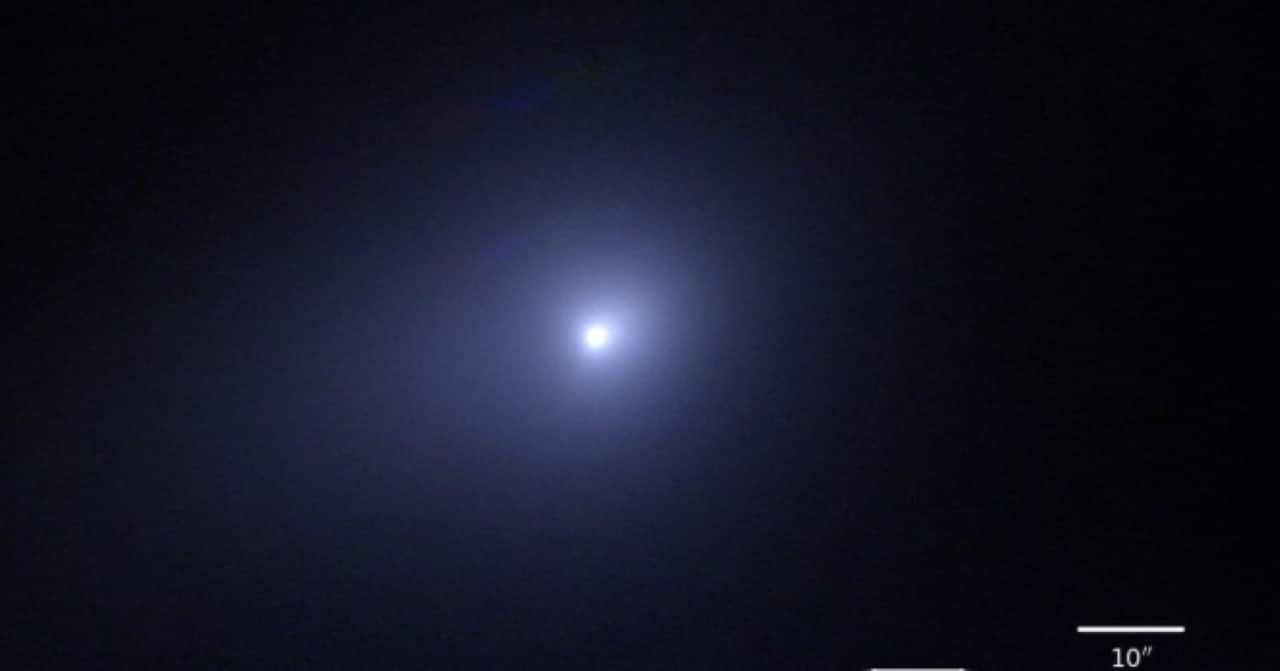
The interstellar body 3I/ATLAS has an amount of deuterium much higher than the standards observed in comets in our planetary system. The discovery generated immediate alert. Astrophysicist Avi Loeb, researcher at Universidade Harvard, analyzed the object’s characteristics in depth. Ele raised a theoretical question about the catastrophic consequences of an interception with atomic weapons. The idea of exploding a bomb inside the star revealed frightening scenarios.
The proportion of the heavy isotope reaches one atom for every hundred hydrogen in water and one for every thirty in methane. Esses indexes exceed the records of any other star known to science by dozens of times. The scientist related this peculiar chemical composition to classic studies on thermonuclear weapons developed in the last century. The direct assessment impacts future defense proposals against possible space collisions.

Anomalia chemistry reveals remote origins of celestial body
The most recent observations confirmed the exceptional abundance of material released during the star’s trajectory. The rate reaches almost one percent in water and exceeds three percent in organic methane. The data is from detailed surveys published throughout 2026. High-precision Telescópios, like James Webb and ALMA, provided the fundamental measurements for the research. The crossing of this information allowed for unprecedented mapping.
3I/ATLAS is the third visitor from outside Sistema Solar identified by astronomers. Suas physical and orbital properties already aroused great academic interest since its first detection. The traced route suggests the formation of Via Láctea in an extremely cold and ancient environment. The massive presence of heavy isotopes reinforces the thesis of a birth under conditions very different from those on Earth.
Experts estimate that the formation occurred between ten and twelve billion years ago. The place of origin probably had low metallicity and temperatures close to absolute zero. Essas characteristics have preserved the material’s original chemical signature during millennia of vacuum travel. The continued study of this structure offers a unique window into understanding the early universe.
Military Histórico bases calculations on chain reaction
The current debate revives old concerns of the pioneers of nuclear physics. Durante o Projeto Manhattan, scientist Edward Teller questioned whether an atomic detonation could ignite Terra’s atmosphere. Hans Bethe performed complex mathematical calculations to prove that the rapid loss of radiation would impede the process. Relatórios from the forties confirmed the impossibility of accidental global combustion.
Anos later, new theoretical studies evaluated the probability of fusion between deuterium nuclei. Essa mathematical basis allowed the creation of the modern hydrogen bomb. The mechanism works in two distinct and complementary steps. An initial fission explosion generates the extreme heat needed to fuse secondary material. War engineering used exactly the same principles now applied to the celestial body.
The same fear arose during the first underwater tests carried out by the armed forces. Havia feared that oxygen in the oceans could ignite after detonation. Practical experiments quickly ruled out the risk. Astrophysics absorbed this knowledge to explain the functioning of low-mass stars and the dynamics of burning light elements in the cosmos.
Destructive Potencial surpasses biggest tests ever carried out
The idea of using explosives against space threats gained momentum in the 1990s. Após the collision of a comet with Júpiter, proposals for interception with one gigaton warheads were presented to the government. The kinetic energy of an average asteroid served as a calculation parameter for engineers. Avi Loeb applied this same logic to the current interstellar visitor scenario.
The researcher considered the minimum mass of the object, calculated at one hundred and sixty million tons. The amount of combustible material available would generate an unprecedented event in the history of physics. Theoretical projections point to alarming results if a detonation occurs inside the icy rock. The visual and energetic impact would change the understanding of explosions in space.
- The energy released would reach ten teratons of TNT in the event of total melting of the material.
- The power is equivalent to two hundred thousand times the explosion of the Soviet Tsar Bomba.
- The process of complete disintegration of the structure would only last fractions of a second.
- The surface would need to reach millions of degrees to contain thermal dissipation.
- The heavy isotope would ignite in a self-sustaining and uncontrollable reaction.
The main issue involves the ability to start the reaction before the energy escapes into space. In very dense and opaque environments, thermal loss occurs only in the outer layers of the structure. Preliminary calculations indicate that the core would reach critical temperature quickly. The explosion would transform the target into a momentary artificial star with intense brightness.
Space Protection Estratégias Requires New Protocols
The analysis demonstrates that the use of nuclear brute force requires extreme caution from space agencies. A preemptive strike against a target rich in flammable isotopes could drastically worsen the situation. The chain reaction would generate an energy source far superior to the original detonation sent from Terra. The resulting fragments could cause even greater damage to our planet in the event of a meteor shower.
The astrophysicist recommends urgent investment in alternative route diversion technologies. Kinetic impact Métodos or gravitational tractors appear as safer and more predictable options. The main objective is to avoid any thermal trigger in materials of unknown chemical composition. Terra’s security depends on precise scientific approaches controlled by state-of-the-art computers.
The cosmic visitor has already begun its exit route from our planetary system. The quick pass provided crucial data for the international astronomical community to analyze. The chemical anomalies identified will continue to be under rigorous analysis in the coming months. Nenhuma space agency currently has real plans to bomb the star. The theoretical warning serves as a fundamental guide for planning future cosmic security missions.