

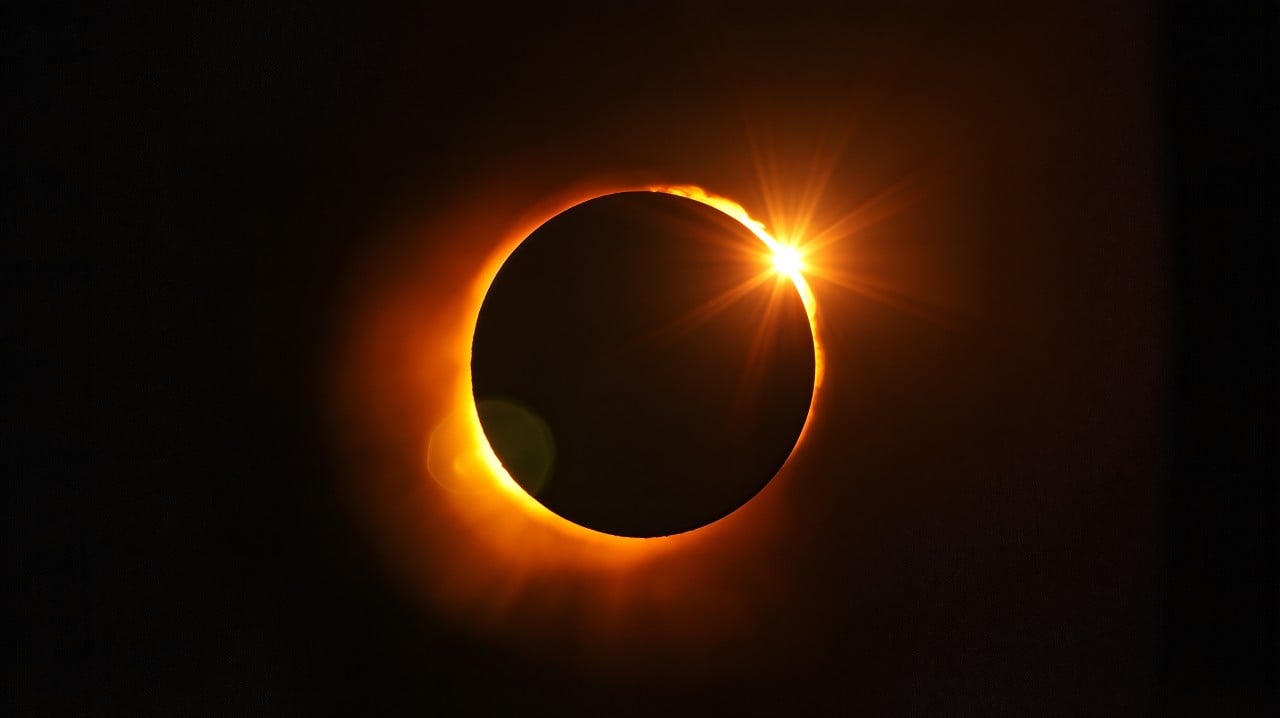
Cosmic phenomena have always aroused great interest and curiosity in humanity, motivating researchers and enthusiasts to observe the sky in search of understanding about the universe. The month of August 2026 promises two remarkable astronomical events, but it is essential to know which of them can be accompanied by Brazil to enjoy the correct spectacle.
Details of the August 12 total solar eclipse visible in Europe
The solar eclipse scheduled for August 12, 2026 represents an event of considerable relevance to astronomy, although its totality will be observed primarily in regions of the Northern Hemisphere. A study released by NASA presents the visibility map of the phenomenon, detailing the trajectory of the lunar shadow globally and the areas where the eclipse’s partiality will be noticeable.
The period of greatest darkness will reach approximately two minutes and eighteen seconds, with the peak located approximately 45 kilometers off the northwest coast of Iceland. The band of totality continues across the North Atlantic and enters the European continent through the northern part of Spain, passing through metropolises such as A Coruña, Bilbao, Zaragoza and Valencia, as well as Palma in the Balearic Islands.

Confirmed: visibility of the August solar phenomenon does not reach Brazilian territory
It is crucial to clarify that the total solar eclipse of August 12, 2026 cannot be seen in Brazil, not even partially. The area covered by the phenomenon does not include the national territory.
However, interested Brazilians will have the opportunity to follow the event through live broadcasts carried out by space organizations such as NASA and ESA, as well as specialized astronomy channels on YouTube.
Crucial times for observing the maximum point of the phenomenon
Astronomy experts have organized the lunar passage schedule into precisely timed stages, facilitating the work of scientists and photographers in the field. The first contacts between the edge of the Moon and the solar disk should take place in the late afternoon, considering Brazilian time.
The brief duration of the summit requires that all optical observation equipment be perfectly calibrated and positioned in advance. As the event will take place with the Sun in a low position in the sky, it is essential to find elevated locations without major obstacles, such as buildings. Planning timing logistics carefully ensures that no details of the transition of this memorable 2026 solar eclipse are missed in your location.
The starting point of totality is predicted for 16:58 UTC, the peak moment will occur at 17:46 UTC, and the global end of the total eclipse will be at 18:34 UTC.
The celestial spectacle awaited by Brazilians: partial lunar eclipse at the end of August
The main astronomical event for the Brazilian public in August 2026 will occur two weeks after the solar eclipse: a partial lunar eclipse, scheduled for the early hours of August 28, will be visible throughout Brazil and should cover approximately 93% of the lunar disk, leaving only a small portion illuminated.
According to information from the National Observatory, on the night between August 27th and 28th, a partial eclipse of the Moon will be widely visible throughout the national territory, with 93% of the lunar disk penetrating the umbra – a condition that is very close to a total eclipse.
The partial phase of the lunar eclipse will begin on the night of August 27th and will last into the early hours of the 28th, with the maximum point of occultation predicted for the early hours of the 28th, local time in each region.
The uniqueness of the August lunar phenomenon for Brazilian observers
The August 28th eclipse is touted as the most easily accessible astronomical event for observers in Brazil in 2026. The next occurrence of a total lunar eclipse visible in the country is only projected for June 26th, 2029, which means that, after this 93% partial eclipse, there will be a gap of almost three years without a lunar spectacle of comparable magnitude.
Fundamental guidelines for observing the celestial event safely
Direct viewing of any alignment involving our star requires extreme precautions to prevent serious and permanent damage to the human retina. Looking directly into sunlight without using adequate barriers can cause severe internal burns to sensitive eye cells. Ordinary sunglasses, old x-rays or photographic film do not offer effective protection against infrared radiation that falls into the Earth’s atmosphere.
- Avoid using cameras or cell phones pointed directly at glare without appropriate solar filters.
- It is mandatory to use astronomical glasses equipped with filters certified by the international ISO standard.
- Use welder’s glasses with tint number 14 to protect against harmful ultraviolet rays.
- Perform indirect projection of the image onto white surfaces, using binoculars or simple perforated cardboard.
The safest method recommended by ophthalmology professionals involves the use of welder filters with specification number fourteen or higher. Another very creative and affordable alternative is the construction of indirect projection boxes, using cardboard and a small hole. These basic safety measures ensure that the whole family can enjoy the show without compromising their long-term visual health.