Astronomers identify brightest quasar ever recorded at 12 billion light years

Astrônomos discovered the most luminous celestial object ever cataloged in the known universe. Quasar J0529-4351 is located more than 120 billion light years from Terra. The light that reaches us was emitted when the universe was just 20 billion years old. The brightness of this object is equivalent to 500 billion times the luminosity of Sol.
Identification required precise observations from Universidade Nacional Australiana researchers. The work was supported by Observatório Astronômico Europeu and Sul. The discovery reveals extreme characteristics of a supermassive black hole surrounded by matter heated to very high temperatures.
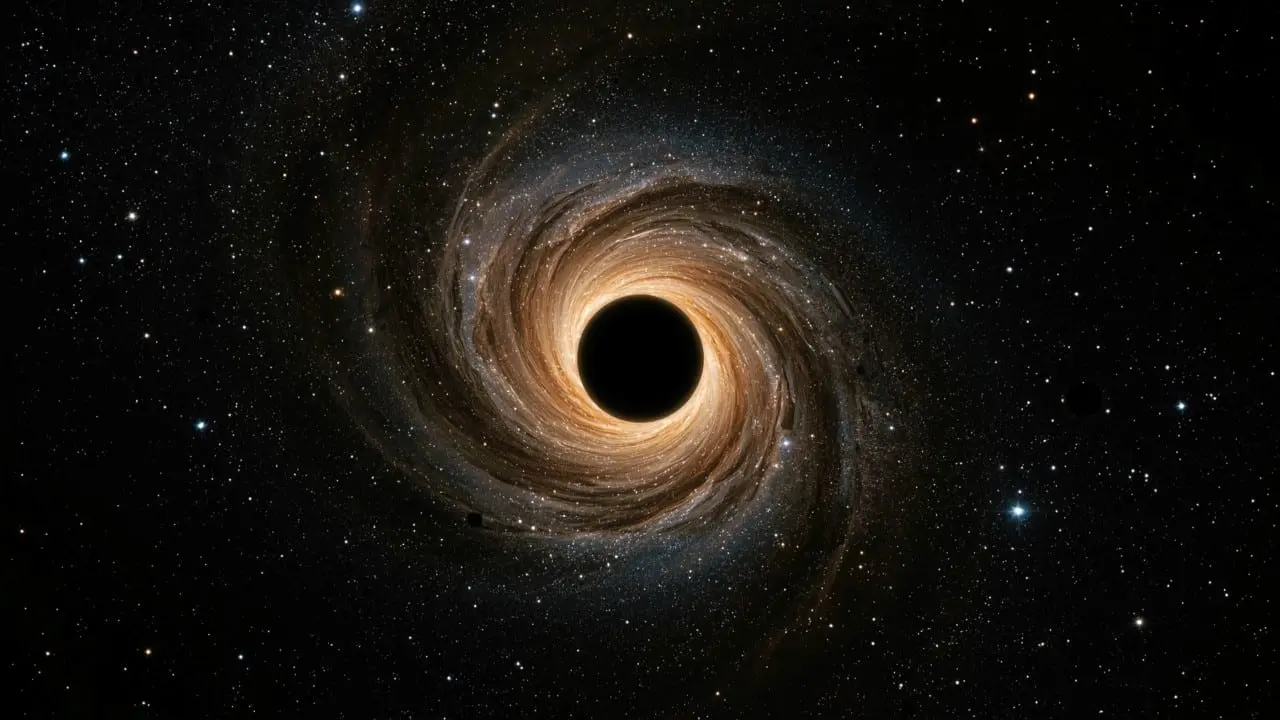
Quasar J0529-4351 surpasses all known objects in brightness
The quasar stands out among approximately 100,000 similar objects already catalogued. Sua’s energy comes from a supermassive black hole with an estimated mass of 170 billion times that of Sol. The disk of matter surrounding this black hole has a diameter of about 7 light years.
Gás and dust fall toward the central black hole. Friction raises the temperature to tens of millions of degrees. Esse material turns into plasma and emits visible radiation, X-rays and other forms of electromagnetic radiation. The process explains the object’s extraordinary brightness.
- The mass of the central black hole is estimated at 170 billion solar masses.
- The quasar consumes material equivalent to one solar mass per day.
- The object is located in the constellation Pictoris, in the southern hemisphere.
- Sua light was initially captured in 1980, but was not correctly identified at the time.
The object remained unknown for decades. Early Imagens images of Observatório Espacial Hubble showed the bright spot, but its extreme intensity led astronomers to consider it an ordinary star. Dados from the Gaia satellite reinforced this interpretation until 2022, when new analyzes confirmed its true nature.
Australian Telescópio revolutionizes understanding of the quasar
Cientistas used Observatório Siding Spring’s 2.3 meter telescope on Austrália. Measurements confirmed that it was a distant quasar. The redshift of 3.962 allowed us to accurately calculate the distance to the object.
Mesmo With these observations, details about the true magnitude of the glow remained unclear. Accurate Confirmações required more powerful equipment. The X spectrometer attached to a giant telescope at Atacama, at Chile, provided definitive data on the quasar’s properties.
Essas measurements made it possible to accurately determine the black hole’s mass and its falling speed. The daily rate of increase in solar mass represents the fastest rate ever recorded for a black hole in this category.
Leia Também

Messi reaches 19 goals in FIFA World Cups with great free kick for Argentina in clash with Jordan

Cristiano Ronaldo shines beyond the pitch at the 2026 World Cup with business empire and family luxury

At 41, Cristiano Ronaldo reaffirms his historic legacy and prepares to shine in the 2026 World Cup
Accretion Disco reveals energy emission mechanism
The disk of matter around the black hole is not uniform. Falling Material suffers intense heating due to internal friction. At extreme temperatures, radiation is generated and escapes in all directions.
Astrônomos estimate that the accretion disk is 7 light years in diameter. Essa structure is much larger than most known systems. The quasar does not have obvious gravitational lenses that could artificially amplify its brightness.
Dados morphological features of Gaia indicate that the object appears point-shaped. The absence of foreground lenses confirms the intrinsic nature of the glow. Nenhuma important frontal structure explains the quasar’s exceptional luminosity.
Buraco black man in rapid growth since the young universe
The falling speed approaches the limit of Eddington. Modelos fitted to the spectrum indicate annual consumption of 280 to 490 solar masses, depending on the viewing angle.
Esse rhythm emerged when the universe was young. The quasar allows researchers to study how supermassive black holes formed and evolved in the first 10 billion cosmic years. The discovery opens up possibilities for understanding the formation of extreme structures in the early universe.
- Emissão X-ray reaches power close to 10^48.37 erg/s.
- The quasar is classified as a quiet radio wave object.
- Future Observações may improve the exclusion of gravitational lensing effects.
- The research was published in the magazine Nature Astronomy.
Localização celestial and discovery context
The quasar is located in the direction of the constellation Pictoris. Imagens from old surveys of the southern sky contained records of the object more than 40 years ago. The extreme brightness caused confusion with a nearby 16th magnitude star.
Recent spectroscopic analysis has eliminated this ambiguity. Pesquisadores emphasize the importance of systematically reviewing old data with modern tools. Essa discovery reinforces how new instruments can reclassify previously misinterpreted objects in the astronomical archive.