Cosmic mirage shows star exploding five times and helps measure speed of universe
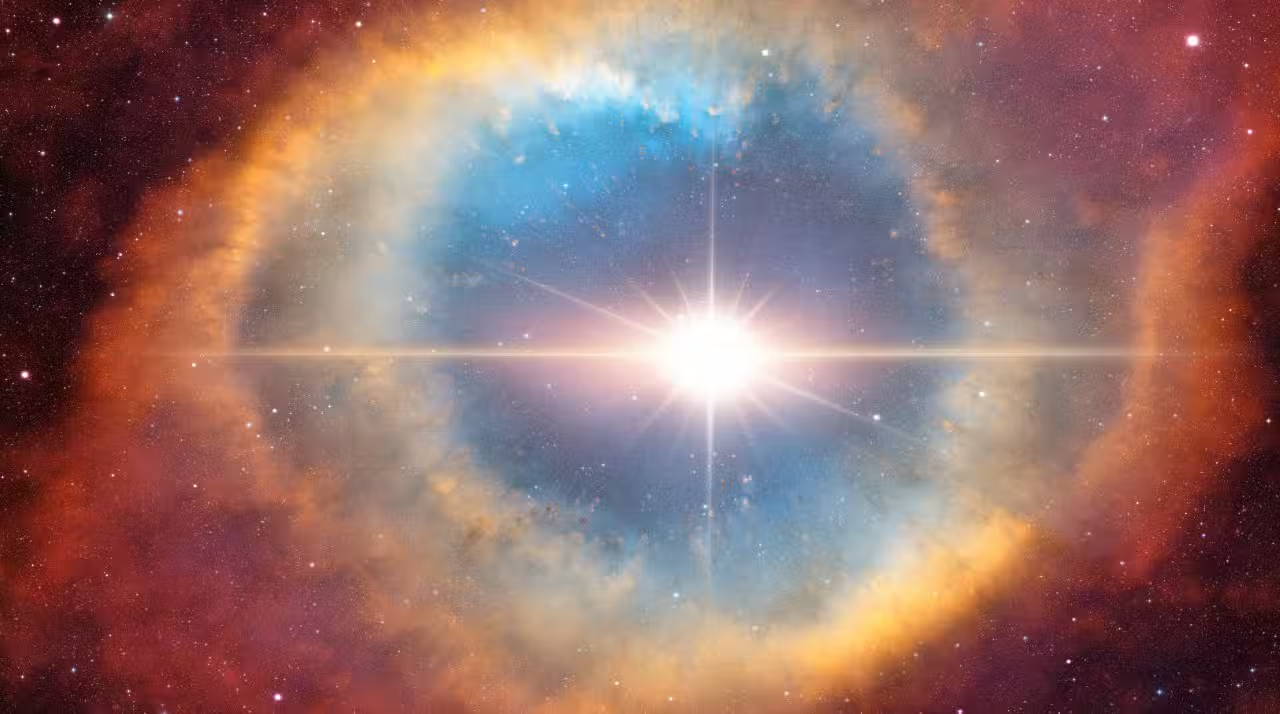
A distant stellar explosion has just provided a new tool for scientists to understand the true growth rate of the cosmos. The supernova named SN Winny appeared multiplied in the night sky, revealing five distinct images of the same astronomical event thanks to an extreme visual effect. The rare phenomenon functions as a natural laboratory of gigantic proportions. Pesquisadores now use this optical anomaly to try to resolve one of the biggest impasses in contemporary theoretical physics. The discovery promises to rewrite the cosmology manuals.
Localizada an impressive 10 billion light-years from Terra, the dying star had its light intensely distorted before reaching the mirrors of ground-based telescopes. Equipes of Universidade Técnica of Munique (TUM) and Universidade Ludwig Maximilian (LMU) lead the complex analysis of the collected data. The central objective is to measure the exact delay time between the appearance of each of the five light reflections. Essa chronological difference holds the key to determining the constant of Hubble with unprecedented accuracy. The joint effort involves dozens of experts focused on deciphering the enigma.
Gravitational Lente creates optical illusion on a colossal scale
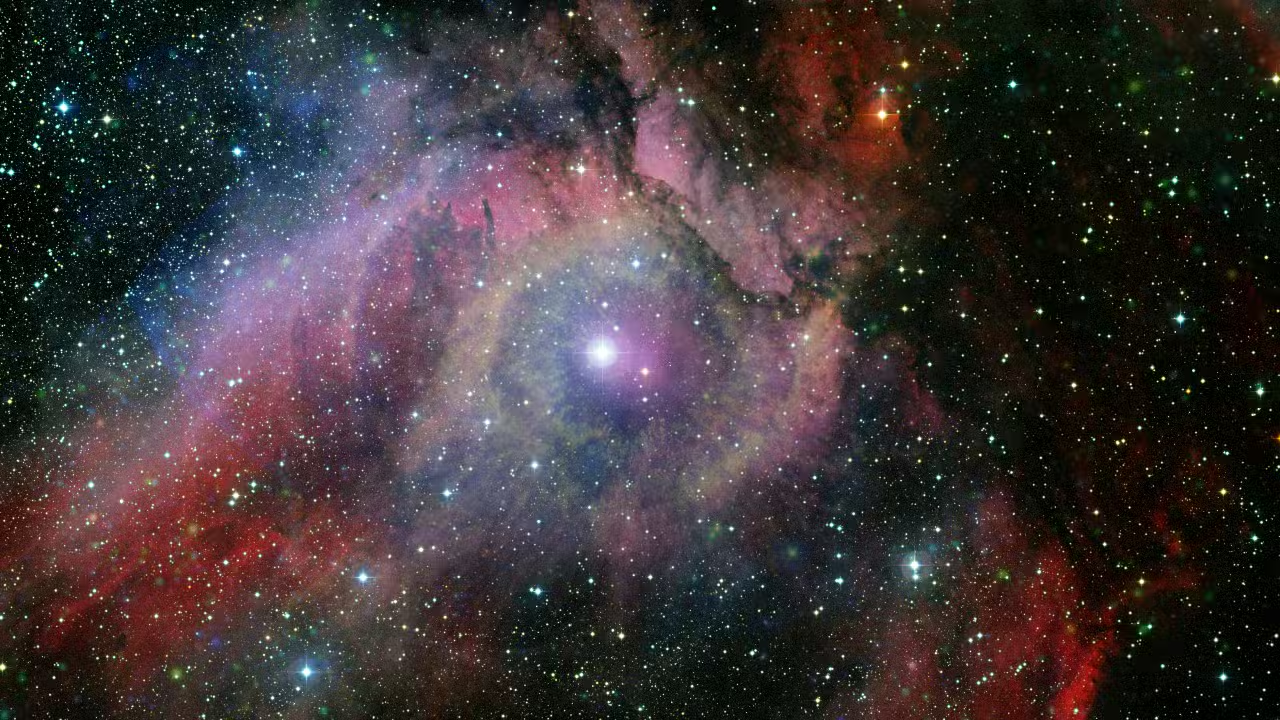
The multiple emergence of the SN Winny does not represent an error in observation instruments, but rather a direct consequence of the laws of general relativity formulated by Albert Einstein at the beginning of the last century. Entre to Terra and the exploding star, there is a massive galaxy that acts as a true colossal cosmic magnifying glass. The gravitational force of this intermediate body is so intense that it can bend the fabric of space-time around it. Consequentemente, the photons emitted by the supernova travel along different paths, bypassing the galactic obstacle through several circuitous routes. Light obeys the curvature of space.
Como each path has a unique length and faces different levels of gravitational density, the light reaches our planet at different times. Astronomers observed the first appearance of the flash and, shortly afterwards, recorded the aftershocks appearing at slightly different points in the same spatial region. The geometric alignment necessary for this effect to occur requires extraordinary perfection between the observer, the lens and the light source. Trata is a fortuitous event that transforms the intermediate galaxy into a natural telescope much more powerful than any equipment built by humanity to date.
Atraso upon the arrival of light allows us to calculate the rhythm of the cosmos
The importance of SN Winny goes far beyond its visual beauty or the mere curiosity of the multiplier phenomenon. Scientists currently face a profound dilemma known as the Hubble tension, where different measurement methods point to strongly divergent results for the expansion speed of the universe. Algumas techniques analyze the cosmic microwave background left by Big Bang, while others look at pulsating stars in neighboring galaxies. Os números simplesmente não batem. The new discovery offers an alternative and completely independent path to solving this mathematical discrepancy that haunts researchers.
Para understand how measurement works in practice, experts divide the analysis process into fundamental steps:



- The gravity of the frontal galaxy deflects light rays at varied and unpredictable angles.
- The longer route results in a delay in arrival that can last from days to several months.
- The exact time difference reveals the distance traveled by radiation in the vacuum of space.
- The final calculation delivers the stretching rate of space between distant celestial bodies.
The research team focuses intensely on refining the light curve of each of the five images captured by the instruments. Continuous monitoring requires extreme patience, as the light from the supernova gradually weakens over the weeks following the explosion. Eliminar statistical noise and ensuring that brightness variations correspond to exactly the same event is the biggest technical challenge of the entire operation. Supercomputers at German universities process terabytes of information daily to guarantee the absolute integrity of the applied physical model.
Phenomenon Raridade defies current astronomical statistics
Encontrar a supernova multiplied by a gravitational lens is already considered a remarkable feat, but the SN Winny belongs to an even more special and valuable category. Ela was classified as a supernova of Tipo Ia, a thermonuclear event that occurs when a white dwarf star absorbs matter from a companion until it reaches a critical threshold and explodes violently. Essas detonations have a standardized intrinsic brightness, functioning as accurate standard candles for measuring distances in the vast universe. The rare combination of a standard candle and the multiple lens effect creates the perfect setting for modern cosmology.
The probability of observing something similar borders on impossible according to the rigorous estimates of experts in the field. Pesquisadores calculate that only one in every hundred thousand supernovae suffers this type of gravitational distortion capable of generating five simultaneous and clear images. Geralmente, astronomers can detect two or, at most, four replications when the spatial alignment is favorable. The fifth bright spot provides an extra layer of crucial data that helps eliminate uncertainties in modeling the dark matter distribution of the lensing galaxy.
Observatórios prepares new catalog for the coming months
Full analysis of SN Winny is expected to span much of the year 2026, requiring rigorous peer reviews before definitive results are published. Researchers need to ensure that no hidden variables, such as interstellar dust clouds, are influencing the arrival time of the light. If the measurement confirms initial expectations, theoretical physics could discard old models and adopt a new understanding of the behavior of dark energy. Dark energy acts as the mysterious force responsible for accelerating the separation of galaxies from each other on a large scale.
The overwhelming success of this isolated observation drives the scientific community to actively seek new, similar deep-sky targets. The Observatório Vera C. Rubin, equipped with state-of-the-art scanning technology, has the ability to map the firmament with a speed unprecedented in the history of astronomy. The general expectation is that the new astronomical complex will be able to identify dozens of mirror supernovae over the next few years of operation. Criar an extensive catalog of these cosmic events will allow us to definitively map the evolution of the universe from its beginnings to the contemporary era.
See Also em Latest News (EN)

Sony releases system update for PlayStation 5 with improvements and two free games
30/04/2026
PlayStation 5 players receive free access to two full titles in the digital store
30/04/2026
Sony releases redemption of two free digital games for PlayStation 5 users after update
30/04/2026
Sony makes two complete titles available for free for PlayStation 5 console users
30/04/2026
Square Enix prepares multiplatform launch for the conclusion of the Final Fantasy VII trilogy
30/04/2026
Free update brings Red Dead Redemption 2 to native 4K at 60 frames per second
30/04/2026
Total solar eclipse of 2027 will last a record six minutes and will turn day into night
30/04/2026
Konami releases package with historic athletes in eFootball to transform the competitive scene
30/04/2026
Memory shortage delays Valve’s computer, but new control has confirmed launch
30/04/2026
EFootball launches ‘Epic National Strikers’ event with 139 special players
30/04/2026
Intimate image of former deputy Átila Lira leaks onto the internet after error in publication on Instagram
30/04/2026