Artificial intelligence identifies pancreatic cancer up to three years before diagnosis
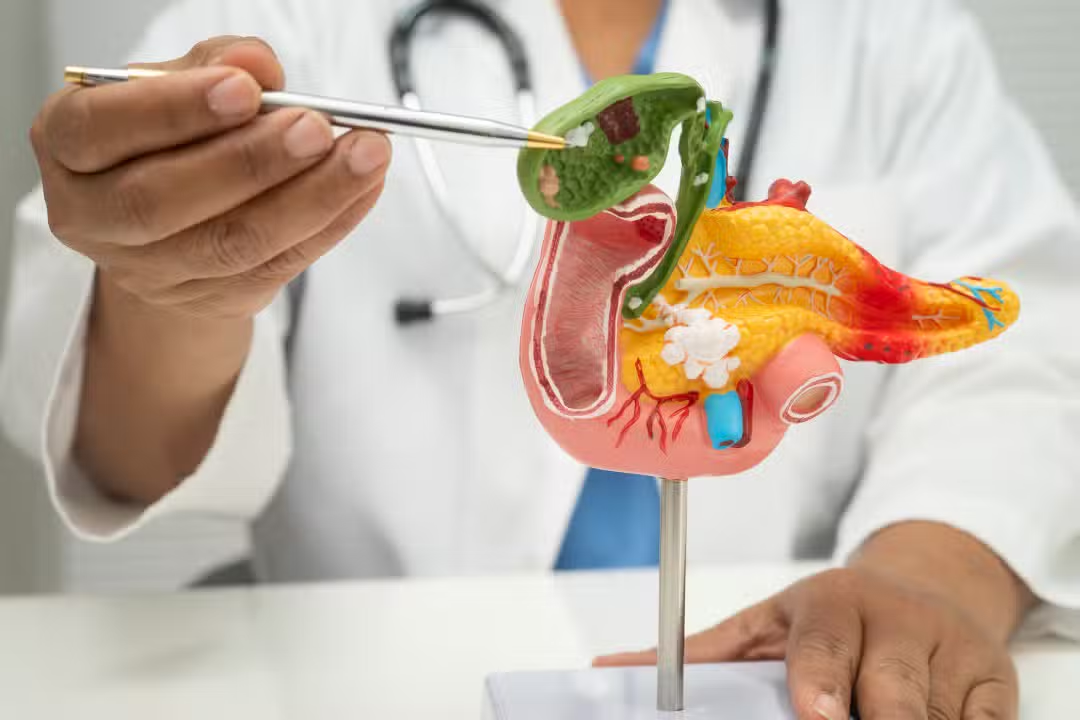
An artificial intelligence model developed by researchers at Clínica Mayo and Centro of Câncer MD Anderson detected signs of pancreatic cancer in CT scans with surprising accuracy. The system, called REDMOD (radiomics-based early detection model), was able to identify the disease approximately 16 months before conventional diagnosis in around 73% of the cases tested. In some exams, AI recognized suspicious patterns more than two years in advance, with the potential for detection up to three years before clinical confirmation.
Pancreatic cancer is on track to become the second leading cause of cancer death in Estados Unidos by 2030. Atualmente, 85% of diagnoses occur when the disease has already spread to other organs, making curative treatment significantly difficult. REDMOD appears as a promising tool to reverse this scenario by identifying minimal changes in routine exams.
Como the system detects signals invisible to the human eye
REDMOD does not look for obvious tumors. Instead, it looks for radiomic patterns – subtle changes in the texture and structure of pancreatic tissue that escape human visual detection. The model was trained with 969 CT scans to learn to recognize the early signs of the disease at stages where it is still curable.
Normal Células develop mutations in their DNA that affect their growth. Pancreatic cancer often takes years for these changes to develop into a tumor that is visible on imaging studies or causes symptoms. REDMOD can capture this invisible progression long before a tumor manifests itself clinically.
Resultados outperforms human expert analysis
The researchers tested REDMOD on 63 CT scans of patients who later developed pancreatic cancer, as well as 430 control scans of healthy individuals. The system correctly identified 46 of the 63 suspected cases, achieving a hit rate of 73%.
Dois human radiologists who analyzed the same scans simultaneously detected early signs in only 38.9% of cases. The difference represents a significant advantage: the AI model almost doubled the early detection capacity compared to experts.
The tests were repeated on two different data sets with different equipment in different hospitals. In all scenarios, REDMOD maintained consistent performance. Para patients with multiple scans available, AI produced broadly aligned results, even when scans were performed months apart.




Desafios and next steps for implementation
The study identified an important point: of the 430 healthy individuals, 81 were incorrectly marked as suspects by REDMOD. If implemented in a real scenario, these people would receive additional tests before confirming a negative result. Refinamento of this specificity represents priority to avoid unnecessary procedures.
- Prospective Validação in high-risk groups
- Testes in larger and more diverse populations
- Integração in existing clinical processes
- Model Specificity Aprimoramento
- Acessibilidade in different hospital contexts
Radiologista Ajit Goenka of Clínica Mayo says the biggest obstacle to saving lives in pancreatic cancer has always been the inability to detect the disease when it is still curable. “This AI can now identify the signature of cancer in a normal-appearing pancreas, and can do so reliably over time and in a variety of clinical settings.”
Caminho for changing the diagnostic paradigm
The real potential of REDMOD lies in its application to routine CT scans performed for other reasons. Médicos often request pancreas tests to investigate unrelated symptoms. If REDMOD routinely monitors these images, it could detect cancer at the preclinical stage, when curative treatments are still effective.
The researchers plan to expand the tests to larger, more diverse groups. Também will investigate the ease of incorporating AI into existing medical workflows. The goal is to transform current diagnosis – based on advanced symptoms – into proactive interception of early disease.
The study authors highlight that the framework’s demonstrated ability to consistently detect hidden signals in large, clinically oriented datasets, combined with its high stability over time and validated specificity, lays a solid foundation for AI-augmented early detection. The researchers express optimism that, with continued development and refinement, they will be able to offer an incredibly useful system against one of the deadliest types of cancer in existence.
See Also em Latest News (EN)

IOS 26.5 Beta 4 is now available with performance and RCS improvements
02/05/2026
Kathy Hilton denies responsibility for guest’s fall at Bel Air mansion
02/05/2026
Apple ends Intel support in macOS 27 and kills Rosetta 2 in September
02/05/2026
Tesla Model X leads used car market in the US with sales in 25.6 days
02/05/2026
Berkshire Meeting Reveals Changing Era with Greg Abel Featured in Omaha
02/05/2026
Berkshire Hathaway reduces attendance at annual shopping event, with Greg Abel in the spotlight
02/05/2026
Gas over $8 makes Los Angeles drivers spend $100 per fill-up
02/05/2026
Nintendo announces nine releases for Switch 2 and Switch in May 2026(99)
02/05/2026
Crimson Desert receives update 1.05 with rematch mode and new challenges
02/05/2026
Samsung regains leadership in smartphones with Galaxy S26 in the first quarter of 2026
02/05/2026
Vellfire Sedan gets rear diffuser and returns to the track in preparation for Toyota event
02/05/2026