Dust silhouettes in superimposed galaxies impress in Hubble photo
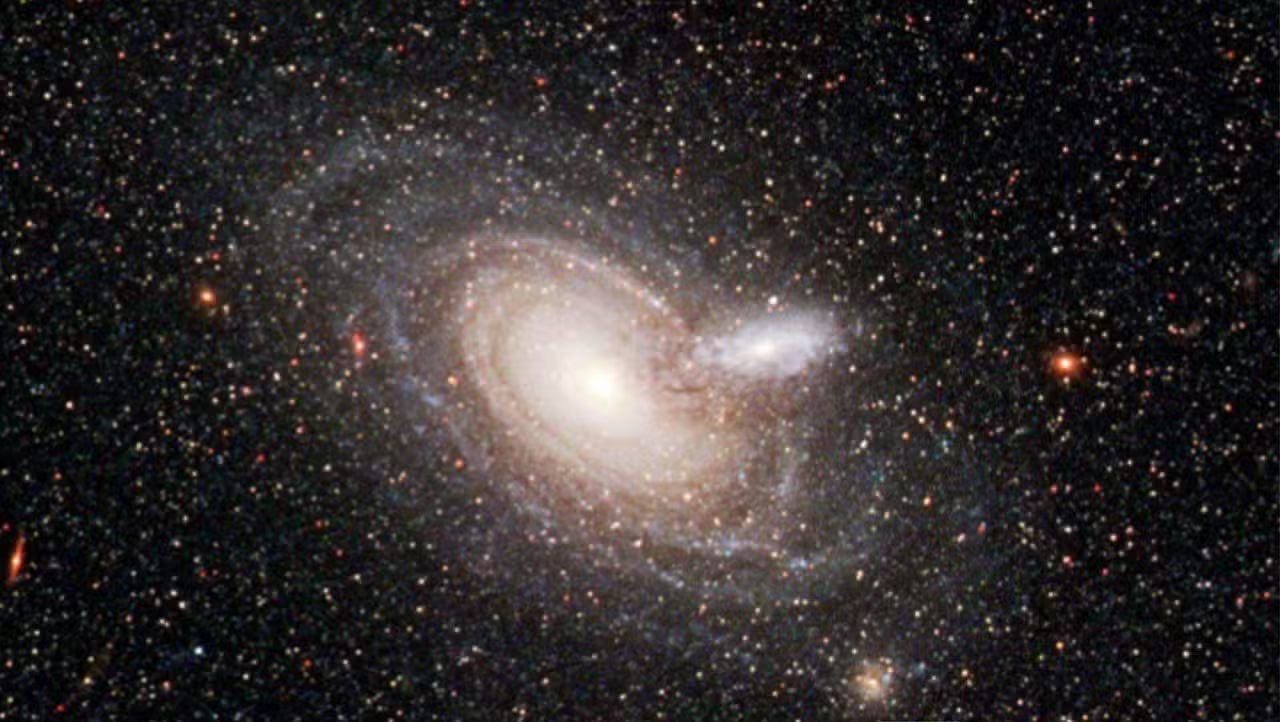
Duas Overlapping spiral galaxies in the constellation of Sculptor have been captured by Telescópio Espacial Hubble in a rare configuration that reveals dust structures never observed so clearly before. The image released by NASA, ESA and Equipe of Patrimônio Hubble shows a fascinating phenomenon: the dust silhouette of the foreground galaxy drawn against the intense light of the background galaxy. Dark, striated Estruturas stretch across the cosmic periphery, creating a pattern that astronomers describe as dry branches hanging in the vacuum of space.
Telescópio Espacial Hubble captured this configuration on September 16, 2008. The instrument’s Advanced Survey Camera (ACS) was able to resolve what appeared as a single mass of light when observed by telescopes based on Terra. Essa’s discovery reclassified the catalog object known as 2MASX J00482185-2507365 from a supposed single entity to a rare alignment of two distinct galactic systems, one in front of the other.
Grande galaxy rivals Via Láctea in size and distance
The larger galaxy, which visually dominates the image, has dimensions approximately Via Láctea. Ela is located about 780 million light-years from Terra, a distance that places the observed event when the universe was just a few billion years old. Apesar From the apparent proximity in the image, the two galaxies do not gravitationally interact with each other. The overlap is purely perspective, a result of the perfect alignment between Terra and these two distant star systems.
Hubble’s advanced research camera revealed a critical feature: the dust structures extend approximately 1.5 times the outer edge of the disk where starlight is visible. Esta discovery marks the first time astronomers have directly observed dust extending so far into the outer region of a galaxy. The phenomenon raises fundamental questions about the prevalence of such vast dusty structures in other galaxies and their formation mechanisms.
A majestosa galáxia Sombrero, capturada pelo Telescópio Espacial Hubble. Esta galáxia tem 50.000 anos-luz de diâmetro e é imediatamente reconhecível por seu núcleo branco brilhante circundado por espessas faixas de poeira. pic.twitter.com/jDLXXCRtmg
— Ariel Góes (@cara_zeus) May 2, 2026
Revelation Mecanismo: Backlighting as an Observation Tool
Cosmic dust does not emit visible light. Normalmente, these particles camouflage themselves in the darkness of space, making direct observation by conventional telescopes impossible. Sem a light source behind them, the dust remains invisible to the eyes of astronomers and the instruments’ electronic sensors. However, the overlapping configuration of this Hubble observation created an extraordinary natural experimental condition.
The galaxy in the background acts as a giant backlight, illuminating the dust of the foreground galaxy like a silhouette. Cada intergalactic dust particle blocks starlight that has traveled through space for hundreds of millions of years. Essa absorption creates the visible pattern that astronomers can map and study. The technique of backlit observation, although well known in microscopy and terrestrial photography, rarely occurs so clearly and on such monumental scales in the distant universe.


Dust Estruturas and Implications for Galactic Understanding
The dust arms observed in the foreground galaxy exhibit distinct patterns. Eles are not randomly distributed around the system. Instead, they form organized structures that resemble dry branches extending from the outer edge of the galactic disk. Essa organization suggests that gravitational and dynamic forces of the stellar system channel and shape dust along specific trajectories.
The unusual extent of the dust raises significant scientific questions:
- Dust extends far beyond the limits where starlight is detected
- Estruturas so vast could be the result of previous galactic collision or merger events
- The distribution follows patterns that indicate complex gravitational dynamics
- The prevalence of these structures in other galaxies remains unknown
- The mechanism that keeps dust so far from the galactic nucleus requires further investigation
Importância from observation to modern astronomy
Esta image exemplifies how Telescópio Espacial Hubble continues to reveal cosmic structures that defy astronomers’ expectations. The advanced research camera, installed during the 2002 servicing mission, enabled unprecedented resolution of small structures on very distant objects. Sem technology, the binary nature of the galactic overlap would remain a mystery.
The observation also demonstrates how accidental configurations in the universe can provide natural observation tools. Astrônomos have used similar opportunities to study the composition of distant galaxies, detect dark matter and map intergalactic dust fields. Cada alignment offers a unique opportunity to test theoretical models and expand knowledge about the structure and evolution of galaxies.
Contribuições Continuous International Space Agencies
The image was released jointly by multiple scientific institutions. NASA and Agência Espacial Europeia (ESA) have coordinated Hubble operations for decades. The Equipe of Patrimônio Hubble (STScI/AURA) maintains an archive of processed and analyzed images, making the data available to researchers around the world. Essas international partnerships ensure that discoveries like this reach the global scientific community and the public interested in astronomy.
The space images regularly published by these agencies include not only observations from Hubble, but also data from other orbital and ground-based telescopes. Entusiastas and space and astronomy experts frequently contribute complementary observations and analyzes that enrich the collective understanding of the universe. Transparent dissemination of scientific data accelerates progress in astronomical research and inspires future generations of astronomers and aerospace engineers.
The discovery of extended dust structures in distant galaxies opens new lines of investigation into how galactic systems evolve over billions of years and how they interact with the cosmic environment around them.
See Also em Latest News (EN)

Director reveals that he played third Final Fantasy VII Remake more than 40 times
04/05/2026
Volkswagen launches Jetta X electric crossover to recover market in China
04/05/2026
Virgo horoscope suggests cleaning out the closet and focusing on feelings from May 4th to 10th
04/05/2026
Astrological forecast: Taurus gains tranquility at work and shine at the weekend
04/05/2026
João Fonseca knows Rome’s bracket and could face number 5 in the third round
04/05/2026
Lafcadio Hearn turned concubine into queen, shows NHK series
04/05/2026
Met Gala 2026 brings together Beyoncé, Nicole Kidman and Venus Williams on the red carpet
04/05/2026
OPPO Find X9 Ultra arrives with 200 megapixel cameras and 10x zoom
04/05/2026
Hubble records proplidium 181-825 in the Orion Nebula
04/05/2026
Al-Ittihad x Al-Kholood: where to watch live in the Saudi Pro League
04/05/2026
Casemiro evaluates Neymar on the national team bench and transfers the final decision to Carlo Ancelotti
04/05/2026