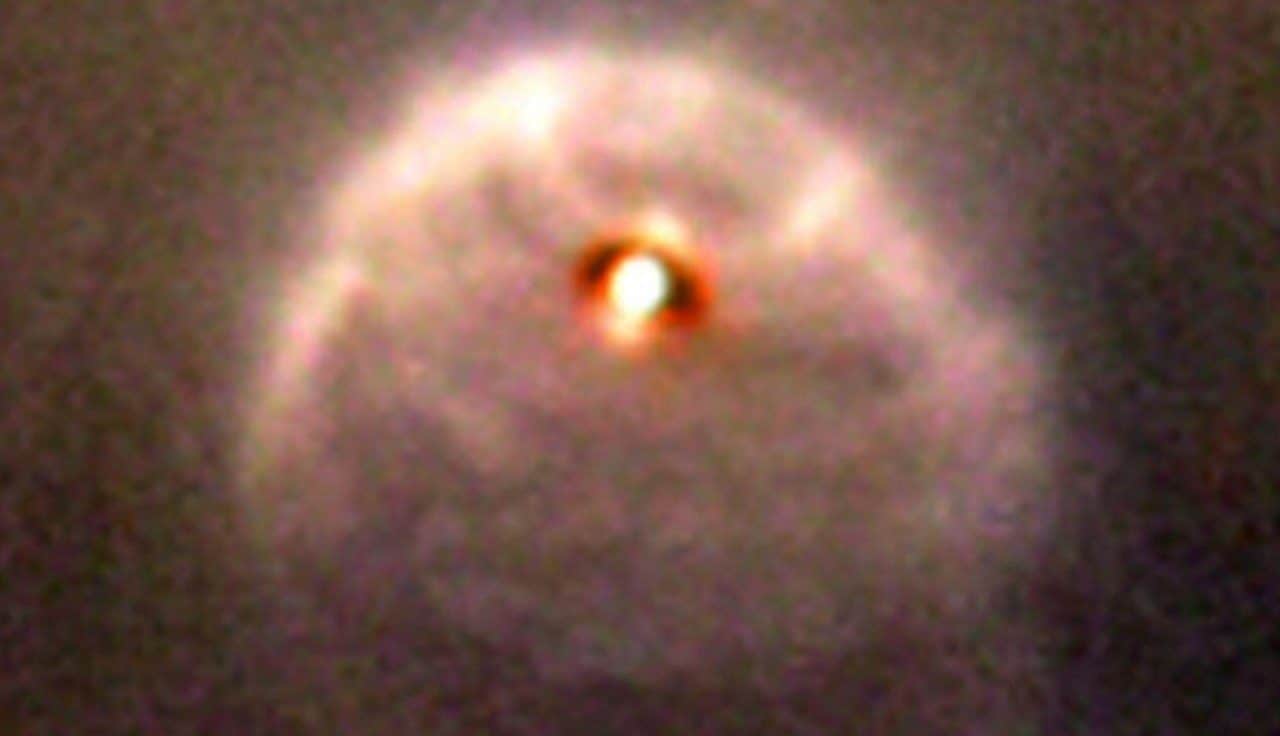
Telescópio Espacial Hubble captured fascinating images of a rare cosmic structure known as proplidium 181-825, located in Nebulosa of Órion. The discovery offers crucial clues about how planets are born around newly formed stars. The region studied is approximately 1,500 light-years from Terra and remains a natural laboratory for understanding the first stages of the formation of planetary systems.
Astrônomos has been following the behavior of structures like this for decades. Programa of Tesouro of Telescópio Espacial Hubble identified 42 distinct protoplanetary disks within this nebula, making the region one of the most important for contemporary astronomical research. The image released by ESA/Hubble on December 14, 2009 by Câmera Avançada for Pesquisas reveals unprecedented details of the celestial object.
What is a proplidium and how does it work
A proplydium constitutes a disk composed of gas and dust that orbits a young, newly formed star. Essa structure functions as a “cradle of a planetary system”, an environment where gases and solid particles gradually agglomerate to form larger celestial bodies. The process takes millions of years, but direct observations allow scientists to follow different stages of this cosmic transformation.
Proplydium 181-825 has distinct characteristics that make it especially relevant to researchers:
- Localização close to Theta 1 Orionis C, the brightest and most massive star of Nebulosa of Órion
- Presença of a young star at the center surrounded by a gaseous and particulate disk
- Intense Brilho caused by ultraviolet radiation emitted by the primary star
- Direct Influência of stellar winds from the neighboring massive star
- Catalog-based Designação that reflects your position on the astronomical map
Scientists classify proplids into two main categories. Aqueles close to Theta 1 Orionis C glow brightly due to heating caused by strong ultraviolet radiation. Já distant ones appear as dark silhouettes when observed against the background of more luminous nebulae. Proplydium 181-825 belongs to the first category, exhibiting characteristic luminosity that facilitates its observation and analysis.
The influence of Theta 1 Orionis C
The massive star Theta 1 Orionis C exerts a decisive influence on the structure and appearance of proplidium 181-825. Esse astro emits an extremely powerful stellar wind that continually collides with the nebula’s surrounding gas. The collision creates shock waves that visually shape the protoplanetary disk, giving it its characteristic appearance seen in Hubble images.
Esse phenomenon illustrates how dynamic stellar environments affect the development of future planetary structures. The wind not only heats the gas, but can also compress or disperse parts of the disk, influencing which regions have enough density to form planet-size bodies. Pesquisadores use observations of systems like proplidium 181-825 to better understand these fundamental astrophysical processes.
Conexão with the origin of our solar system
Cientistas believe that our own solar system originated from a similar protoplanetary disk approximately 4.6 billion years ago. Estudar structures like proplydium 181-825 offer valuable insights into how Mercúrio, Vênus, Terra, Marte and the other orbital bodies formed around the primordial Sol. Direct observation of proplids at different evolutionary stages works like a cosmic time machine for astronomers.
Features observed in 181-825 suggest processes that likely occurred in the early solar nebula. Estimativas indicate that our solar system took tens of millions of years to consolidate into its current form. Comparações between ancient and modern protoplanetary disks reveals consistent patterns in the formation of worlds, validating theoretical models developed by generations of astronomers.
Importância from Hubble for astronomical research
Telescópio Espacial Hubble remains a fundamental instrument for observations of distant celestial objects. The Câmera Avançada to Pesquisas can capture details that ground-based telescopes cannot achieve due to interference from the atmosphere. The images released by ESA and NASA have revolutionized the understanding of star and planetary formation over the last three decades.
Programa of Tesouro represents an innovative approach where observers collaborate to systematically map important astronomical regions. Nebulosa of Órion was a priority in this initiative precisely because of its wealth of training objects. Pesquisadores at institutions around the world access this public data to conduct independent and collaborative analyzes into the mysteries of the early universe.
Nomenclatura and scientific cataloging
The name “181-825” does not refer exclusively to the young star at the center, but encompasses the entire system: the primary star, the surrounding disk, and the gas that surrounds it. The designation was derived from astronomical cataloging based on the object’s position within structured maps of the nebula. Esse standardized system allows scientists to accurately reference cosmic structures in international publications.
Astrônomos continues to observe proplids to track changes over time. Successive Imagens of the same object reveal movements, gas dispersion and disk evolution. Esses progressive logs function as visual documentation of processes that typically occur on time scales longer than a human lifetime.
Implicações for future space studies
Observações continuations of protoplanetary structures fuel hypotheses about exoplanets and solar systems discovered in the vicinity of other stars. Compreender better understands how planets are born and evolve in varied environments, expanding knowledge about the possibilities of life in a vast universe. Proplydium 181-825 remains an invaluable astronomical laboratory for researchers committed to unraveling cosmic history.