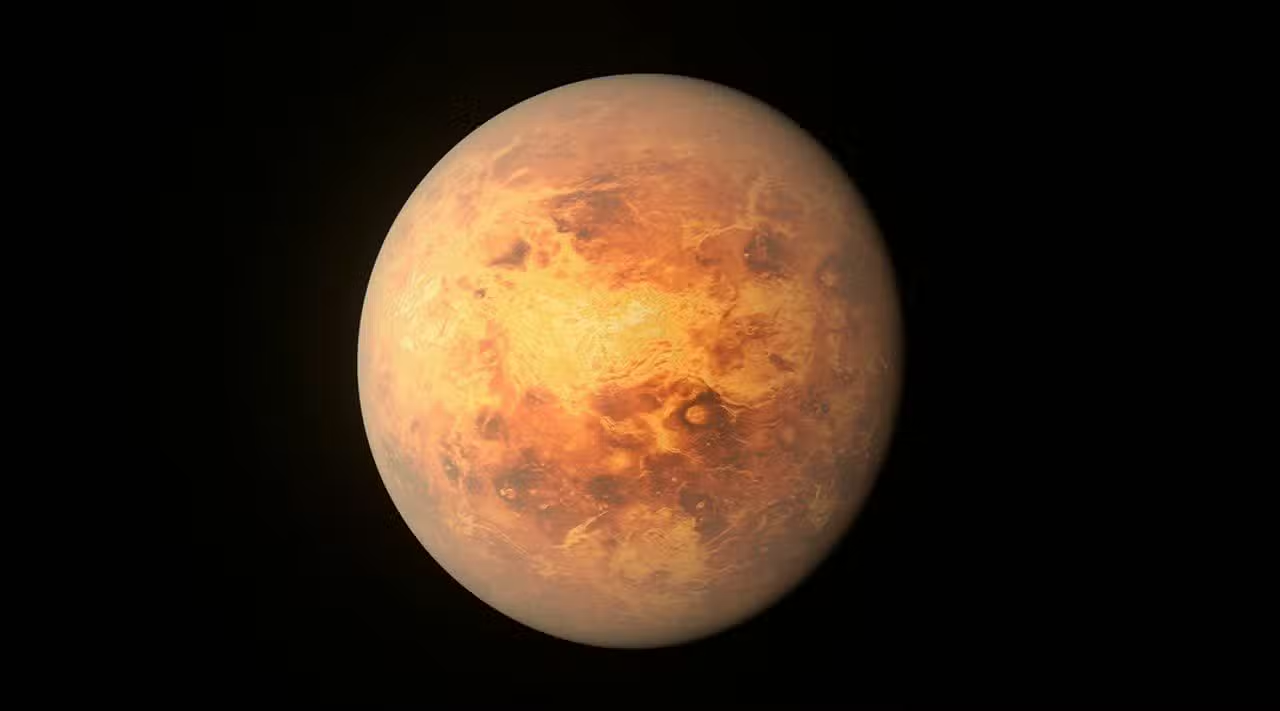
A new study from 2024 reinforces the hypothesis that a massive, as yet unobserved planet orbits far beyond Netuno. Astrônomos have identified the strongest statistical evidence yet by analyzing patterns in the orbits of distant objects. The celestial body remains invisible to current telescopes, but gravitational signals indicate its presence.
The work, published in the journal The Astrophysical Journal Letters, marks an important step in the search for this ninth planet. Simulações computational tests show that models without the planet cannot reproduce the observed orbital behavior. Quando a massive body is inserted into the equations in addition to Netuno, the results coincide with the real data collected by astronomers.
Órbitas grouped together point to an invisible force

Objetos with long orbits that cross the region of Netuno are not randomly distributed in space. Suas trajectories present a grouping that suggests the influence of a massive celestial body guiding its movements by gravitational attraction. Essa observation builds on previous research conducted by Caltech scientists.
In 2016, the same research institution identified a common alignment between six distant objects. The researchers proposed that a hidden giant planet could be causing this pattern through intense gravitational forces. The current analysis expands on this work and offers new data that strengthens the theory.
The objects analyzed have perihelion distances between 15 and 30 astronomical units. Essa zone is located in a region where gravitational interactions with a massive body would be significant and detectable through precise mathematical calculations.
Simulações confirm the need for a ninth planet
The research team carried out simulations that included several factors: galactic tides, the influence of nearby stars and long-term orbital dynamics. The computational models tested two different scenarios: one without the ninth planet and another with a massive body in addition to Netuno.
Sem the hypothetical planet, simulations failed to reproduce the observed orbital clustering. The calculations produced very different patterns than what astronomers see in the real data. Quando the massive body was added to the equations, the results changed radically.
With the planet included in the models, the simulations aligned much more closely to the documented orbital behaviors. The orbital dynamics induced by the massive object explain a wide variety of exotic orbits. Algumas are characterized by high perihelia, while others have extreme inclinations that defy astronomers’ expectations.
- Fatores tested in simulations: galactic tides, stellar influence, long-term dynamics
- Resultado without ninth planet: fails to reproduce observed orbital clusters
- Resultado with the planet: close match to real data collected
- Predicted orbital Distância: 15 to 30 astronomical units beyond Netuno
- Tipo of influence: gravitational attraction of a massive body
Detectar the planet continues to be the great challenge
The current study does not determine the exact location of the ninth planet. Essa limitation remains as a crucial obstacle in final confirmation of its existence. Scientists involved in the research recognize that more direct observations are needed to fully validate the hypothesis.
Durante For a long time, the discovery of planets depended on direct visual observation through telescopes. Marte, Júpiter and others were first identified using this method. The discovery of Netuno changed this approach, as it was predicted based on irregularities in Urano’s orbit before it was even observed telescopically.
Atualmente, astronomers often detect exoplanets using indirect methods. Quedas’s stellar luminosity and parent star’s motions provide clues about distant planets. Tornou is easier to find planets around distant stars than within the solar system itself. Internal signals are more subtle and much more difficult to interpret with conventional technology.
Observatório Vera Rubin promises to solve the mystery
Astronomers’ attention now turns to the Observatório Vera Rubin, a state-of-the-art telescope in the operational phase. The study authors express optimism about the capabilities of this instrument. Segundo conclusion of the research, the dynamics described in the work, along with all other evidence for the existence of the ninth planet, will be rigorously tested when the observatory begins operations.
The Observatório Vera Rubin represents a significant technological leap in the ability to track distant and faint celestial objects. Sua increased sensitivity will allow it to detect much weaker signals than any previous telescope. The next phase of exploration of the outer solar system promises to provide crucial insights into the mysteries of the outermost regions of planetary orbit.
The instrument will be able to map interstellar space with unprecedented precision. Essa capability opens up real possibility of locating the ninth planet or definitively ruling out its existence. Astronomers are excitedly awaiting the data that will soon arrive from this revolutionary observatory.