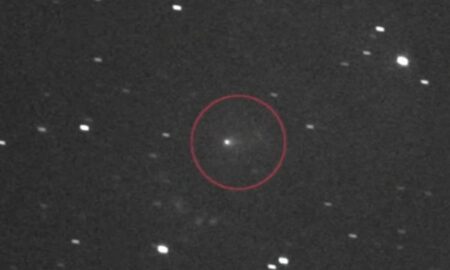
Harvard researcher points out bias in analyzes of the 3I/ATLAS object compared to spending on physics


Astrophysicist Avi Loeb started a rigorous debate behind the scenes of science. The Universidade professor of Harvard questions the criteria adopted by the academic community in evaluating astronomical data that deviate from the established standard. The center of the discussion involves the interstellar object 3I/ATLAS. The celestial body was discovered in July 2025 by continuous monitoring systems. The space rock presents orbital and physical characteristics that diverge from traditional models applied to comets and asteroids in our planetary system. The hyperbolic trajectory of the element confirms its external origin. Especialistas from different countries maintain disagreements about the exact nature of the visitor.
The controversy gained new developments after the publication of results of physical experiments in the magazine Nature in early December 2025. Estudos internationals ruled out the existence of subatomic particles called sterile neutrinos. The conclusion came after years of complex testing funded with tens of millions of dollars by government agencies. The researcher uses this financial and methodological scenario to support his main argument. Hipóteses on technological origins in space faces immediate rejection from peers. Teorias traditional physics receive vast public resources for continued investigation, even when they present weak initial evidence or inconclusive results over decades of research.
Is 3I/ATLAS Using a Beam to Clear Its Path Through Space?
Harvard astrophysicist Avi Loeb suggests that 3I/ATLAS might be using a beam to protect itself from potential damage.
In a recent podcast with Danny Jones, he explained that, by analyzing NASA HiRISE images, there… pic.twitter.com/MtGnw61u99
— Space and Technology (@spaceandtech_) December 9, 2025
Atypical Comportamento recorded by the Hubble telescope
The ATLAS alert system identified the third confirmed visitor from outside Sistema Solar. The body follows the historical passages of objects 1I/Oumuamua and 2I/Borisov. Imagens captured by Telescópio Espacial Hubble in late November revealed unexpected behaviors of the rock. The anomaly occurred shortly after passing through perihelion, the point of closest proximity to the central star. An anti-solar tail formed with an inverted orientation relative to the space structure’s motion vector. The visual phenomenon cannot be attributed to observational perspectives common in modern astronomy.
The structural anomaly persists even under extreme conditions of exposure to cosmic radiation. Solar energy and stellar wind should disperse the formation quickly in these high-temperature and high-pressure environments. Observações performed with advanced filters confirmed the presence of jets directed at Sol. The dynamics differ considerably from the pattern observed in local comets composed of ice and dust. Fragmentos with rapid evaporation or materials highly resistant to solar forces could explain the physical scenario. Artigos published by Harvard researcher details these mathematical possibilities.
The scientist cataloged several deviations found in recent photometric and astrometric analyses. The raw data points to the following central points in the investigation of the celestial body in transit:
- Aceleração expressive non-gravitational during the journey through deep space.
- Estrutura complex of jets unparalleled in bodies in our planetary system.
- Specific Trajetória targeting the internal Sistema Solar rather than a random distribution.
The technical list prioritizes information with the highest degree of statistical probability. The data was obtained by the main terrestrial and space observatories in operation. The astrophysicist defends a stance of analytical caution. The sample size of just three known interstellar objects invalidates any absolute certainty about the nature of these celestial bodies. Science needs more data before closing complex questions.
Contraste with investments in subatomic particle testing
The counterpoint established by the astronomer is based on two large studies recently conducted on Estados Unidos and Alemanha. The MicroBooNE experiment operated in the state-of-the-art Fermilab facility. The scientists used a high-precision liquid argon time projection chamber. The equipment analyzed particle beams continuously between 2015 and 2021. The main objective of the mission was to find signs of a fourth type of neutrino. The theoretical particle would interact with matter only through the force of gravity. The discovery would justify anomalies seen in previous tests, such as the LSND and MiniBooNE projects.
The final analysis excluded the presence of the sterile neutrino with a statistical confidence level of 95%. The results reaffirmed the validity of the particle physics Modelo Padrão. The dominant theory recognizes only the electron, muon and tau variations in nature. Discrepancies noted in the past have derived from experimental errors or inaccurate initial interpretations by the research teams involved. The project consumed around 20 million dollars from American public coffers. The tests serve to refine the technical limits in the search for dark matter in the observable universe.
Na Alemanha, the KATRIN experiment evaluated the beta decay of the tritium isotope over 259 days of continuous measurement. The laboratory’s sensors recorded 36 million electrons with energies close to the limit of 18.6 keV. The presence of a new particle would cause obvious distortions in the energy spectrum measured by high-sensitivity equipment. The processed data demonstrated the complete absence of this expected signal. The result overturned previous claims made by other independent scientific projects at Europa.
Academic Resistência against hypotheses of technological origin
Investigations into subatomic particles consumed approximately 90 million dollars in global funding from various funding agencies. Testing continued for years without interruption with broad institutional support. Avi Loeb points out a contradiction in the method. Science advances by testing hypotheses that expand the limits of knowledge established by traditional institutions. The scientific method is strengthened by excluding viable options through rigorous experimentation and high government investments in infrastructure.
The reception to the proposals on 3I/ATLAS followed a different path in academic corridors. The astrophysicist suggested that a physical radius greater than 10 kilometers could indicate intentional design. The extreme rarity of interstellar rocks with these proportions supports the line of reasoning presented. The hypothesis of a technological origin faced strong immediate opposition from other researchers in the field. Editor Chris Lintott classified the idea in pejorative terms just weeks after the celestial body was discovered by telescopes.
Editorial resistance forced the removal of excerpts in initial publications submitted by the author. The researcher had to send the complete material on technological interpretation to another internationally renowned scientific journal. The article went through a peer review process and received formal approval for publication. Repositórios academics recorded 11 documents authored by the scientist about the space visitor by the end of 2025. A public debate with Tim Dalrymple explored the role of anomalies in modern research. The president of Fundação Templeton discussed how the unusual pushes the frontiers of knowledge.
Divergências in the astronomical community and next steps
The astronomical community maintains the majority consensus that 3I/ATLAS represents a natural comet of distant origin. Críticos of the technological approach argue that the anomalies result from differences in the chemical composition of the rock material. Astronomer Jason Wright assesses the impact of the space environment. The Penn State researcher claims that cosmic radiation alters the structure of interstellar objects over millennia of travel through the vacuum. The unusual accelerations would derive from gas emissions underestimated by current measuring instruments.
Profissionais from the area pointed out flaws in the statistical analyzes that attributed a 40% chance to an artificial origin of the object. Passagens from space missions detected ion tails without exotic signatures during the month of October 2025. The object crossed space 29 million kilometers from Marte in the same astronomical observation period. Imagens of the American space agency’s HiRISE camera has suffered operational delays. A 42-day government shutdown of Estados Unidos affected the data processing schedule.
A study published in the arXiv repository analyzed the object’s astrodynamics based on recent telemetry data. The document hypothesized the presence of alien technology inspired by Floresta Escura’s Paradoxo’s Fermi solution. The text served as a pedagogical exercise for academics to debate probabilities. Monitoring of the celestial body will continue through large terrestrial observatories. Monitoring continues until the definitive departure of the Sistema Solar object in 2026. Novos data from the TRISTAN detector will expand the statistics of the KATRIN project in the same year. The flow of discoveries in particle physics and observational astronomy will maintain the analytical rigor of the institutions.