China identifies lunar cavity that reduces radiation by 20% for future manned missions
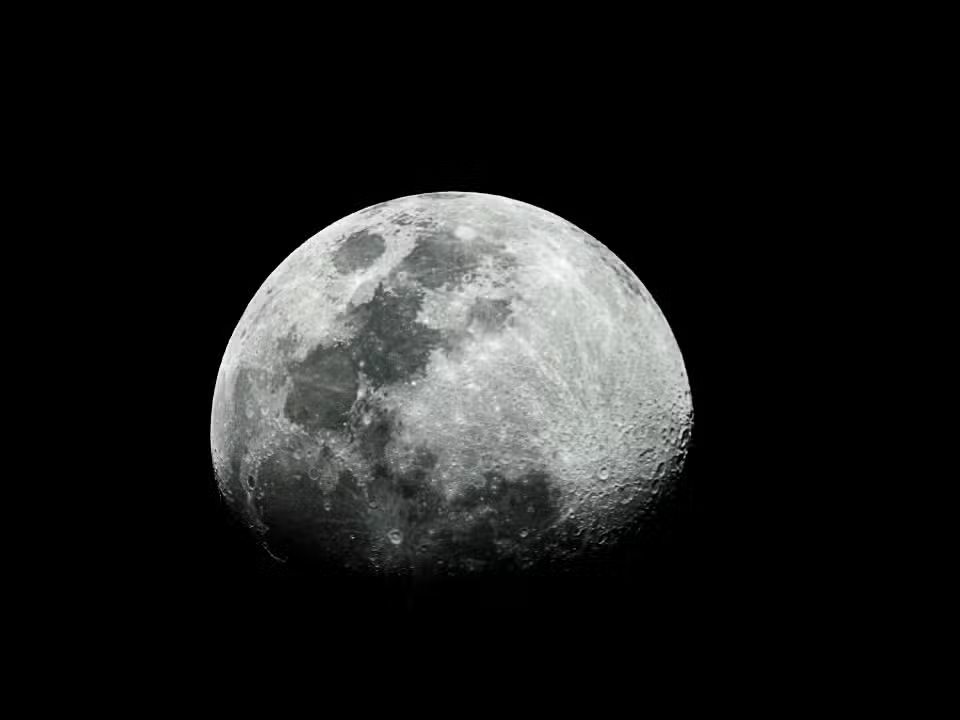
The Chinese space agency discovered a unique geological formation on the lunar surface that has significantly lower radiation levels than the rest of the satellite. Advanced Sensores coupled to an exploration probe identified the cavity while monitoring environmental conditions for future long-duration manned missions. The data collected indicates that radioactive exposure on the moon is not uniform, revealing safety windows that can be leveraged by space agencies for safer human operations.
Redução radiation and natural protection
The phenomenon occurs at specific times of the lunar day, when the inclination and structure of the cavity block part of the charged solar particles. The reduction in radioactive impact reaches 20% compared to open surface areas, representing a substantial change in health planning for astronauts. Geólogos spacefarers believe the lay of the land acts as a natural shield against galactic cosmic rays and the constant solar wind.

The site’s characteristics provide crucial information for the development of new security protocols and housing module engineering. Statistical analysis of the mission reveals the following key points about the discovery:
- Natural protection reduces the absorption of ionizing radiation by human tissues during planned extravehicular activities.
- Radiation levels undergo cyclical variations according to the position of the moon in relation to the sun, allowing the creation of safe work schedules.
- The density of the soil in the vicinity of the cavity suggests a mineralogical composition that helps in the dispersion of energy from subatomic particles.
- Novos measuring equipment will be sent on future missions to map larger extensions of this region of scientific interest.
Implicações for biological mission safety
Prolonged exposure to space radiation is one of the biggest obstacles to establishing human colonies outside of Earth due to the risk of severe cellular damage. With the discovery of this cavity, scientists can design less cumbersome and more efficient protection systems for spacesuits and transport vehicles. Esta low intensity zone allows the human body to withstand longer periods of exposure without reaching the critical biological safety limit established by aerospace medicine.
The Chinese probe’s analysis focuses on the behavior of neutrons and gamma rays that reach the moon without the protection of a dense atmosphere or magnetic field. By finding a point where this incidence is mitigated, China gains a strategic advantage in the race to dominate lunar habitation technologies. The researchers are now working on correlating this data with local topography to identify whether there are other similar cavities at different lunar latitudes.
Potencial for permanent infrastructure
The identification of locations with natural radiological protection directly influences the choice of points where the first fixed laboratories will be installed. Construir bases in or near these cavities reduces the need to transport tons of shielding materials from the ground, drastically decreasing the logistical cost of the missions. Harnessing lunar geology for passive defense against space weather is considered the logical next step toward sustainable colonization.


Engineers assess that the structure of these formations can support the partial burial of habitable modules, further increasing thermal and radioactive insulation. Como the moon has extreme thermal variations, the cavities also provide a more stable environment for the preservation of sensitive electronic components and oxygen supplies. The economic viability of a lunar base depends entirely on the human ability to utilize the resources and characteristics of the satellite itself.
Continued Monitoramento and technological advancements
The orbiting probes continue to send real-time data about how radiation behaves as the moon orbits the Earth and receives different intensities of sunlight. Durante at lunar noon, the sensors recorded emission peaks, but the cavity maintained greater stability than the open plains of the lunar seas. Esse detailed monitoring is essential for predicting solar storms that could be fatal to unprepared astronauts in the open field.
The technology used to detect this cavity represents a qualitative leap in remote sensing instruments applied to modern astronomy. The sensors are capable of differentiating between different types of radiation, allowing an accurate diagnosis of the quality of the environment for organic life. The success of this instrumentation validates Chinese investment in microelectronics resistant to extreme conditions and deep vacuum.
Perspectivas future and international collaboration
Embora the discovery is an achievement of the Chinese agency, the data generated has invaluable value for the entire international scientific community involved with space. Knowledge about radiation cavities could lead to new technical cooperation agreements for the standardization of space safety modules. Entender How radiation interacts with lunar soil is a common challenge for all nations seeking to send humans beyond Earth’s orbit.
The Chinese strategy involves using autonomous robots to carry out detailed mapping of cavities before human disembarkation. Esses robots enter hard-to-reach areas and install communication beacons and fixed sensors to create a local data network. When Quando astronauts arrive, they will find an already prepared and monitored environment, with clearly defined exclusion zones and safety routes. Esta approach minimizes uncertainties and increases the success rate of operations on lunar soil, serving as a model for future trips to Mars.
Veja Tambem em Latest News (EN)

Atlético-MG confirms agreement with defender Léo Duarte after period of prominence in Turkish football

Tiger shark bites 19-year-old girl and rips off her leg in Boa Viagem, Recife

2026 World Cup will have 32 athletes who play in Brazilian football

OnePlus develops portable video game with Android system focused on competitive shooters

New BYD Seal 6 DM-i Touring hybrid station wagon debuts in Europe with ample interior space and super-efficient engine

Costco reaches historic volume in gasoline sales in the United States with prices below market

June PlayStation Plus Catalog Brings Grounded and Warhammer 40,000 Darktide to Subscribers

Disney+ brings Avatar Fire and Ash finale to The Bear and new Pixar animation in June

Netflix updates June catalog with new season of Avatar and classic cinema sagas

Geely Xingyuan electric compact gains 47 kWh battery and autonomous driving system in China

Episode 1156 of One Piece marks arrival at Elbaf with decisive actions by Shanks and Blackbeard