Pesquisadores propose an alternative explanation for the massive object located at the center of Via Láctea. Instead of a supermassive black hole, Sagitário A* could be a dense cluster of fermionic dark matter. The hypothesis arises from theoretical modeling that accurately reproduces observations of star orbits and radio emissions collected over decades. Diferentemente of black holes, this model avoids singularities where the laws of current physics collapse.
Theoretical Modelo developed by Argentine researchers
The team led by researcher Valentina Crespi, from Universidade Nacional and La Plata, developed calculations that indicate the viability of this alternative structure. The model uses neutral dark matter particles with a mass of approximately 300 keV to form a compact nucleus. Essa configuration generates the gravitational field necessary to explain the accelerated motion of stars close to the galactic center, with precision similar to that of the conventional black hole.
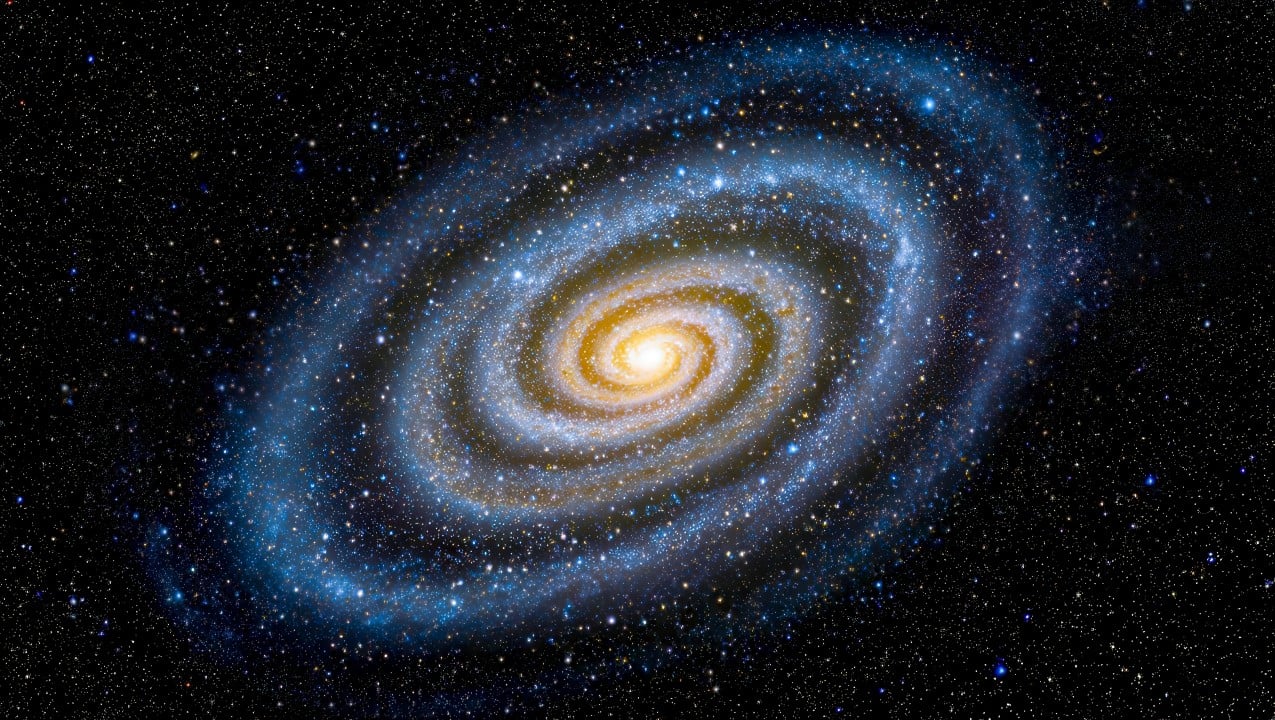
The discrepancy between the traditional model and this alternative is below 1% in orbit measurements. Essa small margin makes it difficult to differentiate the two hypotheses with current instruments. Future Observações with higher resolution could provide decisive data to validate or refute the idea.
Fenômenos observations that support both interpretations
- Estrela S2 reaches speeds of up to 7,000 kilometers per second in its closest orbit.
- Nuvem of gas known as G-objects follows trajectories consistent with the observed intense gravity.
- Imagem captured by Event Horizon Telescope in 2022 shows circular shadow compatible with both the black hole and the proposed cluster.
In 2022, Event Horizon Telescope produced the first direct image of the shadow cast by the object, revealing a structure consistent with predictions from general relativity. X-ray Instrumentos, like Chandra, records intense emissions coming from the area around Sagitário A*. Astrônomos have been following the movement of stars like S2 for years, which complete orbits in short periods and reach extreme speeds, requiring a mass concentration equivalent to around 4.3 million solar masses in a relatively small volume.
Cluster Estrutura and mass distribution
The dark matter cluster would form a dense core responsible for most of the concentrated mass. At the same time, a more diffuse halo of dark matter would extend across the outer regions of the galaxy. Essa dual distribution helps explain not only the behavior near the center, but also the rotation curves observed in more distant stars.
The proposed neutral fermionic dark matter exhibits properties that allow the formation of a stable object without collapsing into a singularity. Diferentemente of black holes, where general relativity predicts infinite density at a point, the cluster maintains finite distribution of mass. Essa feature resolves persistent theoretical questions about the behavior of gravity at extreme scales.
Compatibilidade with wider galactic phenomena
The dark matter cluster hypothesis also aligns with the problem of galactic rotation curves. Estrelas in the peripheral regions of Via Láctea rotate at speeds greater than predicted by visible matter alone. The outer halo of dark matter would provide the additional gravity needed to keep these orbits stable and explain the collective motion of the stars.
Pesquisadores highlight that dark matter is already invoked to explain the large-scale structure of the universe. Estender’s role to the galactic center would represent an interesting conceptual unification. The dense core would act as a gravitational anchor, while the peripheral halo would influence stellar dynamics on larger scales.
Perspectivas for future observational checks
Instrumentos in operation and under development will allow for more rigorous testing of the hypothesis. Análises radio polarization, high-precision spectroscopy and continuous monitoring of nearby stars will help refine the models. Qualquer discrepancy accumulated over time may indicate which description best fits physical reality. The traditional explanation of the supermassive black hole remains the simplest and most widely accepted by the scientific community, based on decades of observations consistent with the theory of general relativity. However, the dark matter alternative offers a way out of the mathematical difficulties associated with singularities, enriching the debate about the fundamental nature of compact objects in the universe.