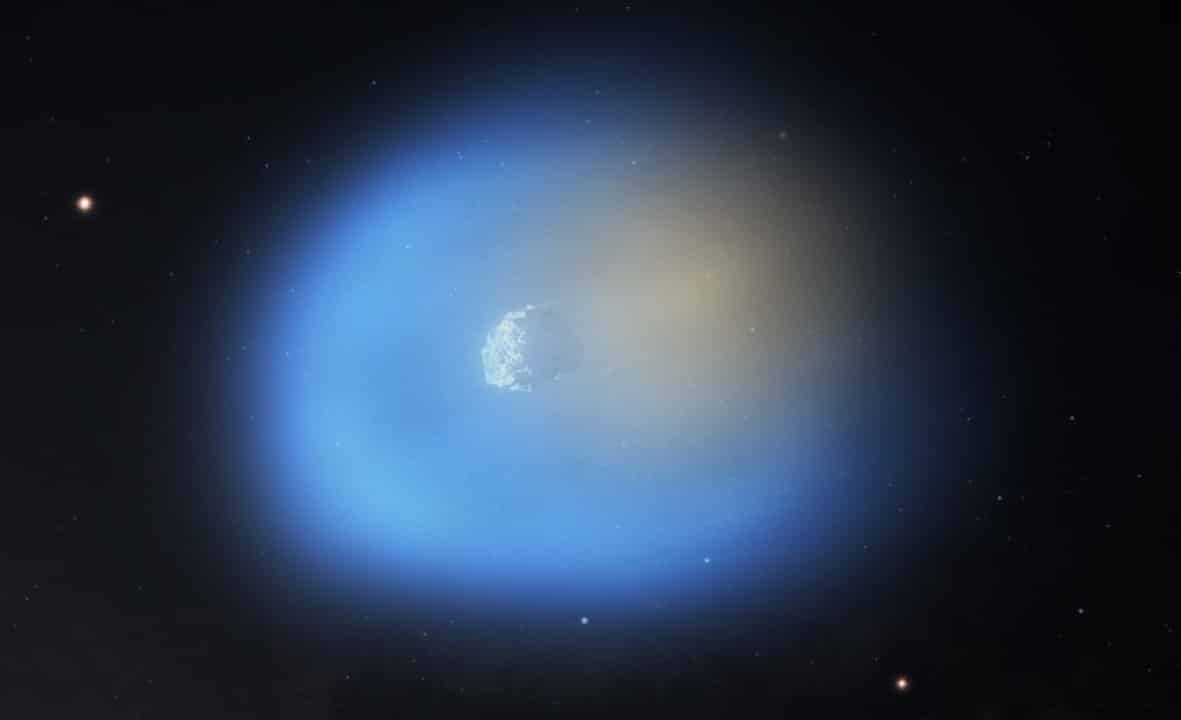
The Hubble and James Webb space telescopes detected for the first time the nucleus of the interstellar comet 3I/ATLAS, confirming dimensions of 2.6 kilometers in diameter. The object, the third confirmed visitor from outside Sistema Solar, turned out to be significantly more massive than its predecessors 2I/Borisov and 1I/’Oumuamua. Observations carried out between December 2025 and January 2026 also identified surprising methane emission from the comet’s coma, raising questions about its thermal history and origin in a distant star system.
Core Detecção by Hubble
Telescópio Espacial Hubble mapped 3I/ATLAS after it passed through perihelion on October 29, 2025. Post-perihelion images, taken between December 2025 and January 2026, allowed us to isolate the nucleus through careful subtraction of the coma model. Essa processing technique revealed clear variations in the light curve, indicating modulation caused by the object’s rotation. On January 22, 2026, a rare alignment between Sol, Terra and 3I/ATLAS generated a 20% increase in light scattered by dust grains 3 degrees wide across the sky.
Dimensional measurements established an effective diameter of 2.6 kilometers, with a margin of error of 0.4 kilometers, considering a typical albedo of 0.04. Essa scaling places 3I/ATLAS as approximately 40 times more massive than 2I/Borisov and at least 20 thousand times more massive than 1I/’Oumuamua. The irregular shape or non-uniform rotation of the nucleus explains the temporal variations observed in the Hubble images.

Composição chemistry revealed by James Webb
Telescópio Espacial James Webb used its MIRI instrument for 3I/ATLAS infrared spectroscopy in December 2025. The observations occurred when the comet was at heliocentric distances of 2.20 and 2.54 astronomical units. The spectra identified multiple volatile compounds in the object’s coma:
- Água (H2O): detected between 5.8 and 7.0 micrometers.
- Dióxido carbon (CO2): present at around 15 micrometers.
- Níquel (Ni): identified at 7.507 micrometers.
- Metano (CH4): recorded at 7.6 micrometers.
Total volatile production decreased over 12 days of observation, with a more pronounced reduction in water compared to other species. Water activity remained associated with ice grains in the extended coma, while methane production rates corresponded to 13.7% and 27% of the water rate in the two observed periods.
Detecção unpublished methane in interstellar object
The robust identification of methane represents the first direct detection of this compound in an interstellar object. Solid methane has a lower sublimation temperature than carbon dioxide, making its absence in pre-perihelion observations puzzling to astronomers. Observações prior to Webb in August 2025 did not record methane despite initial outgassing activity. Isso suggests depletion of the compound in the outer layers of the nucleus.
Solar heating near perihelion apparently exposed methane-rich inner layers. The early presence of carbon monoxide, more volatile than methane, adds complexity to the composition model. Essa volatile activation sequence differs significantly from patterns observed in Sistema Solar comets, possibly reflecting distant stellar system formation conditions and unique thermal history.
Assimetria in post-perihelion activity
The brightness trend of 3I/ATLAS showed a marked difference before and after its maximum approach to Sol. The object faded more rapidly after perihelion in October 2025. The post-perihelion surface brightness profile had a significantly shallower slope than pre-perihelion, corroborating seasonal variations in the sublimation of volatiles to the surface. Comparações with pre-perihelion data revealed earlier enrichment in carbon dioxide, with the post-perihelion CO2/H2O ratio halving from initial values.
Interstellar Population Estimativas
The 3I/ATLAS core measurements allow us to estimate the presence of similar objects in near space. Calculations indicate the lower limit of more than one object of this size to within 4.5 astronomical units of Sol at any given time. Essa density represents conservative value, as inactive objects would be more difficult to detect. The passage of 3I/ATLAS through the interior of Sistema Solar highlights the potential frequency of these interstellar visitors and contributes to understanding the distribution of matter in intergalactic space.