Invisible universe: dark matter and energy make up 95% of the cosmos
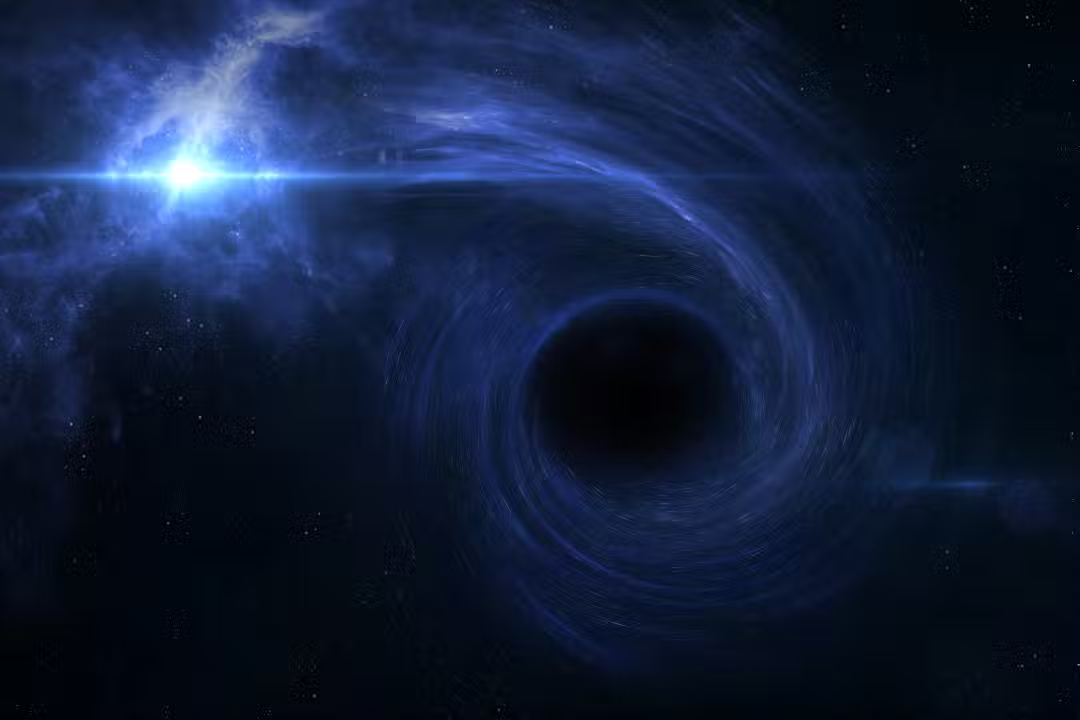
The universe we know is just the tip of the cosmic iceberg. Observações spaces confirm that everything we can see and touch represents only 4.9% of universal reality. The remaining 95.1% is divided between dark matter, responsible for 26.8% of the cosmos, and dark energy, which makes up approximately 68.3%. Esses invisible components have never been directly detected by human instruments, but their existence is proven through gravitational effects and the accelerated expansion of space.
Sem the presence of these unknown elements, galaxies would lose cohesion and the known laws of physics would not be able to explain the current structure of the universe. The biggest challenge for researchers is finding material evidence of something that does not emit, reflect or absorb light. Essa vast invisible portion remains the greatest enigma of contemporary science.
The pillars of the invisible composition of the cosmos
- Dark Matéria: Responsável for about 26.8% of the total, acting as a gravitational “glue” that holds the galaxies together and cohesive.
- Dark Energia: Representa approximately 68.3% of the cosmos and functions as a repulsive force that continually accelerates the expansion of the universe.
- Matéria baryonic: Apenas the remaining 4.9% that makes up everything we can see, touch and observe in everyday life.
Fritz Zwicky and the mystery of the missing mass
The historical origin of this enigma dates back to 1933, when Swiss astronomer Fritz Zwicky analyzed the movement of galaxies in Aglomerado Coma. Ele realized that the speed of celestial objects was incompatible with the amount of visible mass, suggesting that galaxies should separate if there was no hidden mass exerting gravitational attraction. Zwicky coined the term “dark matter” to describe this invisible influence that prevented the disintegration of cosmic structures.
The pioneering work was met with initial skepticism, but gained robust theoretical support decades later. The discrepancy between luminous mass and dynamical mass has become a central piece of evidence for revising the standard model of cosmology. Cientistas uses advanced computer simulations to map how this invisible mass is distributed into filaments that connect the great structures of the universe.
Vera Rubin and spiral galaxies
In the 1970s, astronomer Vera Rubin provided definitive observational evidence for the existence of dark matter by studying the rotation of spiral galaxies. Ela found that stars located at the outer edges of galaxies moved at the same speed as stars near the galactic center. Pelas laws of Kepler, the expected would be a decrease in orbital speed as the distance increased, which did not occur in practice.
Essa uniformity in rotational speed indicated that most of a galaxy’s mass was not concentrated in the luminous core, but distributed in an extensive, invisible halo. Rubin’s work transformed dark matter from a mathematical hypothesis into a physical necessity for understanding extragalactic astronomy. Desde So, the search to identify the particle that makes up this mass has become a global priority in high-energy laboratories.
Buscas frustrated by dark matter particles
The main focus of particle physics involves WIMPs, an acronym for weakly interacting massive particles. Diversos underground experiments have been built around the world, such as the LUX-ZEPLIN detector on the Estados Unidos and the XENONnT on the Itália, aiming to capture rare collisions between these particles and liquid xenon atoms. Apesar due to the unprecedented sensitivity of this equipment, no confirmed collisions have been recorded to date.
The lack of positive results calls into question the most traditional physics models and forces theorists to look for viable alternatives. Alguns researchers suggest that dark matter could be composed of much lighter particles, such as axions, or even primordial black holes formed soon after Big Bang. Frustration with the lack of direct detection drives a new era of scientific experimentation with quantum sensing technologies.
Aglomerado Bala: physical evidence of mass separation
One of the most striking demonstrations of the existence of dark matter occurred during the observation of the collision of two galaxy clusters, an event known as Aglomerado Bala. Através from gravitational lensing, astronomers mapped the distribution of total mass and compared it to the location of heated gas detected by X-ray telescopes. The result showed that the gravitational mass separated from the visible gas during the monumental impact.


Este phenomenon proves that most of the matter in the cluster does not interact electromagnetically, passing through the collision without slowing down as ordinary gas would. Tal observation is considered by experts to be the “smoking gun” that validates the presence of something other than atomic matter. The physical separation between what we see and what we gravitationally attract is a factual fact that supports the predominant cosmological model.
Dark Energia and the accelerated expansion of the universe
If dark matter acts as a binding agent, dark energy plays the opposite role by driving the accelerated drift between galaxies. Descoberta in 1998 through the study of distant supernovae, this invisible force appears to fill the entire vacuum of space, exerting a constant negative pressure. Diferente of matter, the density of dark energy does not decrease as the universe expands, which puzzles cosmologists.
The nature of this energy remains unknown, and is often associated with vacuum energy or a fifth force of nature that has not yet been described. Sua predominance of 68.3% in the total composition indicates that it will determine the final fate of the cosmos on billion-dollar timescales. If the acceleration continues at the observed rate, distant galaxies will eventually disappear from Terra’s visible horizon.
Radiação cosmic background confirms invisible proportions
The definitive confirmation of the proportions between matter and energy comes from the study of the cosmic background radiation, the luminous echo of Big Bang. Missões spacecraft like the Planck satellite have mapped the tiny temperature variations in this primordial signal with millimeter precision. Essas fluctuations act as a fingerprint of the young universe, allowing us to calculate the density of each component necessary to generate the currently observed pattern.
Measurements from the Planck satellite corroborate the model that the universe is flat and dominated by invisible components, ruling out several alternative theories. The agreement between different measurement methods, from primordial radiation to modern gravitational lenses, reinforces the scientific community’s confidence in the statistical data presented. Mesmo without touching or seeing 95% of the cosmos, science can measure its influence with rigorous mathematical accuracy.
Novas technologies to unveil the invisible universe
Advances in understanding the invisible universe now depend on a new generation of space observatories and ground-based detectors that will come into operation this decade. The Nancy Grace Roman space telescope will have as its main mission to investigate the nature of dark energy by mapping millions of galaxies. Enquanto this, the Observatório Vera C. Rubin in Chile will perform deep scans of the sky to identify distortions caused by dark matter.
The integration of data from these new instruments will make it possible to test whether Einstein’s theory of general relativity needs modifications on cosmological scales. The search for new particles continues in particle accelerators, where scientists try to recreate the energy conditions of the early universe to artificially produce dark matter. The solution to this almost century-old mystery may be close to being revealed by new frontiers in technology.
Veja Tambem em Latest News (EN)

Atlético-MG confirms agreement with defender Léo Duarte after period of prominence in Turkish football

Tiger shark bites 19-year-old girl and rips off her leg in Boa Viagem, Recife

2026 World Cup will have 32 athletes who play in Brazilian football

OnePlus develops portable video game with Android system focused on competitive shooters

New BYD Seal 6 DM-i Touring hybrid station wagon debuts in Europe with ample interior space and super-efficient engine

Costco reaches historic volume in gasoline sales in the United States with prices below market

June PlayStation Plus Catalog Brings Grounded and Warhammer 40,000 Darktide to Subscribers

Disney+ brings Avatar Fire and Ash finale to The Bear and new Pixar animation in June

Netflix updates June catalog with new season of Avatar and classic cinema sagas

Geely Xingyuan electric compact gains 47 kWh battery and autonomous driving system in China

Episode 1156 of One Piece marks arrival at Elbaf with decisive actions by Shanks and Blackbeard