Mysterious Distant Supernova Signal Reveals New Processes in the Death of Massive Stars
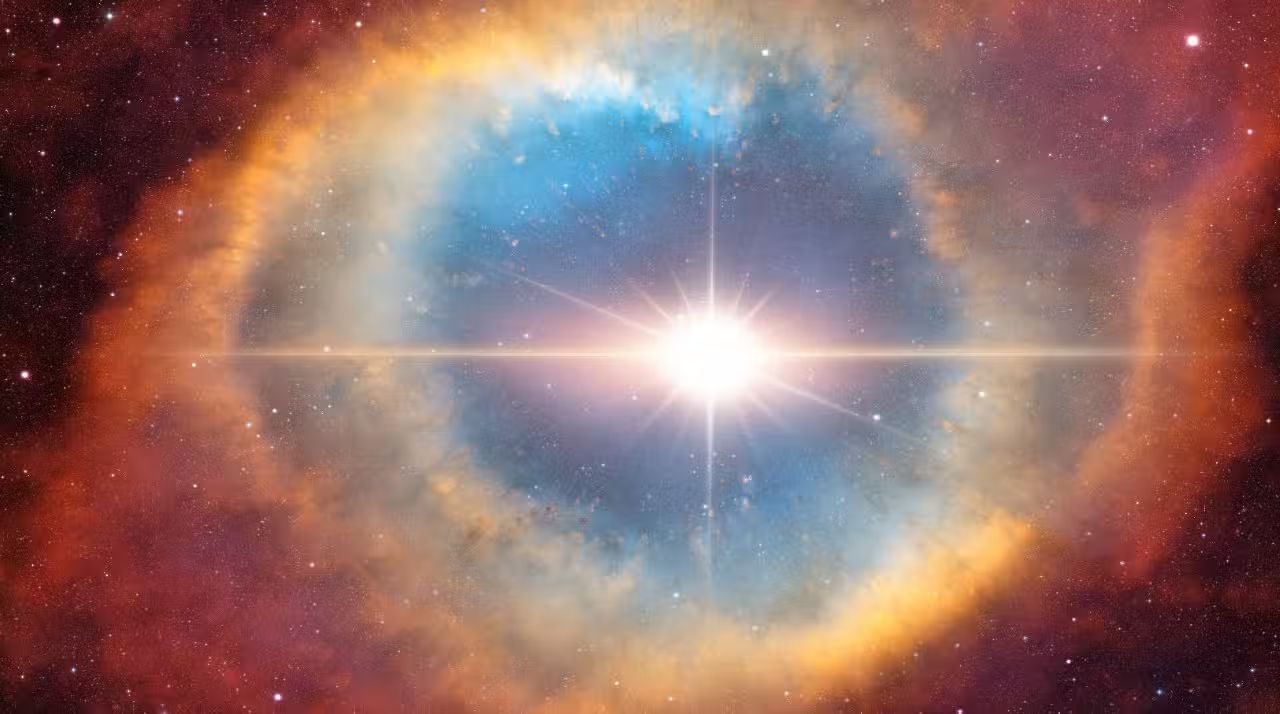
Astrônomos have detected an unusual signal emitted by a distant supernova that challenges current understandings of stellar explosions. The discovery, made by an international team of researchers, reveals complex physical processes that are still little explored during the final stages of the lives of massive stars. The phenomenon, imperceptible to the human ear, was identified in data collected by a network of state-of-the-art telescopes and opens a new field of investigation into the nature of stellar remnants and the formation of compact objects such as neutron stars and black holes.
The research was published in a renowned scientific journal and details how the signal was isolated from a vast amount of astronomical data. The particularity of the phenomenon lies in its frequency and duration, which do not completely align with existing theoretical models for the emission of gravitational or electromagnetic waves associated with supernovae. Essa discrepancy indicates that not yet fully understood events may be occurring at the heart of these explosions, possibly related to instabilities in the collapse of the stellar core or interactions with the surrounding environment.
Características of the signal detected in the supernova
The term used by astronomers to describe the signal is an analogy that resembles a rapid and increasing variation in frequency, similar to the sound of a cricket. In the astronomical context, this translates to fluctuations in gravitational waves or electromagnetic emissions that exhibit an unusual pattern. The detection of this specific pattern in a supernova is particularly intriguing because supernovae emit a wide range of signals, but this particular one doesn’t fit into any of the categories scientists expect.
The team responsible used a network of telescopes that includes gravitational wave observatories and radio telescopes to triangulate and characterize the source of the signal. Esta’s multi-messenger approach was crucial to validating the authenticity of the detection and beginning to unravel its origin. The supernova in question is located in a distant galaxy millions of light years from Terra, providing a natural laboratory to study extreme conditions impossible to replicate in any terrestrial environment.
Implicações for theoretical models of stellar evolution
Modelos Supernova theorists predict violent explosions that scatter stellar matter across space, leaving behind a dense remnant. Contudo, the presence of this anomalous signal suggests that the stellar core collapse may be more complex than previously thought. The phenomenon may involve resonances of nuclear matter or the transient formation of exotic states of matter under unimaginable pressures and temperatures. Compreender the exact origin of this signal could lead to a fundamental revision of current models of stellar evolution and the formation of heavy elements in the universe.


- Possível formation of neutron star or black hole shortly after core collapse.
- Ondas gravitational forces generated by complex and asymmetric movements in the collapsing core.
- Oscilações of a newly formed compact object during stellar transition.
- Processos nucleosynthesis not yet fully understood during the explosion.
Desafios technical and future investigations
Identifying and interpreting such a subtle signal amidst the cosmic noise represents a considerable technical and theoretical challenge. Astronomers are committed to refining their detection techniques and developing new computational models that can simulate the extreme conditions that generate this phenomenon. The goal is not only to reproduce the observed signal, but also to predict other types of emissions that could be detected in future supernova observations.
The next generation of instruments, such as LIGO and Virgo, with even greater sensitivity, promises to unlock more secrets of the universe. International collaboration between scientists and research institutions is vital given the complexity of data and the need for cross-validation. The detection of this signal is an example of how modern science depends on the global interconnection of minds and resources to push the limits of human knowledge.
Relevância for understanding the cosmos
The discovery marks a turning point in stellar astrophysics, opening new avenues for investigating phenomena that were previously only theoretical. The coming years will see an intensified focus on searching for similar signals in other supernovae and further analyzing existing data. Understanding these extreme events fills gaps in knowledge about the life and death of stars and helps us better understand the origin and evolution of the universe. The ability to detect these signals is fundamental to multi-messenger astronomy, which combines information from different types of emissions to form a more complete picture of celestial events.
Veja Tambem em Latest News (EN)

Atlético-MG confirms agreement with defender Léo Duarte after period of prominence in Turkish football

Tiger shark bites 19-year-old girl and rips off her leg in Boa Viagem, Recife

2026 World Cup will have 32 athletes who play in Brazilian football

OnePlus develops portable video game with Android system focused on competitive shooters

New BYD Seal 6 DM-i Touring hybrid station wagon debuts in Europe with ample interior space and super-efficient engine

Costco reaches historic volume in gasoline sales in the United States with prices below market

June PlayStation Plus Catalog Brings Grounded and Warhammer 40,000 Darktide to Subscribers

Disney+ brings Avatar Fire and Ash finale to The Bear and new Pixar animation in June

Netflix updates June catalog with new season of Avatar and classic cinema sagas

Geely Xingyuan electric compact gains 47 kWh battery and autonomous driving system in China

Episode 1156 of One Piece marks arrival at Elbaf with decisive actions by Shanks and Blackbeard