Deuterium in interstellar asteroid opens debate on nuclear weapons for planetary defense
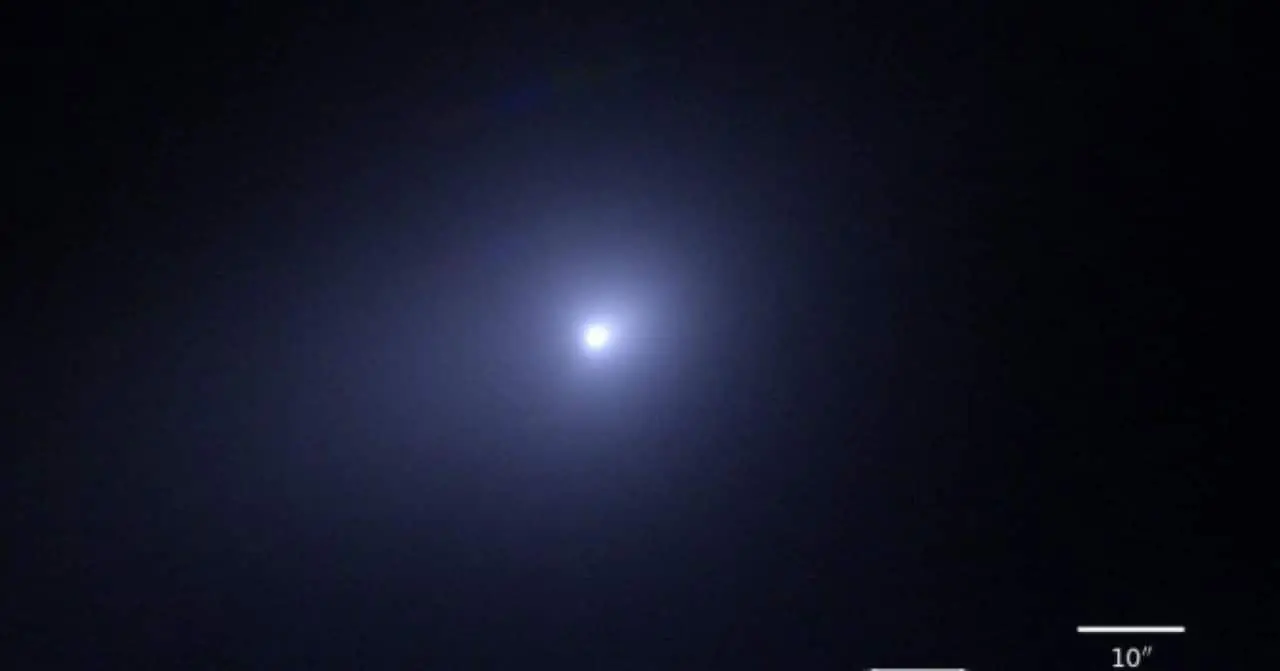
The interstellar object 3I/ATLAS has a deuterium concentration tens of times higher than that found in Sistema Solar comets, raising theoretical questions about the use of nuclear devices as a defense strategy against cosmic impacts. Astrophysicist Avi Loeb of Harvard analyzed this atypical composition and connected it to historical debates about thermonuclear weapons and planetary protection. The fraction of deuterium in the object’s water reaches 0.95%, while in methane it reaches 3.31%, values that significantly exceed known galactic standards.
Isotopic Composição reveals origin in primordial environment
Observações from telescopes such as James Webb and ALMA confirmed the high proportion of deuterium in the material released by 3I/ATLAS. Esses data, published in 2026, indicates that the object formed approximately 10 to 12 billion years ago in a region with low metallicity and temperatures below 30 kelvins. The abundance of deuterium in water exceeds that of typical solar comets by more than 30 times, while in methane the value is around 14 times greater than that measured in comet 67P by the Rosetta probe.
On the same topic: Abundant deuterium in interstellar comet raises questions about nuclear planetary defense
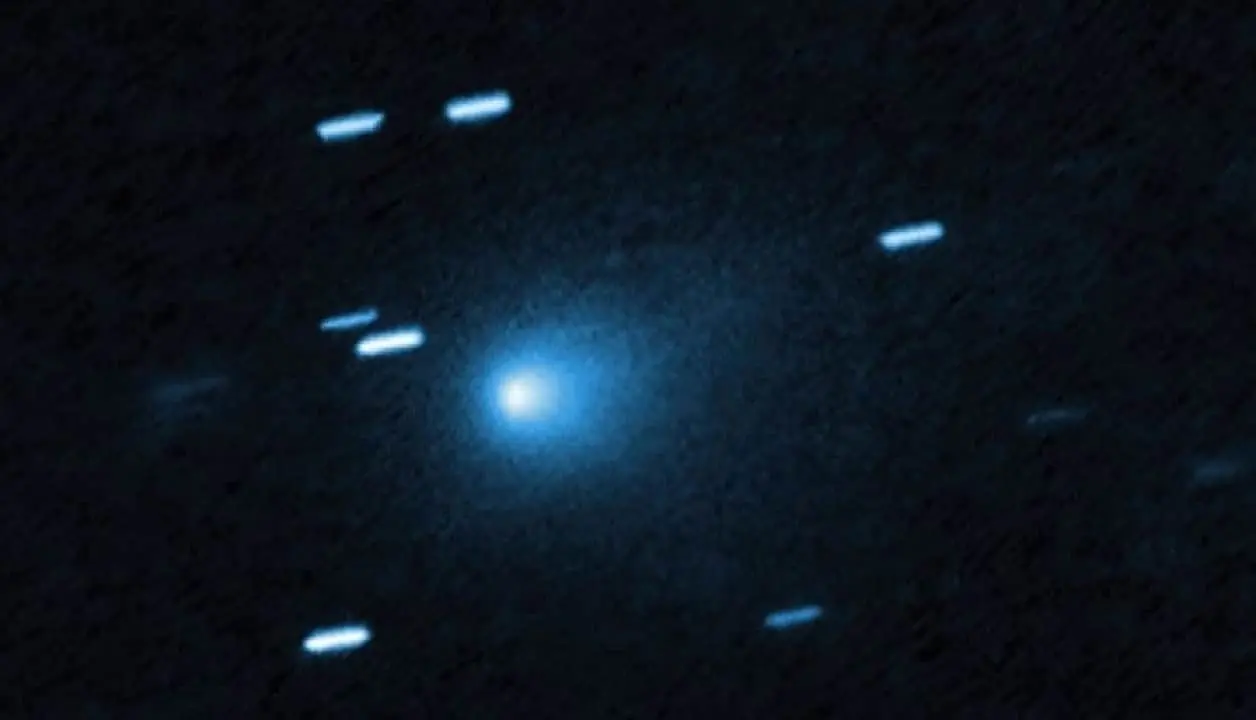
Carbon isotopes also show deviations from nearby galactic standards, reinforcing the interpretation that 3I/ATLAS originated in an environment distinct from our planetary system. Essa’s unique composition offers scientists a window into understanding how ancient interstellar material behaves as it passes through the solar neighborhood.
- The D/H fraction in water is more than 30 times higher than that in typical solar comets.
- In methane, the value is around 14 times greater than that measured on comet 67P by the Rosetta probe.
- Carbon isotopes also show deviations from nearby galactic standards.
Conexão history with development of thermonuclear weapons
Loeb’s analysis resumes Projeto Manhattan’s debates on the behavior of nuclear reactions in extreme environments. Durante During this period, Edward Teller speculated whether the fireball from an atomic bomb could initiate fusion reactions in nitrogen in the Earth’s atmosphere. Hans Bethe calculated that radiation losses would make any self-sustaining chain unlikely, a conclusion reinforced by 1946 reports signed by Konopinski, Marvin, and Teller.
Posteriormente, Konopinski and Teller published theoretical work on the probability of fusion of two deuterium nuclei, a calculation that helped in the development of the two-step hydrogen bomb: an initial fission explosion creates the conditions for deuterium fusion. Similar Preocupações emerged in underwater nuclear tests, when scientists evaluated the possibility of igniting oxygen in water, but experimental and theoretical data reduced the perceived risk.
More on this story: Interstellar asteroid with abundant deuterium revives debate about nuclear chain reaction
Cenário hypothetical detonation in interstellar object
Loeb applied historic planetary defense concepts to 3I/ATLAS. Após the impact of comet Shoemaker-Levy 9 on Júpiter in 1994, Teller had suggested a nuclear device equivalent to a gigaton of TNT to deflect or destroy threatening asteroids. With a minimum mass estimated at 160 million tons, 3I/ATLAS has enough deuterium to, in theory, release energy equivalent to 10 teratons of TNT if all the material were fused.
See Also

Anonymous fan funds Thimbleweed Park 2 and frees creator from publishers

Consortium led by Jeff Bezos and Eduardo Saverin buys 30% of Liverpool

Cristiano Ronaldo and Georgina’s agreement shields fortunes in official union
Essa’s power would represent about 200,000 times that of Tsar Bomba, the largest terrestrial nuclear explosion ever recorded, at 50 megatons in 1961. The central question raised by Loeb is whether a nuclear detonation at the center of the object could initiate a deuterium-deuterium chain reaction. In opaque, dense environments, radiative losses occur primarily at the surface, allowing the internal temperature required for fusion to be reached before the radiation dissipates the energy. The process would lead to the object’s disintegration in fractions of a second, with the surface reaching millions of degrees so that the losses would compete with the release of energy.
Implicações for Cosmic Protection Strategies
The assessment indicates that the use of nuclear devices would require additional caution when dealing with deuterium-rich objects. A chain reaction could transform the target into an energy source much greater than the initial explosion, creating unpredictable risks. Loeb recommends the development of alternatives that are less dependent on nuclear detonation for protection against impacts, including methods that avoid triggering fusion in materials with atypical composition.
3I/ATLAS is already on its way out of Sistema Solar, but its passage offered a unique opportunity to study primordial interstellar material. Isotopic anomalies continue to be analyzed by international teams, with new observations refining data on gas production and variations over time. Até At this time, there is no evidence of significant variability in daily measurements.
Learn more: Interstellar object reveals high level of deuterium and raises debate about nuclear fusion
Limitações calculations and future prospects
The deuterium measurements come from multiwavelength spectroscopy, with data from ALMA and JWST contributing to the estimates. Values represent snapshots and may vary with object activity. The fusion energy calculation assumes complete fusion of the deuterium present, but in practice efficiency depends on density, temperature and duration of extreme conditions. The minimum mass of 3I/ATLAS serves as a conservative basis, with real values being able to be higher and altering the potential energy scale.
The debate remains in the theoretical field, with no current plans involving nuclear detonation on interstellar objects. Loeb’s contribution highlights the importance of considering specific chemical compositions when designing cosmic defense strategies, opening a new chapter in the discussion on planetary protection against extraterrestrial threats.