Global study reveals deformation of the Earth’s mantle caused by ancient plate tectonics
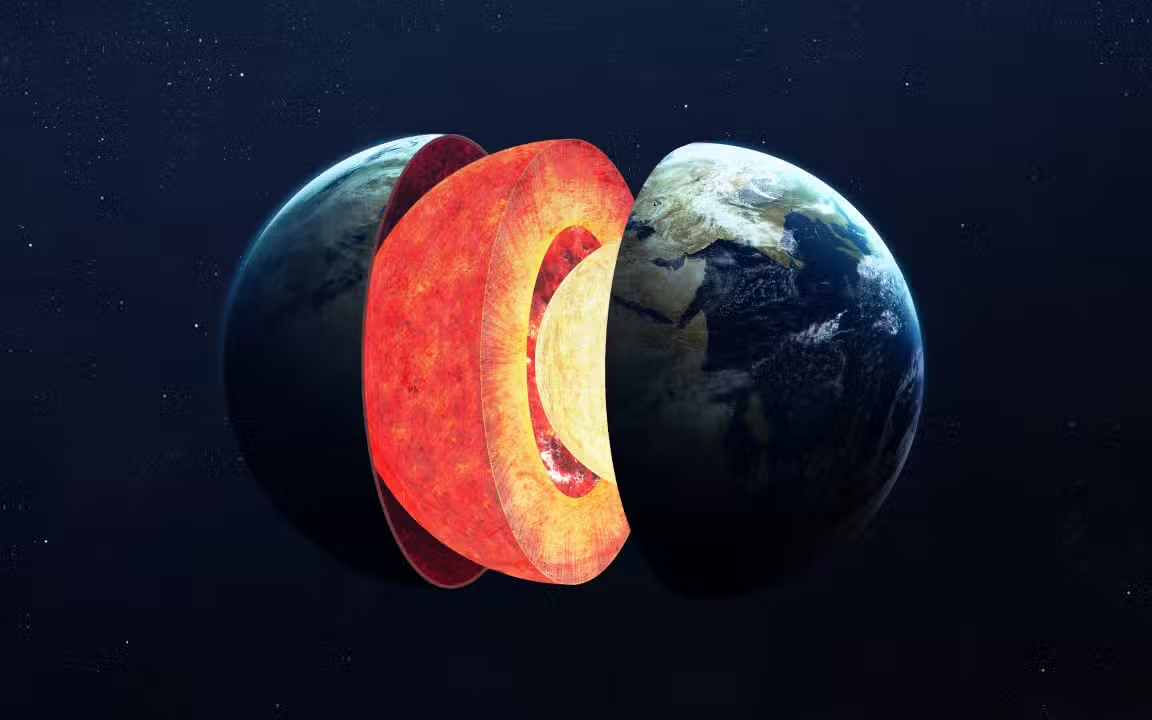
Pesquisadores mapped for the first time on a planetary scale how Terra’s deep mantle undergoes deformation caused by tectonic plates that sank millions of years ago. Analysis of more than 16 million seismograms collected at 24 data centers revealed patterns of seismic anisotropy in about two-thirds of the lower mantle, the layer approximately 2,900 kilometers deep just above the Earth’s core. The results confirm long-held theories and offer the first global observational evidence about how these deep structures deform the planet’s interior.
Unpublished Mapeamento from the Earth’s lower mantle
The team led by Universidade researchers at Califórnia at Berkeley has compiled one of the largest collections of seismic data ever assembled. The work examined approximately 75% of the lower mantle, analyzing multiple phases of seismic waves generated by earthquakes that travel down the mantle, through the core and return to the surface. Essa approach allowed mapping the distribution of deformation over distances of hundreds of kilometers, offering an unprecedented view of the Earth’s interior.

Shear waves travel at different speeds depending on the direction and characteristics of the material. Essa directional variation, called seismic anisotropy, functions as a direct indicator of accumulated deformation in the mantle over millions of years. The study was published in the journal The Seismic Record, linked to Seismological Society of America, consolidating an important milestone for modern geophysics.
Dados collected and patterns identified
- Volume total seismograms analyzed: more than 16 million records
- Cobertura from the lower mantle: almost 75% of the studied region
- Anisotropia detected: in around two thirds of areas analyzed
- Centros of data involved: 24 institutions on a global scale
- Profundidade of the lower mantle: approximately 2,900 kilometers
Deformation patterns are most evident in areas associated with ancient subducted tectonic plates, those that sank into the bowels of the planet. The concentration of anisotropy in these specific regions suggests a direct connection between plate motion at the surface and deformation of the deep mantle. Essa relationship was already predicted by geodynamic models, but the new mapping offers the first confirmation based on global seismic observations.
Subducted Placas and mantle transformation
Quando tectonic plates descend into the interior of Terra, carrying with them structures formed when they were closer to the surface. Over time, extreme heat and brutal pressure alter the minerals and create a new orientation in the material. Esse process not only modifies the plate itself, but also pushes and reshapes the mantle around it, generating the anisotropy observed by the researchers.
Jonathan Wolf, lead author of the study, explained that deformation in the upper mantle was already well understood by the pull of moving plates. In the lower mantle, however, a similar large-scale understanding was lacking. The work advances significantly in this direction, offering observational evidence that connects the behavior of surface plates to the planet’s deep processes.


Mecanismos behind the deep warp
Scientists consider two main hypotheses to explain the detected anisotropy. The first suggests that the plates preserve fossil anisotropy of their surface phase, maintaining a structural memory of the past. The second, considered more likely by the researchers, points to intense deformation during the sinking of the plates and their contact with the core-mantle boundary. Esse process modifies the mineralogical fabric and generates a new anisotropic structure.
Nem all regions without clear anisotropic signal are necessarily free of deformation. In some cases, the signal may simply be too weak for current methods to detect. The researchers highlight that the dataset continues to be a valuable source for future investigations that seek greater resolution and detail of mantle processes.
Implicações for Earth Dynamics
The Earth’s mantle slowly circulates through convection currents closely linked to the movement of tectonic plates. Essas currents not only displace plates at the surface but also stretch and distort the mantle material itself on a planetary scale. The study confirms long-standing theories and offers observational evidence that reinforces understanding of the planet’s long-term dynamics.
Conhecer better understands these deep processes and helps us understand how deformation influences the thermal and chemical behavior of the Earth’s interior over millions of years. Additional Pesquisas with the same dataset may reveal more details about mantle flow patterns and their relationship to plate tectonics. The work reinforces the importance of global seismic databases for continued advances in geophysics and understanding the planet.
Veja Tambem em Latest News (EN)

Atlético-MG confirms agreement with defender Léo Duarte after period of prominence in Turkish football

Tiger shark bites 19-year-old girl and rips off her leg in Boa Viagem, Recife

2026 World Cup will have 32 athletes who play in Brazilian football

OnePlus develops portable video game with Android system focused on competitive shooters

New BYD Seal 6 DM-i Touring hybrid station wagon debuts in Europe with ample interior space and super-efficient engine

Costco reaches historic volume in gasoline sales in the United States with prices below market

June PlayStation Plus Catalog Brings Grounded and Warhammer 40,000 Darktide to Subscribers

Disney+ brings Avatar Fire and Ash finale to The Bear and new Pixar animation in June

Netflix updates June catalog with new season of Avatar and classic cinema sagas

Geely Xingyuan electric compact gains 47 kWh battery and autonomous driving system in China

Episode 1156 of One Piece marks arrival at Elbaf with decisive actions by Shanks and Blackbeard