Interstellar comet 3I/Atlas crosses the solar system in 2026 with unprecedented data for astronomy
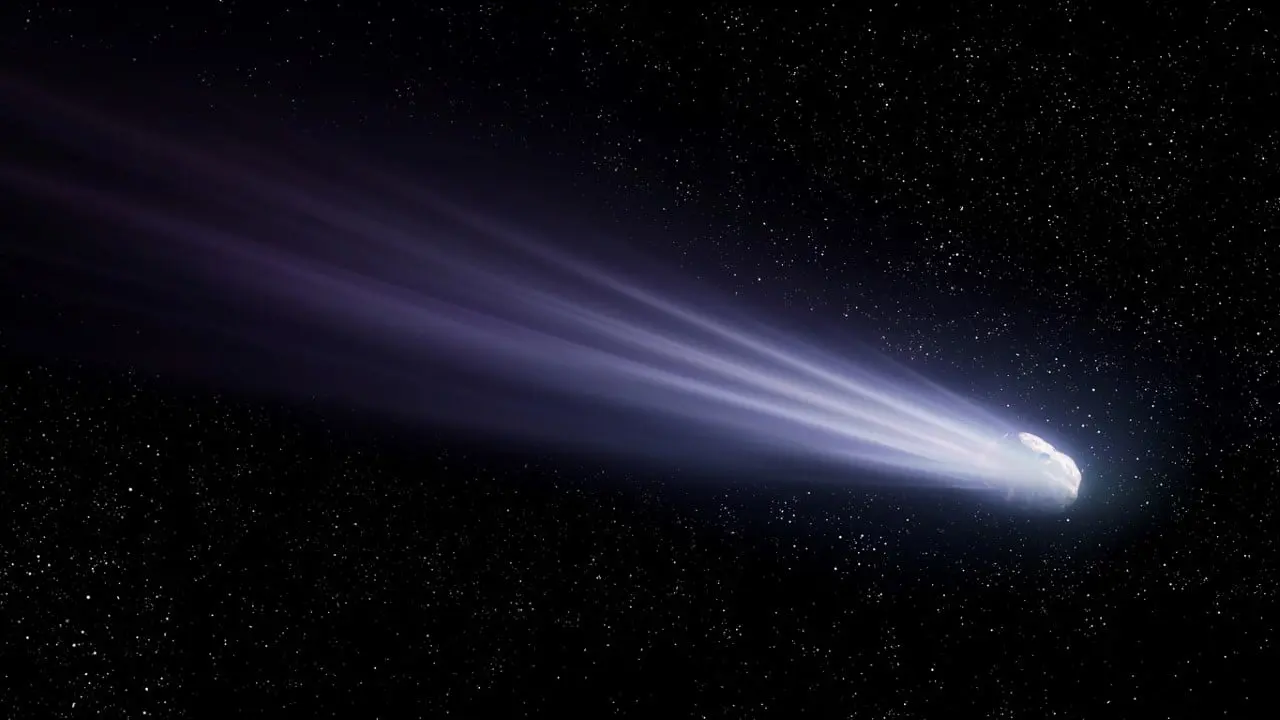
The interstellar comet 3I/Atlas continues its trajectory through the solar system in 2026, mobilizing astronomers from around the world in an unprecedented observation campaign. The celestial body travels at extreme speeds, carrying chemical elements preserved since its formation in another distant star system. Trata is the third confirmed visitor originating outside the solar neighborhood. Analysis of its mane and tail provides direct indicators of dust and gas conditions in remote regions of Via Láctea. The observation window is limited, requiring intense effort from space agencies before the comet definitively returns to deep space.
Rastreamento orbital on hyperbolic trajectory challenges research teams
Diferentemente of the local planets, interstellar bodies do not orbit Sol in elliptical trajectories. 3I/Atlas follows an open hyperbolic path, plunging toward the center of the solar system and gaining extreme acceleration from gravitational pull. The travel speed exceeds one hundred thousand kilometers per hour, making tracking a considerable technical challenge for ground control teams. The object will not return after this unique passage through the terrestrial cosmic region.
Instrumentos high-precision tracking requires constant calibration to keep the star in the lens’s field of view. Automatic alert Sistemas transmits daily updated coordinates to research centers spread across several continents. Strict synchronization between teams prevents loss of crucial data during short observation nights. The comet’s brightness fluctuates unpredictably as solar radiation heats its frozen surface. Jatos of violent gases are ejected into the vacuum of space, creating a diffuse and extensive cloud around the solid core.
Composição exotic chemistry differentiates the visitor from the local bodies
The chemical signature of 3I/Atlas completely breaks the pattern established by comets of Nuvem of Oort or Cinturão of Kuiper. The light reflected by its structure passes through high-resolution spectrometers and reveals an exotic composition. Moléculas of carbon and complex organic compounds have isotopic ratios very different from those found in the solar neighborhood. The dust released by the nucleus acts as an astronomical time capsule, storing information about the star around which the comet formed billions of years ago.
Cientistas seek to quantify the presence of carbon monoxide and cyanide at levels considered anomalous. The exact proportion of these gases helps in accurately classifying the type of stellar environment that gave rise to the distant visitor. The density of the gaseous formation directly affects the quality of the images captured by the infrared sensors of the agencies involved in the project.
Estratégia integrated multi-spectrum data collection
The American space agency coordinates the simultaneous use of different observation platforms to cover the entire electromagnetic spectrum. The goal is to cross visual, thermal and radio information with maximum efficiency. Advanced technological integration allows a three-dimensional reading of the comet’s behavior under intense thermal stress. The teams divide monitoring tasks strictly according to the specialty of each available equipment.
Leia Também

The absence of Neymar’s wedding ring in a New York club stirs social media during the Brazilian team’s break

Parachuting plane crash leaves eleven dead in northeastern France this Sunday

Financial analysis indicates that GTA 6 generated US$1 billion in the first hour of pre-sales
- Mapeamento infrared to determine the exact size of the solid core and its rotation speed.
- Análise spectroscopic focused on identifying exotic ices and unknown minerals in the structure.
- Monitoramento ultraviolet to measure the rate of water loss during Sol’s closest approach.
The massive volume of data generated requires gigantic processing capacity. State-of-the-art Supercomputadores analyzes real-time telemetry packets in labs. Digital filtering removes interference caused by the Earth’s atmosphere in images captured by ground-based telescopes. Careful refinement of the photographs reveals spiral jets of dust that demonstrate the rotational movement of the rocky core.
Consolidação of new astronomical field with successive discoveries
The detection of 3I/Atlas marks the definitive consolidation of the study of interstellar objects as a regular discipline. The pioneer Oumuamua raised questions due to its elongated shape and lack of a cometary tail. Dois years later, comet Borisov presented physical characteristics more familiar to astronomers. The current visitor offers the chance to apply methodologies developed in previous meetings with much greater precision. The official nomenclature reflects the order of discovery and the intrinsic nature of the object. The name Atlas pays homage to the automated scanning system responsible for the first photographic record of the celestial body.
Implicações for Understanding Planetary Formation in Distant Systems
The violent ejection of trillions of comets during the youth of a stellar system represents a natural and expected process. Material that does not coalesce to form planets is expelled into interstellar space due to gravitational interactions with gas giants. The in-depth study of 3I/Atlas provides concrete observational evidence about the frequency and intensity of this scattering mechanism in other parts of the galaxy. International cooperation involves government agencies from Europa, Ásia and América from Sul. Observatórios located on the Andes, Chile, and Havaí operate in an integrated network to guarantee uninterrupted twenty-four hour coverage. Earth rotation requires passing the baton between hemispheres so that tracking does not suffer from temporal gaps. The gradual receding of Sol dramatically reduces activity on the comet’s surface, as researchers archive light spectra for rigorous laboratory analysis in the coming years.