

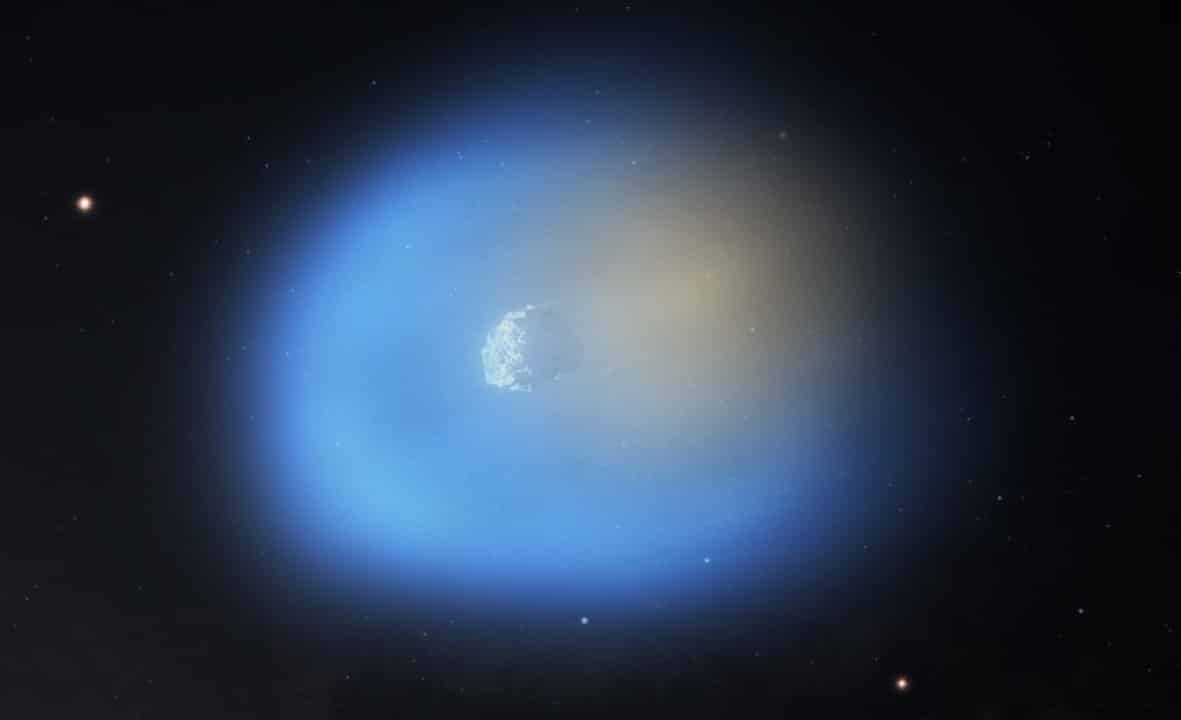
The interstellar comet 3I/ATLAS, which visited the solar system in 2025, bears the marks of an environment much colder than that where objects in our solar system were formed. Pesquisadores from the ALMA observatory (Atacama Large Millimeter/submillimeter Array) performed the first measurement of deuterated water in a body from outside the solar system, revealing radically different formation conditions. The discovery, published in the journal Nature Astronomy, opens new perspectives on the diversity of planetary environments in Via Láctea.
Primeira detection of semi-heavy water in interstellar object
The team led by Luis E. Salazar Manzano, of Universidade of Michigan, pointed ALMA’s 66 antennas at 3I/ATLAS as the comet approached Sol. The instruments captured signals from the HDO molecule, a form of water in which hydrogen is replaced by deuterium, a heavier isotope. Essa unprecedented measurement on an interstellar object revealed surprising proportions of deuterated water in relation to ordinary water.
https://twitter.com/almaobs/status/2047308325352559059?ref_src=twsrc%5Etfw
The data shows that 3I/ATLAS contains approximately 30 times more deuterated water than comets originating in the solar system. Compared to Terra’s oceans, the ratio is even more extreme, reaching about 40 times. Essa difference is not merely numerical: it reflects fundamentally distinct chemical processes that occur only at very low temperatures, below 30 Kelvin, indicating that the comet’s original environment was icy and underwent less thermal processing.
Origem and Interstellar Visitor Trajectory
- The comet was discovered on July 1, 2025 by the ATLAS telescope on Chile.
- It is the third interstellar object confirmed to visit the solar system.
- Sua’s hyperbolic trajectory confirms that it is not bound by Sol’s gravity.
- Passou passes perihelion in October 2025 and now heads into interstellar space.
3I/ATLAS does not pose any risk to Terra. Sua minimum distance was safe, and the comet continues its journey through the cosmos without threatening our planet. Apesar from a distance, ALMA’s instruments were able to capture accurate signals during the period in which the object was still releasing enough gases for spectroscopic analysis.
What the abundance of deuterium reveals about distant worlds
The relative abundance of deuterium and hydrogen in the universe dates back to Big Bang. Porém, local chemical processes in cold molecular clouds significantly alter this ratio in water. In the case of 3I/ATLAS, the high deuterium value suggests that the comet formed in a planetary system that evolved in a completely different way from ours. Conditions were cooler, and the material underwent much less thermal processing over time.
Teresa Paneque-Carreño, co-author of the study and professor at Universidade of Michigan, highlighted that each interstellar comet functions as a chemical messenger from its place of origin. Instruments like ALMA allow us to begin comparing these conditions with those in the early solar system. Essa discovery reinforces that planetary systems in the galaxy are not all the same, offering a direct sample of chemistry from elsewhere without the need for intergalactic travel.
Independent observation and confirmation Técnicas
ALMA operated in bands 5 and 6 of the radio spectrum to capture emission lines from ordinary water and the deuterated version. The antennas, located in the desert of Atacama in Chile, overcome limitations of conventional optical telescopes, which cannot point close to Sol due to intense brightness. Astronomers modeled the data with non-LTE methods to accurately estimate abundances, considering conservative scenarios that keep the lower limit of the deuterium-to-hydrogen ratio at a high level.
Independent Observações performed by James Webb at infrared wavelengths, taken after the comet’s perihelion, also indicated deuterium enrichment in the water of 3I/ATLAS. Essa confirmation using different instruments and techniques consolidates the finding and demonstrates consistency between different observatories, eliminating possibilities of instrumental error or measurement artifacts.
Perspectivas futures for interstellar astrochemistry
The measurement opens the way for more detailed studies of the diversity of planet-forming environments in Via Láctea. Futuras observations of other interstellar objects may confirm whether high proportions of deuterium are common in visitors from interstellar space or whether they represent exceptional cases. Cientistas continues to analyze other compounds detected at 3I/ATLAS, such as methanol, to build a more complete picture of the comet’s chemical composition. Water, however, remains especially important because it is directly linked to the formation of rocky planets and the possible delivery of essential ingredients for life to distant planetary systems.