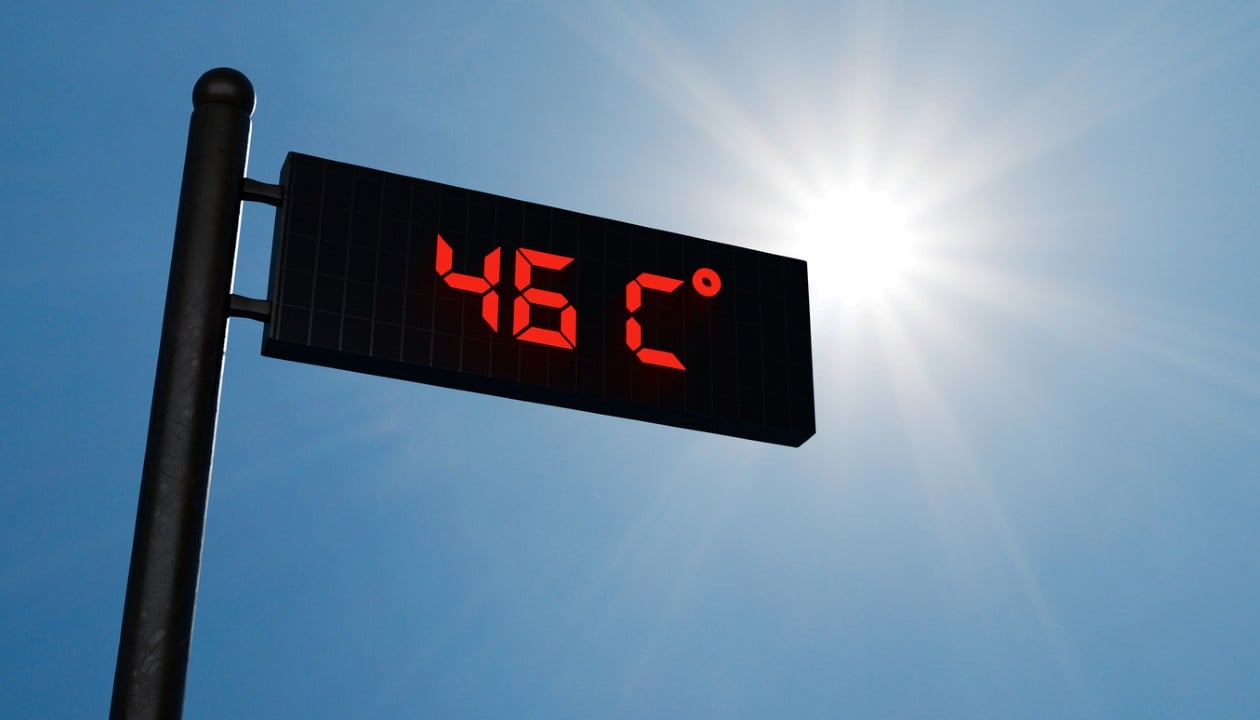
An intense heat wave is plaguing Western Europe, with projections indicating that historical temperature records will be surpassed in the coming days. France has already placed half of its territory on high alert, while Belgium has seen interruptions in train services and Spain and Germany have had to cancel or postpone sporting events.
Last Monday, French authorities issued a level 1 alert, considered imminent danger to life, for 49 of the country’s 96 departments. As a result, around 35 million people were advised to maintain “absolute vigilance”, drink plenty of water, avoid strenuous physical activity and protect themselves from direct exposure to the sun.
In addition, another 40 French departments have been classified as orange alert level 2. The national meteorological service, Météo-France, reported that “very high temperatures are establishing for a long period across the country”, warning that “day and night temperatures will be exceptional”.
According to the statement, temperatures in western and central France are expected to exceed 40°C from Monday afternoon, with peaks of 43°C in Bordeaux, 41°C in Limoges, 40°C in Toulouse and Tours, and 39°C in Paris, continuing the upward trend throughout the week.
Nighttime lows are also expected to be well above average for the season, at least until next Friday, according to Météo-France. Several cities have already recorded historic minimum temperature records during the early hours of last Sunday.
France’s national heat index, which averages daytime and nighttime highs across 30 weather stations, is forecast to reach its highest point ever this Monday or Tuesday, according to estimates.
Stéphanie Rist, France’s health minister, while visiting a hospital in Paris on Monday, expressed concern. “Many people will suffer as bodies are affected by the accumulation of high temperatures,” she said, appealing to the public to check the condition of elderly and vulnerable neighbors.
In the Gironde region of southwestern France, local authorities partly attributed the intense heat to the deaths of three people, aged between 80 and 95, on Sunday. Emergency services also reported 10 drownings, including a 13-year-old boy, in various accidents in the water.
France’s annual street music festival, the Fête de la Musique, took place on Sunday, although some town halls chose to cancel it or restrict it to evening events. Restrictions on alcohol consumption have been implemented in many locations.
More than 800 schools were closed nationwide on Monday, and another 1,800 changed their schedules so students could leave early. A tenth of regional train services near Paris have been suspended due to concerns about the safety of trains and tracks in the high temperatures.
Spain, in turn, declared its first official heat wave of the year, valid from Sunday to Wednesday, with temperatures projected to reach up to 44°C in certain areas. In Madrid, the public exhibition of the Spanish team’s game against Saudi Arabia in the World Cup was cancelled.
Spain’s state meteorological agency, Aemet, warned on Sunday of “extremely high temperatures” during the day and night for this time of year. The forecast indicates that “temperatures will begin to fall on Thursday, but the heat will remain intense”, added the agency.
In Germany, organizers of the Berlin Open tennis tournament had to suspend the final and evacuate the venue due to strong storms that occurred amid temperatures exceeding 30°C in the German capital over the weekend.
Temperatures in Belgium, which already exceeded 30°C on Sunday, are expected to be “the highest ever recorded”, according to David Dehenauw, head of forecasting at meteorological institute IRM. To minimize the risk of failures, some trains at peak times were cancelled.
In the United Kingdom, the Met Office, the national meteorological service, issued an “extreme heat” warning for much of southern England and some areas of Wales, valid from Monday to Thursday, predicting temperatures of up to 38°C. The current record for a day in June is 35.6°C, recorded in 1976.
Scientific experts warn that, with the ongoing process of global warming, extreme heat events, which were historically concentrated at the height of summer, are becoming more frequent, intense and prolonged. The anticipation and extension of these phenomena to earlier and later periods of the year are a clear sign of ongoing climate changes, demanding increasing attention and adaptation from populations and infrastructures.