James Webb Telescope detects unprecedented exoplanet with magma ocean and sulfur atmosphere
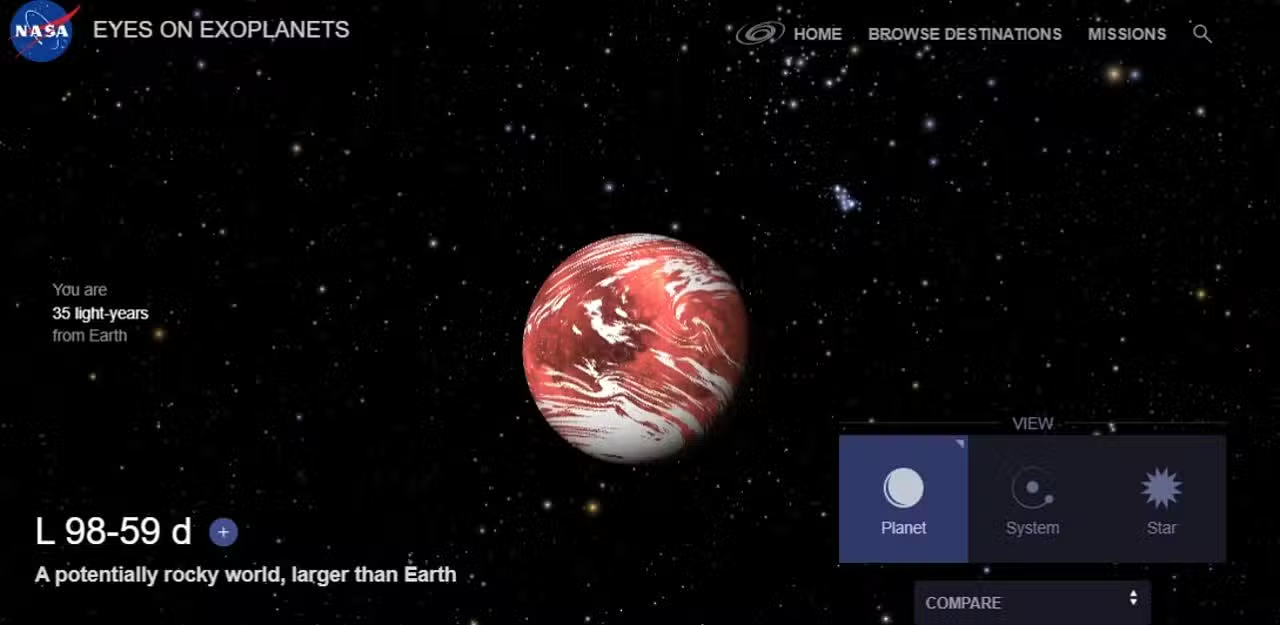
Pesquisadores of Universidade of Oxford have identified a celestial body that defies traditional astronomical classifications. The exoplanet L 98-59 d has an entirely molten mantle and an atmosphere full of sulfur compounds. The star orbits a red dwarf star located approximately 35 light years away from our solar system. The discovery occurred in the Volans constellation.
The scientific finding resulted from crossing observational information from the James Webb space telescope with state-of-the-art computer simulations. The data shows that the planet has sustained an active magma ocean for billions of years. Essa extreme temperature enables the accumulation of vast reserves of sulfur in its internal layers. The constant release of sulfur gas generates a dense atmospheric environment with the characteristic odor of rotten eggs.
ウェッブ宇宙望遠鏡が解き明かす 49光年先の“黒いスーパーアース”「LHS 3844 b」の表面組成https://t.co/7PIJShvXL7
今回観測対象となったLHS 3844 bは、インディアン座の方向・地球から約49光年先のスーパーアース(地球よりわずかに大きく重い岩石惑星)です pic.twitter.com/1yZVgABcpw
— sorae 宇宙へのポータルサイト (@sorae_jp) May 11, 2026
Características structural celestial body located in the constellation Volans
The team of experts reconstructed the evolutionary trajectory of L 98-59 d from the early stages of its formation. The exoplanet has a diameter about 1.6 times larger than that of Terra. The recorded density, however, is considerably lower than the standard expected for a purely rocky world. Essa structural discrepancy indicates a massive presence of volatile elements trapped inside.
The celestial body orbits a red dwarf star, a smaller and cooler stellar type than Sol. Red dwarfs represent the most common category of stars in Via Láctea. The planet’s proximity to its host star directly affects the surface’s energy balance. The constant radiation prevents the surface material from reaching the solidification point necessary to form a stable crust.
Molten silicate Manto sustains extreme greenhouse effect for billions of years
The interior of the planet is home to a mantle composed of liquid silicate that reaches thousands of kilometers deep. Early Terra also went through a magma ocean phase shortly after its formation. Our planet, however, gradually cooled and developed a solid outer crust. L 98-59 d followed a distinct evolutionary path and maintained its original incandescent state.
The thick atmosphere acts as an unforgiving thermal blanket over the magma ocean. The greenhouse effect generated by this gaseous layer blocks the dissipation of internal heat into outer space. Computer simulations suggest that the star may have started its life as a gaseous sub-Neptune. The intense stellar wind would have swept away part of its primordial atmosphere over the geological eons.
Traffic Espectroscopia reveals massive presence of sulfurous gases
The James Webb telescope’s high-precision instruments analyzed the star’s light filtered through the planet’s atmosphere. The transit spectroscopy technique confirmed the existence of hydrogen sulfide and sulfur dioxide in the upper layers. The presence of these specific gases signals a mantle with reducing chemical properties. The local photochemical production of these compounds aligns perfectly with the tested mathematical models.


The detailed survey established fundamental physical and chemical parameters about the distant star:
- The total mass reaches 1.64 times the mass of our planet.
- The equatorial radius measures exactly 1.627 times the terrestrial radius.
- The average density is around 2.2 grams per cubic centimeter.
- The atmospheric envelope contains hydrogen mixed with heavy sulfur molecules.
- The environment rules out dry rocky world or oceanic water planet scenarios.
L 98-59 d orbits in an astrophysical transition region called the radius valley. Essa space lane marks the theoretical boundary between rocky super-Earths and gaseous sub-Neptunes. The planet draws the attention of the scientific community precisely because it does not comply with the formation patterns predicted for this zone. Previous Observações images taken by the Hubble telescope had already ruled out the hypothesis of a light atmosphere composed only of pure hydrogen.
Compact stellar Sistema harbors multiple planets in close orbits
The sulfurous exoplanet does not travel alone through deep space. Ele is part of a multiple planetary system made up of at least five distinct worlds already confirmed. L 98-59 d occupies the outermost position among the celestial bodies that make visible transit from the terrestrial perspective. The compact architecture of the system influences the gravitational and thermal dynamics of all its members.
Previous Campanhas observations had already mapped the basic orbital characteristics of this stellar neighborhood. Precisely measuring the mass and radius of neighboring planets provided the necessary context for the new discovery. Integrating the old data with recent atmospheric readings from James Webb allowed a leap forward in understanding the system. Astronomers continually monitor the star for signs of additional celestial bodies.
Modelagem computational proposes revision of planetary classification categories
The full study published in the journal Nature Astronomy details the complex interaction between internal geological processes and external radiation. The magma ocean acts as a long-term reservoir for volatile elements. Essa geological retention ensures a constant supply of gases to the atmosphere over billions of years. The mechanism explains the durability of the thick gaseous envelope.
The main author of the research, doctor Harrison Nicholls, pointed out that the current system for classifying small planets needs updates. The find reinforces the immense structural diversity of the worlds spread beyond Sistema Solar. Professor Raymond Pierrehumbert, co-author of the work, highlighted the power of numerical simulations to investigate the remote past of inaccessible stars. Current technology makes it possible to dissect the internal composition of planets located trillions of kilometers away.
The extreme environment of L 98-59 d makes it impossible for life to emerge in the manner known by terrestrial biology. The scientific value of the discovery lies in the opportunity to test theories about the formation and evolution of planetary systems. The next generation of space and ground-based telescopes should identify dozens of worlds with similar characteristics over the next decade. Researchers are already preparing new observation proposals to further detail the thermal dynamics of this distant magma ocean.
Veja Tambem em Latest News (EN)

Atlético-MG confirms agreement with defender Léo Duarte after period of prominence in Turkish football

Tiger shark bites 19-year-old girl and rips off her leg in Boa Viagem, Recife

2026 World Cup will have 32 athletes who play in Brazilian football

OnePlus develops portable video game with Android system focused on competitive shooters

New BYD Seal 6 DM-i Touring hybrid station wagon debuts in Europe with ample interior space and super-efficient engine

Costco reaches historic volume in gasoline sales in the United States with prices below market

June PlayStation Plus Catalog Brings Grounded and Warhammer 40,000 Darktide to Subscribers

Disney+ brings Avatar Fire and Ash finale to The Bear and new Pixar animation in June

Netflix updates June catalog with new season of Avatar and classic cinema sagas

Geely Xingyuan electric compact gains 47 kWh battery and autonomous driving system in China

Episode 1156 of One Piece marks arrival at Elbaf with decisive actions by Shanks and Blackbeard