Telescópio Subaru recorded significant changes in the chemical structure of the interstellar comet 3I/ATLAS during its passage through our planetary system. The observations took place at the beginning of January 2026. The space object was already on its way away from Sol during this period. Data collection took place months after the celestial body reached perihelion in October 2025.
The analysis indicated a significant drop in the proportion between carbon dioxide and water present in the celestial body’s coma. The phenomenon suggests that the heating caused by the star altered the release of materials from the core unevenly. The comet represents the third visitor from outside Sistema Solar confirmed by astronomers. The original discovery happened on July 1, 2025 by the monitoring system on Chile.
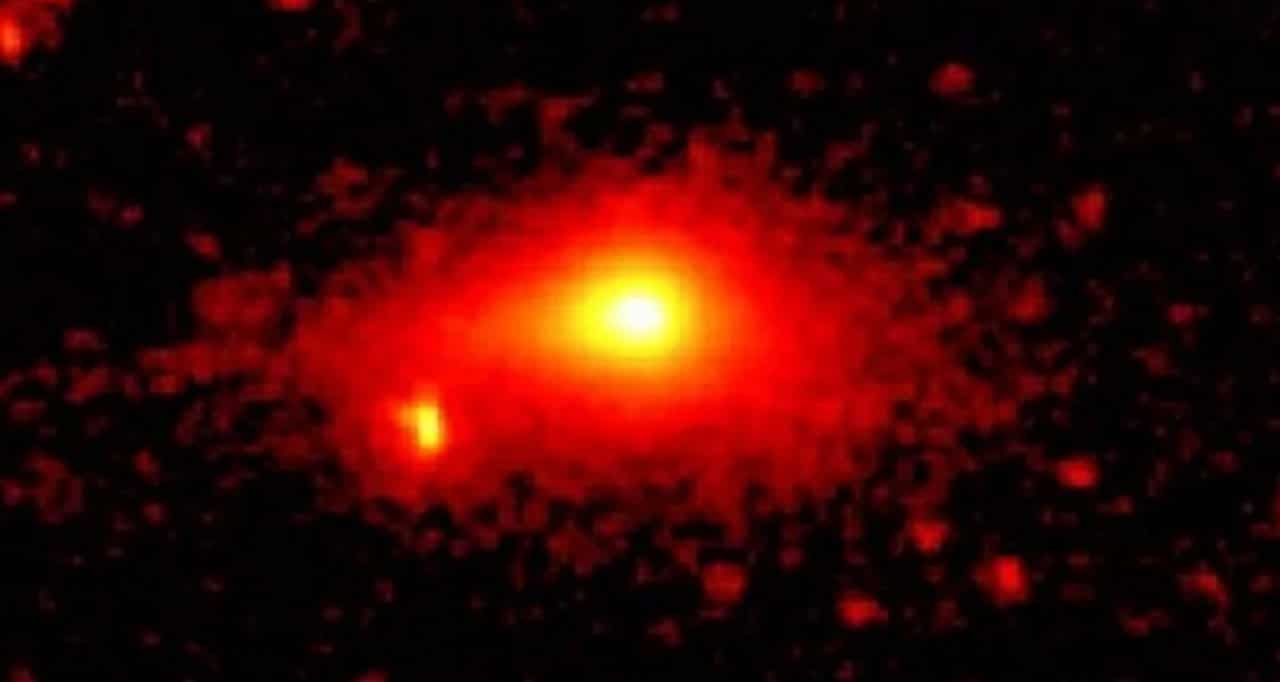
Análise spectroscopy reveals internal dynamics of the nucleus
Scientists used high-resolution optical spectroscopy equipment to examine the cosmic visitor in detail. The high-dispersion instrument attached to the observatory on Havaí allowed the capture of extremely precise data about the gas cloud. The team specifically focused on the forbidden lines of atomic oxygen emitted by the object during its passage. Este type of observation requires ideal atmospheric conditions and extremely sensitive equipment to separate chemical signatures.
The exact measurement of the intensities of the green and red lines provided the basis for the research’s chemical calculations. Este method made it possible to estimate the amount of carbon dioxide in relation to water with a large safety margin. The numbers obtained after perihelion differed strongly from previous measurements. Telescópios spacecraft had recorded higher rates before the closest approach to Sol the previous year.
Thermal behavior explains the variation detected by terrestrial instruments over the months of monitoring. Solar heat caused the accelerated sublimation of the comet’s surface layers in the first moments of approach. Este initial process released gases accumulated in the outer crust of the space object. Continuous removal of this protective layer exposed material stored in the deeper regions of the core.
The internal structure was shown to have a different composition from the original surface observed by telescopes. The drop in the rate of carbon dioxide coincides exactly with the progressive warming of the rocky, frozen core. The celestial body functions as a time capsule of its home star system. The detailed study of these layers offers concrete clues about the formation of planetesimals in other regions of the galaxy.
International Pesquisa applies local body methods on visitor
Astronomer Yoshiharu Shinnaka took over the coordination of data collection and information modeling. The researcher integrates Instituto of Ciências Espaciais Koyama of Universidade Kyoto Sangyo into Japão. The scientific work underwent rigorous peer review and received approval for publication in the journal The Astronomical Journal. The full document has been available to the community on the arXiv platform since March 2026.
The methodology adopted by the team reproduces techniques already consolidated in the study of native comets from our own Sistema Solar. Applying the same analysis protocol facilitates direct comparison between the different cataloged celestial bodies. 3I/ATLAS was traveling at extreme speed relative to Sol during spectroscopic measurements. Esta dynamic characteristic confirms its external origin and its unmistakable hyperbolic trajectory.
Ferramentas spacecraft such as JWST and SPHEREx provided an initial overview of the comet’s composition in 2025. Approach phase readings indicated a considerable abundance of volatile compounds on the object’s surface. The new measurements by Japanese equipment at Havaí rewrote the understanding of the internal distribution of these chemical elements. The heterogeneity of the nucleus has become the main working hypothesis for experts in the field.
The chemical variation reinforces the theory that the object’s formation occurred in stages or in an environment with strong temperature gradients. Deeper Partes harbor different concentrations of ice and gases trapped in their structural matrix. The heat acted as a natural digging tool as it passed through the closest point to the star. The melting process revealed the true internal architecture of the interstellar traveler to scientists.
Histórico Observations and Position in Modern Astronomy
The 3I/ATLAS cataloging adds a fundamental chapter to the practical study of extrasolar objects in modern astronomy. The international scientific community has confirmed only two similar bodies crossing our planetary border previously. The pioneer 1I/’Oumuamua crossed our neighborhood in 2017 with a very peculiar elongated shape and generated intense debates. The second visitor was named 2I/Borisov and appeared on astronomical radars in 2019 with more familiar characteristics.
The physical behavior of the new comet differs substantially from the first object detected last decade. ‘Oumuamua showed no obvious cometary activity or tail formation during its rapid passage through the system. 3I/ATLAS developed a bright coma and an extensive tail visible to various equipment on the ground and in space. The ratio measured in the oxygen lines exceeded the average recorded in local comets at equivalent distances.
- The distance of the object in relation to Sol reached 2.87 astronomical units during data capture on Havaí.
- The proportion of gases measured in January 2026 showed a reduction compared to the numbers recorded in August 2025.
- The research team crossed current information with records from multiple optical and infrared instruments.
- Comet C/2025 N1 maintains material release activity even on its definitive route out of the planetary system.
Current chemical indices bring 3I/ATLAS closer to the structural features observed in comet 2I/Borisov. The similarities and divergences build an essential database for contemporary astrophysics to understand planetary formation. Continuous monitoring makes it possible to map the diversity of materials present in protoplanetary disks far from Terra.
Cross-referencing this information consolidates the understanding of the mechanics of sublimation in extreme microgravity environments. The distance of almost three astronomical units represents an important thermal transition point for the object. The cold of deep space begins to slow activity on the surface of the core as the journey continues.
Perspectivas Futures for Space Monitoring
Ground-based observatories monitor the comet’s trajectory while the reflected light allows it to be captured. The object remains active and releases gases in progressively smaller volumes with each week of separation. Distance expansion reduces the influence of solar radiation on the remaining crust of ice and dust. Astronomers plan to use other facilities to refine composition measurements before they disappear completely into the dark of space.
The integration of optical data with infrared and radio recordings will create an unprecedented three-dimensional model of the cometary nucleus. The episode demonstrates the strategic relevance of large telescopes installed on the Earth’s surface for space research. The summit of the Mauna Kea volcano offers exceptional atmospheric stability for the high-precision spectroscopy required in these cases. Japanese equipment has proven its ability to complement missions operated directly in the vacuum of orbital space.
The accumulation of knowledge about 3I/ATLAS prepares the global observation infrastructure for future astronomical discoveries. Detection technology is advancing rapidly and should identify new visitors with greater frequency and accuracy in the coming years. Detailed analysis of the chemistry of these bodies answers fundamental questions about the distribution of heavy elements in the observable universe. Planetary science gains more robust tools to understand the formation of worlds beyond the influence of our star.