Hubble Telescope detects Cloud-9, a starless gas cloud driven by dark matter
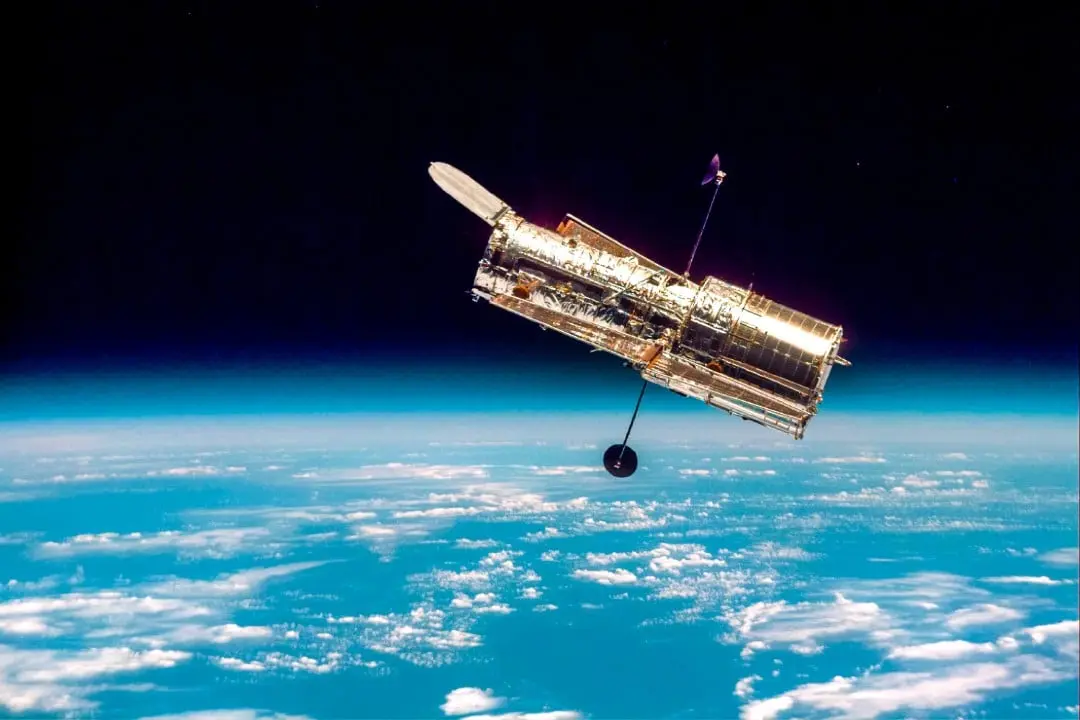
The Hubble space telescope has recorded the first confirmation of a peculiar cosmic structure in the universe. Trata is a gaseous formation completely devoid of stars. The object was named Cloud-9. The cloud is composed of neutral hydrogen gas and dominated by dark matter gravity. The data was published in the magazine The Astrophysical Journal Letters.
The formation is located approximately 14 million light years from Terra. Ela orbits close to the spiral galaxy Messier 94. Scientists classified the find as a cloud of the Reionization-Limited H I Cloud type, known by the acronym RELHIC. The record offers an unprecedented look at the conditions of the early universe. The absence of starlight required high-precision equipment to validate the finding.
Spherical Morfologia and the central role of invisible gravity
The Cloud-9 features a compact, spherical shape that intrigues researchers. The diameter of the structure spans thousands of light years in length. Diferente of other hydrogen clouds already catalogued, this formation maintains remarkable physical integrity. The stability of the gas occurs due to the gravitational confinement generated by a massive halo. Esse halo is made up entirely of dark matter.
More on this story: Vera C. Rubin Observatory begins vast cosmic research to map the universe and uncover dark matter
The internal dynamics of the object works through a delicate balance. The pressure exerted by the neutral gas acts in opposition to the gravitational force of the invisible halo. Esse swing prevents material collapse. Sem the gravitational collapse of the gas, the nuclear ignition process does not happen. Consequentemente, the environment becomes incapable of generating new stars.
Astronomers consider the structure a true cosmological fossil. Ela preserves the characteristics of the period just after Big Bang. Naquela era, the phenomenon of reionization heated the universe and limited the cooling of gas in smaller structures. Cloud-9 captured primordial hydrogen, but the global warming of the cosmos halted its evolution. The system has remained frozen in time ever since.
Initial Rastreamento and validation by optical instruments
The journey to confirming Cloud-9 began three years ago. The Chinese FAST telescope carried out a radio survey focused on neutral hydrogen emissions. The equipment mapped the surroundings of nearby galaxies and detected the anomaly. Outros ground-based observatories joined the research soon after. Green Bank and Very Large Array confirmed the presence of the gas in the indicated region.
Learn more: Dark matter and exoplanets: NASA prepares launch of new space telescope
Apesar of radio data accuracy, ground-based instruments had limitations. Eles could not rule out the existence of very weak or ancient stellar populations. The research team needed higher optical resolution. The Hubble telescope was then directed to the exact coordinates of the anomaly. The goal was to resolve individual objects at extreme cosmological distances.
The use of Advanced Camera for Surveys of Hubble was decisive. The images captured revealed only background galaxies shining through the gas cloud. Não were there any records of point sources of light that indicated local stars. The observation eliminated the hypothesis that the object was an ultra-diffuse dwarf galaxy. The sensitivity of the space equipment ended doubts about the visual composition of the structure.
See Also

End of physical media: PlayStation players organize week-long protest against Sony

Bayern midfielder Musiala faints again in friendly against Heidenheim

Queen Camilla makes unexpected purchases at Royal SpreeSide and surprises residents
Parâmetros that define the scientific classification of the structure
The current cosmological model predicts the existence of remnants of dark halos. RELHIC clouds represent exactly this category of theoretical objects. Cloud-9 provides the first case directly observed by modern science. The discovery makes it possible to test complex theories about the behavior of dark matter on subgalactic scales. The absence of light makes traditional optical detection practically impossible.
The identification of the cloud only occurred due to radio emission from hydrogen. The gas acts as a visible tracer for invisible gravity. The structure received its nickname because it is the ninth gas cloud identified near Messier 94. Scientists observed specific details that differentiate the object from ordinary galaxies.
On the same topic: Vera C. Rubin Observatory begins historic campaign to unravel the mysteries of the Universe in 10 years
- The cloud shows no evidence of strong interaction with neighboring galaxies.
- The spherical shape rules out severe distortions caused by tidal forces.
- The total mass of the system is dominated almost entirely by the dark component.
- The internal gas presents slight distortions indicative of pressure from the intergalactic medium.
Dark matter makes up most of the mass in the known universe. Ela does not interact with light or electromagnetism. The study of gas dynamics in Cloud-9 allows us to infer the exact distribution of this invisible mass. The data helps refine models of the formation of cosmic structures. The cloud serves as a natural laboratory for fundamental physics.
Análises from the research team and next steps
The researchers involved in the project highlighted the relevance of the find for astronomy. Andrew Fox described Cloud-9 as a direct window into the dark universe. The scientist reinforced that cosmological theory already predicted this abundance of invisible mass. However, direct detection of an environment where it predominates so completely remained a technical challenge.
The structure was also characterized as a failed galaxy by researcher Alejandro Benítez-Llambay. Analysis of systems that have not evolved reveals crucial details about cosmic formation processes. The lack of stars highlights a primordial building block that has stopped in time. Rachael Beaton compared these relics to abandoned houses in the galactic neighborhood. The scientist suggests that the local universe may host many other similar examples.
More on this story: AI research reinforces dark matter as a likely source of excess gamma rays at the center of the Milky Way
Visual confirmation stimulates new systematic searches in radio catalogs. Deeper Levantamentos are expected to combine optical and radiofrequency data in the coming years. James Webb Space Telescope emerges as the main tool for the future of research. The equipment has the capacity to perform infrared observations with unprecedented sensitivity. Ele will be able to test even stricter limits for any residual stellar population.
Simulações astrophysics numerics will be updated based on the parameters of Cloud-9. Scientists aim to quantify how many small halos have failed to form galaxies over billions of years. The discovery reaffirms the continued importance of space exploration. Hubble continues to deliver unprecedented results and transform human understanding of the cosmos. The telescope maintains its scientific relevance even after more than three decades of continuous operation.