

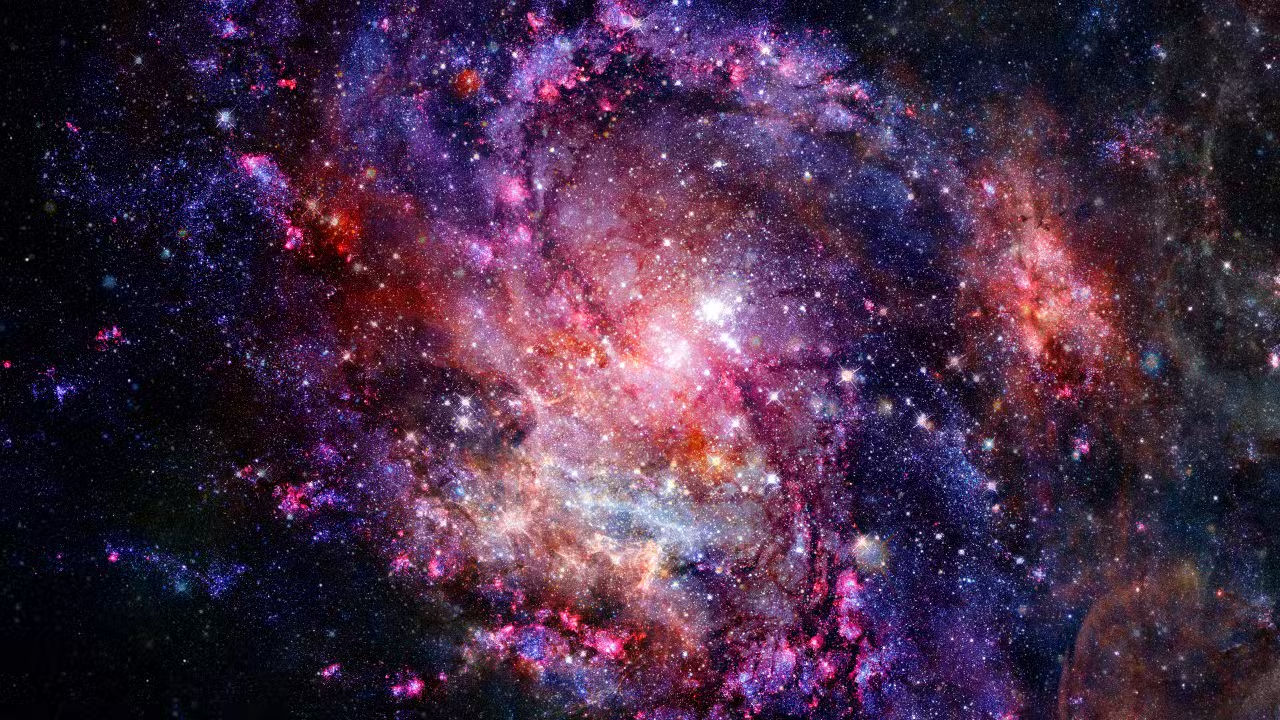
A vast region of space, known as Vazio and Boötes, appears to be one of the largest areas nearly devoid of matter in the observable universe. Seu diameter reaches approximately 330 million light years. Esta colossal cosmic structure intrigues scientists due to its impressive absence of galaxies, challenging the understanding of the distribution of matter in the cosmos. The galactic density observed within its interior is drastically lower than expected for a region of similar size.
Situado towards the constellation of Boötes, this cosmic void is described as a vast sphere with very few celestial objects. The center of Vazio of Boötes is about 700 million light years from Terra. Isso positions it as one of the most remarkable and intensely studied phenomena in modern astronomy. Sua discovery has opened crucial new perspectives on the formation and evolution of the large-scale structures that make up the universe.
Descoberta and cosmic structure mapping
The identification of Vazio from Boötes occurred in 1981, led by prominent astronomer Robert Kirshner. Ele worked in direct collaboration with researchers Augustus Oemler, Paul Schechter and Stephen Shectman, forming a team dedicated to cosmic investigation. The group carried out a meticulous survey that measured the redshift of countless galaxies. Esta technique is essential for accurately mapping the way matter is distributed across the vast sky.
The team’s comprehensive work provided definitive confirmation of the existence and unique characteristics of the void. Ele was subsequently published in the renowned Astrophysical Journal in 1987. Este’s original paper remains a fundamental and widely cited reference for all studies on cosmic voids. The detailed survey revealed a significant and surprising anomaly in the expected distribution of galaxies, indicating the existence of this immense underpopulated region.
Colossal Região with reduced galactic density
Apesar of the nomenclature “Void”, the region does not constitute an absolute vacuum, nor is it completely free of galaxies. Levantamentos In-depth astronomical surveys conducted since its initial discovery have identified approximately 60 galaxies within it. Este number, however, is drastically low and notably lower than expected for a spatial volume of its dimensions.
Para a volume of space the size of Vazio of Boötes, filled with the average matter density of the universe, would be expected to contain about 2,000 galaxies. The void, therefore, houses a small fraction of the celestial objects that a typical area of the cosmos of the same size should have. It is an intensely sparsely populated region, rather than being completely empty, which makes it a unique object of study for cosmologists. The few galaxies that exist in the void exhibit a peculiar alignment, concentrated along a tubular band that runs through their center, adding yet another layer of mystery to their formation.
- Estimated Diâmetro: Entre 250 and 330 million light years, depending on specific surveys.
- Galáxias identified: Aproximadamente 60 inside the structure.
- Expected Galáxias in a region of similar size: Cerca of 2,000, based on universal mean density.
- Localização from center: Cerca 700 million light years away from Terra.
- Reference Constelação: Boötes, where the void is located.
Origem and formation: smaller void merger theory
Exactly how Vazio from Boötes formed is still an active topic of research and debate within the scientific community. The peculiar distribution of galaxies within it, remarkably aligned in a tubular band, provides a crucial clue to this complex question. Essa configuration suggests a fascinating hypothesis about its origin.
Alguns astronomers theorize that this immense cosmic void resulted from the progressive merger of multiple smaller voids. Este process would be analogous to the behavior observed in soap bubbles, which tend to come together to form larger and more complex structures. The coalescence of void bubbles would, over eons, have created the vast, underpopulated region we observe today. Esta theory seeks to explain both the extraordinary scale of Vazio’s Boötes and the unusual organization of the few celestial objects that reside there, offering a model for understanding large-scale cosmic architecture.
The hypothetical impact on knowledge of Via Láctea
The immense size and striking isolation of Vazio from Boötes inspired a highly relevant thought experiment proposed by renowned astronomer Greg Aldering. Ele devised a hypothetical scenario in which Via Láctea, the galaxy where our solar system resides, would be located precisely in the center of this vast uninhabited region. The implications of this conjecture are profound and raise significant questions for the history of astronomical knowledge and for human perception of the universe.
Aldering postulated that, under such a condition, the inhabitants of Terra would not have been able to discover the existence of other galaxies until the 1960s. Esta’s striking statement is recorded in detail in NASA’s accounts of the void, and underscores the vast scale and profound impact that cosmic isolation can have on the advancement of astronomical knowledge. The absence of close galactic neighbors would have significantly delayed the perception of the plurality of galaxies and the true scale of the universe.
Medições and the nature of cosmic edges
Estimates for the exact diameter of Vazio from Boötes exhibit some variation, generally falling between 250 and 330 million light years. Essas differences in measurements depend directly on the specific astronomical surveys that were carried out and on the various cosmological hypotheses adopted to carry out such complex calculations. It is crucial to highlight that all these values are intrinsically approximate, given the complexity of the object of study and the vastness of the space.
The nature of the edges of a cosmic void is not characterized by an abrupt transition or a defined “wall.” Pelo On the contrary, there is a gradual thinning of the density of matter, culminating in a smooth transition between the void and the densest regions of the universe. Esta’s continuous feature and lack of sharp boundaries make determining its exact diameter a particularly complex and interesting challenge for astronomers seeking to map the large-scale structure of the cosmos.