
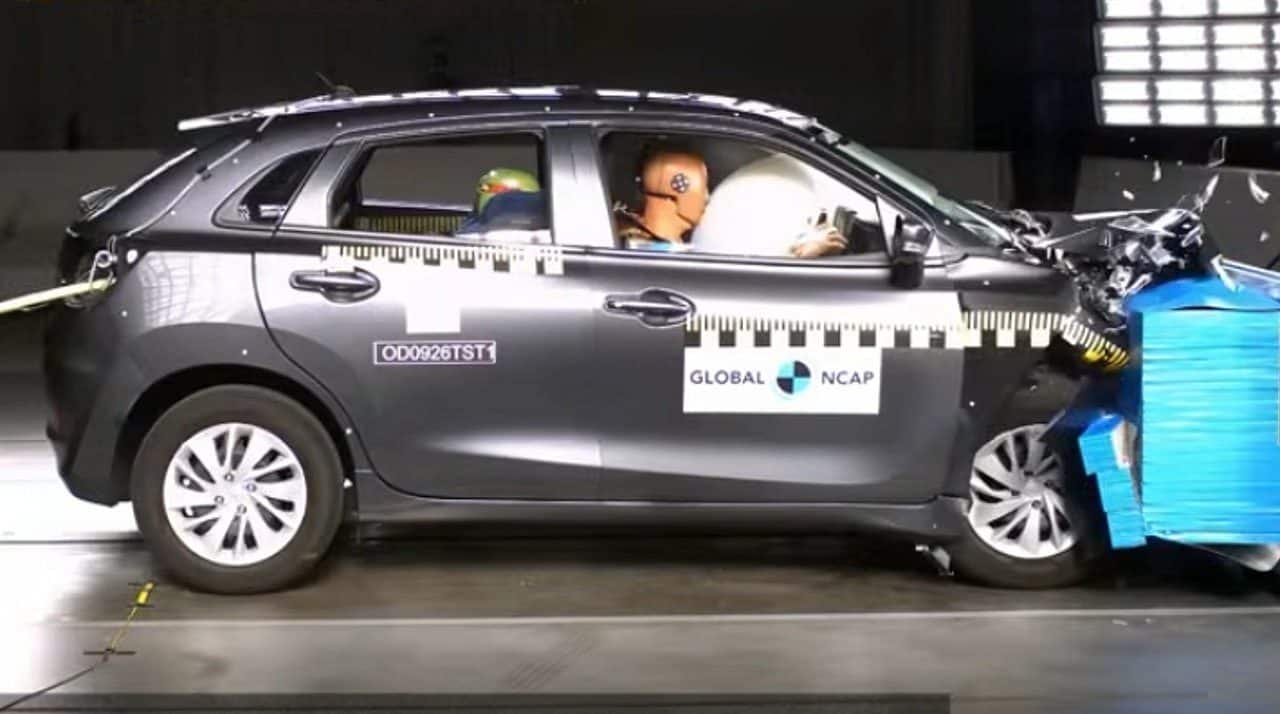
The Toyota Starlet subcompact, a vehicle manufactured in the Índia and positioned among the most sold models in the África of the Sul, obtained zero stars in the protection assessment for adult occupants conducted by the Global NCAP. The negative performance exposes severe weaknesses in impact absorption, generating a direct contrast with the reliability and safety record that the Japanese automaker maintains in global markets. The car shares the same structural platform as the Suzuki Baleno, being produced in the same Indian industrial facility and presenting only aesthetic changes in relation to the original design.
The classification raises an immediate alert for the African automotive market. The security institute’s evaluators highlighted that the model has high commercial penetration in the region, appearing as a frequent choice in car rental companies and corporate fleets. The wide circulation of the subcompact statistically multiplies the exposure of drivers and passengers to severe risks in the event of traffic accidents. The absence of stricter government regulations in emerging countries often allows outdated projects to be sold.
Análise technique reveals instability in the vehicle body
The frontal impact test demonstrated multiple deficiencies in the car’s architecture during the simulated collision at 64 kilometers per hour. Global NCAP engineers found that the area intended for the driver’s feet suffered excessive deformation, while the overall bodywork was classified as unstable. The metallic structure demonstrated a technical incapacity to support additional loads, which means that impacts at higher speeds would result in the total collapse of the passenger compartment.
The lateral assessment revealed critical flaws in preserving the physical integrity of the front occupants. The absence of supplementary protective equipment worsened the results recorded by the test dummies’ sensors. The institute’s official report detailed the following critical points observed during the collision batteries:
Learn more: Toyota Starlet subcompact vehicle records zero stars in Global NCAP frontal impact test
- The footwell and central structure proved unstable and unable to absorb additional kinetic energy.
- Protection for the driver’s head and chest was classified as insufficient in the side impact.
- The protection of the abdominal region received adequate classification, being the only positive point in the lateral simulation.
- Airbags head protection sides are not offered as standard on the tested model.
The side impact test against a pole, one of the most rigorous stages of the Global NCAP methodology, was not even carried out by the technicians. The absence of curtain-type side airbags in the evaluated version makes this specific test unfeasible. The institute’s protocol determines the interruption of advanced evaluations when the vehicle presents deficient results in the first phase of structural tests.
Riscos documented in child occupant protection
Apesar from completely clearing the adult-oriented index, the Toyota Starlet achieved the three-star mark in the child safety category. The partial result, however, does not exempt the subcompact from serious problems identified during the analysis of telemetry data. The median score reflects the presence of Isofix child seat anchors, but the dynamic behavior of the vehicle during the crash raised concerns among road safety experts.
Durante frontal impact simulation, the head of the dummy representing a three-year-old child projected forward and came into direct contact with rigid components inside the vehicle. Failure to properly restrain a child restraint system indicates an increased risk of head trauma in actual crashes. The protection of the chest of child occupants was also classified as insufficient, demonstrating that sudden deceleration transfers excessive force to the children’s body.
Direção from the institute criticizes automotive industry strategies
Richard Woods, Diretor Executivo of Global NCAP, called the subcompact’s performance shocking and unacceptable by contemporary industry standards. The executive highlighted that the adoption of passive safety equipment and the construction of vehicles with high standards of structural integrity should never be treated as optional features. The practice of reserving life-saving technologies only for high-income markets runs counter to global principles of reducing traffic fatalities.
The leader openly criticized the corporate stance of manufacturers who benefit from the lack of strict legislation on vehicle safety in developing nations. The sale of structurally fragile vehicles in African and Latin American countries reflects an unacceptable disparity in the protection of life. The director stated that one cannot put a price on the lives of the South African consumer, demanding global standardization in the levels of safety offered by automakers regardless of geography.
Full coverage: Latest News (EN)
The international organization emphasized a fundamental technical point about the effectiveness of active and passive security systems. The evaluated Toyota Starlet has front airbags for driver and passenger, as well as an electronic stability control system (ESC). The presence of these electronic devices should guarantee adequate protection, but the fragile structure of the body nullifies the effectiveness of the air pockets, representing a serious compromise in the structural safety of the project.
Montadora disputes results and promises new version
The Global NCAP methodology involves the anonymous purchase of vehicles at common dealerships to ensure the fairness of the tests. Após the acquisition and destruction of the Toyota Starlet at the collision facilities, the institute received official information that the model was undergoing an industrial upgrade process. The Japanese automaker criticized the release of the zero rating, formally arguing that the tested unit has become obsolete and no longer represents the specifications of the product currently sold in África and Sul stores.
The renewed version of the subcompact arrives on the South African market with a substantially reinforced safety package from the factory. The new catalog includes side airbags to protect the torso, curtain airbags for the head, as well as improvements applied directly to the torsional rigidity of the metal structure. The modifications indicate a tacit recognition of the deficiencies of the original design and an attempt to align the model with contemporary vehicle protection requirements.
Para To resolve doubts about the real effectiveness of the updates implemented by the manufacturer, the Global NCAP acquired a new unit of the recently released version. Engineers will subject the updated vehicle to the same rigorous battery of frontal and side impacts to see if the structural changes resolve the flaws highlighted in the first report. The independent organization will release comparative results in the future, but has not provided an estimated date for publication of the new technical bulletin.