

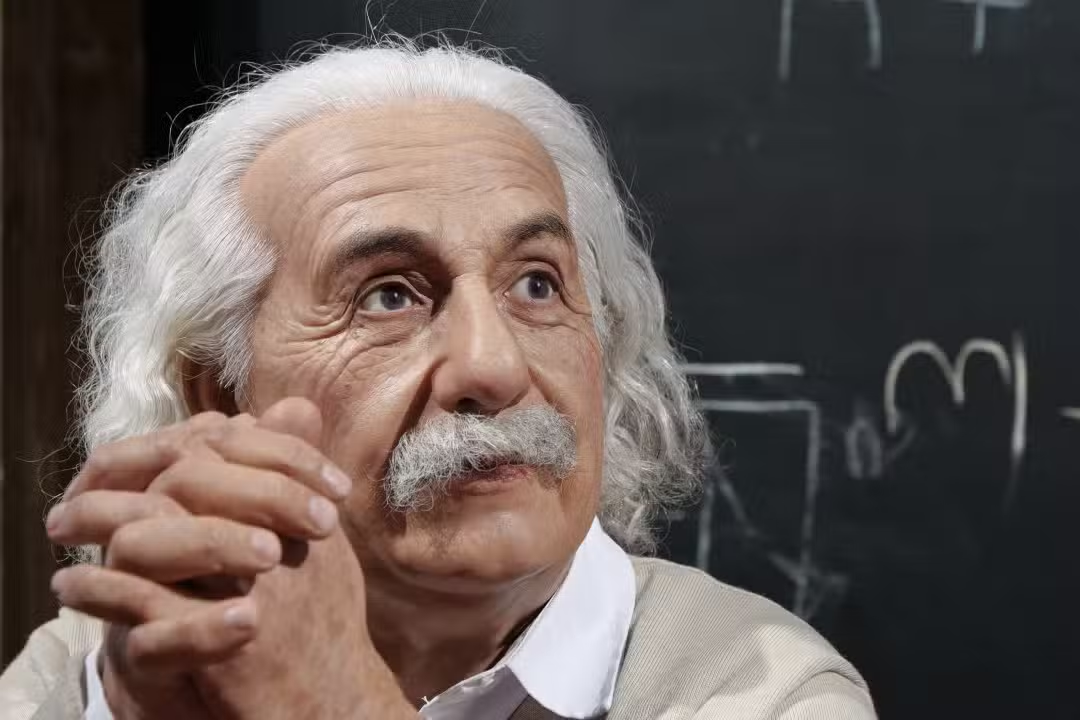
Understanding gravity is going through a period of transition in theoretical physics departments around the world. The classical model established by Albert Einstein accurately describes the behavior of planets and galaxies. However, the framework fails when trying to explain phenomena on a subatomic scale. Pesquisadores are now looking for a mathematical formulation capable of unifying the rules of the macrocosm with the laws of quantum mechanics.
Current scientific efforts attempt to resolve a fundamental incompatibility that has persisted for decades. General relativity treats the universe as a continuous, malleable fabric. In contrast, the quantum world operates in discrete jumps and unpredictable fluctuations. Essa contradiction prevents the creation of a theory of everything, forcing the academic community to develop alternative hypotheses to explain the most familiar force of nature.
The evolution of the concept of space-time in physics
Durante centuries, Newtonian mechanics provided the basis for calculating the attraction between bodies with mass. The system worked to predict the orbit of most stars and the behavior of objects on the Earth’s surface. Contudo, rigorous astronomical measurements revealed anomalies. The displacement of the perihelion of the planet Mercúrio represented a deviation that classical equations could not justify.
The paradigm shift occurred at the beginning of the last century. Albert Einstein presented the theory of special relativity in 1905. The physicist established that the speed of light in a vacuum is a universal constant, independent of the observer’s reference frame. The concept merged spatial and temporal dimensions into a single geometric mesh. Special relativity, however, applied only to inertial frames of reference, leaving out the effects of acceleration.
Expanding the model required a decade of mathematical work. Einstein published general relativity in 1915, redefining gravity. Force is no longer seen as an invisible attraction from a distance. The new formulation described the phenomenon as the direct consequence of the curvature of space-time generated by the presence of mass and energy. A massive object like Sol deforms the environment around it, forcing planets to follow geodetic trajectories in this altered geometry.
The principle of equivalence supported this theoretical construction. The scientist imagined thought experiments involving elevators in free fall or constant acceleration in outer space. The conclusion indicated that the effects of a gravitational field are locally indistinguishable from the effects of an acceleration. A person inside a closed cabin would not be able to determine whether they are standing on the surface of Terra or being pulled upwards by a rocket with equivalent acceleration.
Astronomical Comprovações and the role of telescopes
The Einstein equations have gained rapid and ongoing empirical validation. Observações performed during solar eclipses demonstrated that light from distant stars is bent as it passes close to the edge of Sol. The light beam follows the curvature of space, confirming the mathematical prediction.
Advances in optical instrumentation have made it possible to observe the effect of gravitational lensing on a cosmological scale. Massive Galáxias and clumps of dark matter act as natural magnifying glasses. Eles distort and magnify light from sources positioned far behind them in the universe. The James Webb space telescope uses this property frequently. The equipment captures detailed images of remote structures by pointing at dense clusters, such as El Gordo.
Outro phenomenon attested by modern observations is gravitational redshift. Quando light tries to escape an intense gravitational field, it loses energy. Esse process lengthens the wavelength of the radiation, shifting it toward the red end of the electromagnetic spectrum. Astrônomos routinely measure this effect by analyzing light emission near black holes and neutron stars.
The scientific impasse with quantum mechanics
The success of general relativity on macroscopic scales contrasts with its failure in the microscopic domain. Quantum theory describes the electromagnetic, strong nuclear and weak nuclear forces with extreme precision. The quantum vacuum is not empty, but full of fluctuations where virtual particles continually appear and disappear.
The attempt to apply quantum rules to gravity generates absurd mathematical results. The equations produce infinite values that physicists cannot eliminate through standard renormalization techniques. The incompatibility arises from profound structural differences between the two models:
- General relativity requires perfectly smooth and continuous spacetime to function properly.
- Quantum mechanics introduces uncertainty and graininess at the smallest possible scales of matter.
- Gravity alters the very spatial arena where quantum events should occur stably.
Para tried to get around the problem, theorists postulated the existence of the graviton. The hypothetical particle would act as the mediator of gravitational force, just as the photon transmits electromagnetism. Até At the moment, no experiment has managed to detect a graviton. The extreme weakness of gravity compared to the other fundamental forces makes direct observation of this particle a complex technological challenge with current technology.
Teorias contemporary for the unification of forces
The search for a theory of quantum gravity has generated several independent lines of research. Superstring theory represents one of the most studied approaches in recent decades. The model replaces point particles with one-dimensional filaments of energy that vibrate at different frequencies. String mathematics requires the existence of extra spatial dimensions and naturally includes a particle with the properties of the graviton.
A robust alternative is loop quantum gravity. Essa strand does not attempt to unify all forces, but focuses exclusively on quantizing space-time itself. The theory suggests that space is not continuous, but made up of discrete, indivisible units on the scale of Planck. Redes of intertwined loops would form the geometric structure of the universe, eliminating the need for additional dimensions and avoiding mathematical infinities.
The holographic principle introduced a radical perspective to the physics debate. Derivada from studies on the thermodynamics of black holes, the hypothesis proposes that all the information contained in a three-dimensional volume can be described by interactions in its two-dimensional boundary. Sob from this perspective, gravity would not be a fundamental force. Ela would emerge as a thermodynamic effect or a macroscopic illusion generated by underlying quantum processes.
Observational cosmology continues to provide data to test the limits of human knowledge. The discovery of dark energy, responsible for the accelerated expansion of the universe, resurrected the cosmological constant originally proposed by Albert Einstein. Detectores like the LIGO observatory capture gravitational waves generated by the merger of black holes, confirming the behavior of spacetime under extreme conditions. The scientific community analyzes these signals in search of quantum signatures that could finally indicate the correct path towards the unification of physics.