

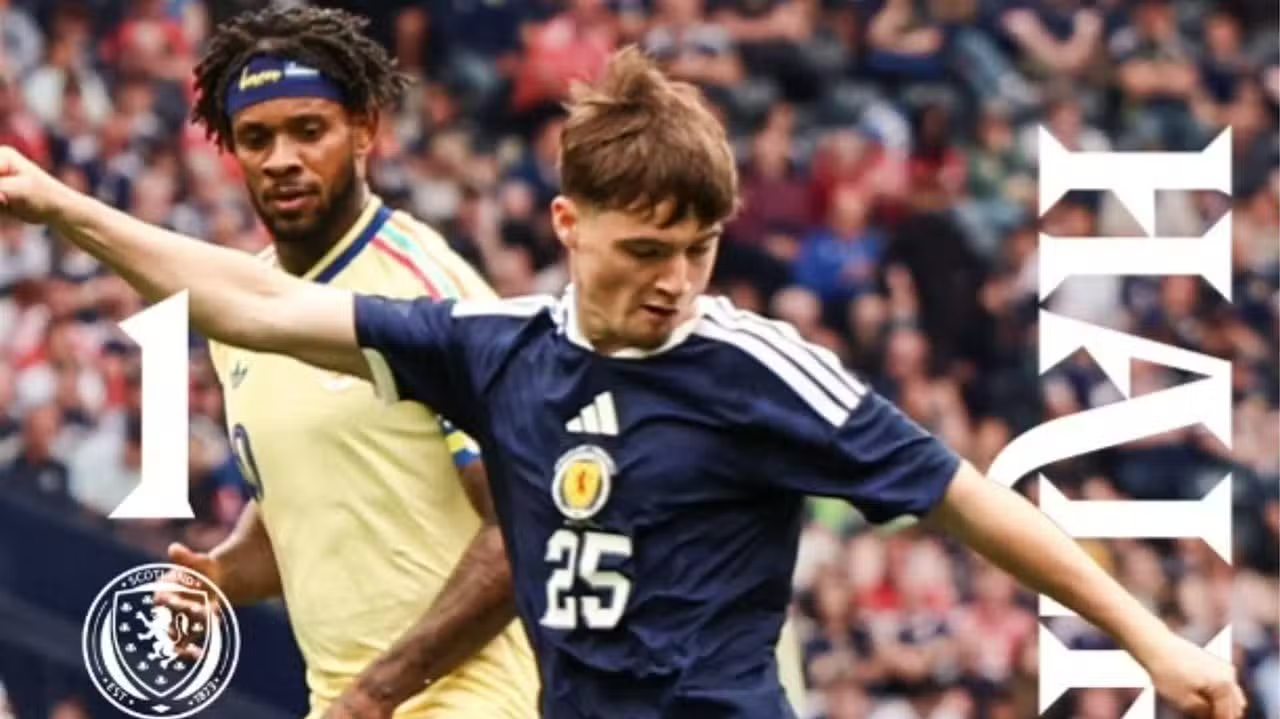
The Escócia team and the Curaçau team draw 1-1 in the international friendly held at Barclays Hampden, located in the city of Glasgow. The match reached half-time with the score level after a first half marked by physical intensity and fierce battles in midfield. The visiting team surprised local fans by opening the scoring in the opening minutes of the match. The home team sought equality in first-half stoppage time, ensuring a breather before going to the changing rooms.
The duel took on a dramatic turn with the direct expulsion of striker Juergen LOCADIA shortly before half-time. The numerical disadvantage forced the Curaçau team to immediately withdraw their marking lines. Coach Steve Clarke took advantage of the opponent’s moment of instability to reorganize the Scottish tactical scheme and increase offensive pressure. The friendly serves as fundamental preparation for the next official commitments of the two teams in the calendar stipulated by football’s highest entity.
The initial scenario and the opening of the scoreboard at Barclays Hampden
The first minutes of the clash showed two teams willing to control the pace of the game through possession of the ball. The Escócia team tried to impose its technical superiority with the massive support of the fans present in the stands at Glasgow. Striker George HIRST recorded the first dangerous shot after just 3 minutes of the ball rolling. The opposing defense managed to block the initial attempt efficiently. The home team’s offensive momentum came up against the strong marking imposed by the visiting defenders from the opening whistle.
Curaçau’s team was not intimidated by the initial pressure and began to explore the spaces left by the Scottish full-backs during their attacks. Full-back Jurien GAARI and midfielder Juninho BACUNA committed precise tactical fouls to break the home team’s transition rhythm. Aos 9 minutes, captain Andrew Robertson risked a long-range shot to try to break through the block. The visiting goalkeeper made a safe save in the center of the goal. Curaçau’s reactive and calculating stance bore fruit in the 17th minute of the opening stage. Midfielder Tahith CHONG received a precise pass from teammate Armando Obispo and finished with no chance of saving the Scottish goalkeeper. The score marked 1-0 for the visitors, changing the atmosphere in the stadium.
The expulsion of Juergen LOCADIA and the immediate reaction of those in charge
The goal conceded forced the Escócia team to advance their marking lines in search of recovering the loss on the scoreboard. The game became considerably tougher in the midfield sector, with strong fights for possession of the ball. Disputes for space resulted in successive infractions committed by athletes on both sides of the field. Aos 36 minutes, the match referee issued a yellow card to try to contain the players’ heated spirits. The tactical scenario of the match changed drastically just two minutes after this disciplinary event. Striker Juergen LOCADIA committed a hard foul in the defense field and received a straight red card in the 38th minute.
The sudden expulsion left Curaçau’s team with just ten players on the field during a critical pressure moment in the friendly. The visiting coach needed to reorganize the defensive system immediately to avoid a collapse before the break. Apesar clearly outnumbered, the athlete Juninho BACUNA still found space to risk a dangerous finish in the 40th minute. Scottish pressure increased considerably in the final minutes of the first half, pushing the opponents into their own area. Aos 45 minutes, midfielder Findlay Curtis took advantage of a millimetric assist from Kenny McLEAN to finish with precision and tie the duel. The equalizing goal completely changed the dynamics and expectations for the second half.
Principais moves that defined the first stage of the confrontation
The first half of the international friendly featured a succession of quick events that led to a 1-1 score at the stadium. The intensity of the physical disputes reflected the importance of the preparatory test for the two technical committees involved. The crucial moments of the match occurred in short intervals of time.
- Aos 3 minutes, George HIRST finishes with danger and scares the defensive line of Curaçau’s team right from the start.
- Aos 17 minutes, Tahith CHONG opens the scoring with a well-aimed shot after receiving a through ball from Armando Obispo.
- Aos 36 minutes, the referee presents the first yellow card of the game after a sequence of fouls in midfield.
- Aos 38 minutes, Juergen LOCADIA receives a straight red card and leaves the visitors with one less athlete on the pitch.
- Aos 45 minutes, Findlay Curtis scores the equalizer for Escócia with a decisive pass from teammate Kenny McLEAN.
- Aos 46 minutes, Andrew Robertson tries to turn it around with a strong shot from outside the area during injury time granted by the referee.
The sequence of offensive moves demonstrated the Scottish team’s ability to react quickly after the initial scare with the goal conceded. The expulsion of the opposing striker acted as a real turning point in the offensive construction of the home team. Curaçau’s technical committee had to rethink the entire counterattack strategy originally designed for the confrontation. The final whistle of the first half brought momentary relief to the exhausted visitors.
Alterações Steve Clarke tactics to exploit numerical advantage
The match’s break served for the coaches to adjust their teams in light of the new tactical scenario imposed by the red card. Coach Steve Clarke decided to modify the central structure of the Escócia team to increase the volume of offensive play and ball possession. The scorer of the equalizing goal, Findlay Curtis, left the pitch in the 42nd minute of the first half for midfielder Billy Gilmour to enter. The change sought to improve passing in the creation sector and accelerate the transition between defense and attack. The Scottish coach made a total of five additional substitutions before the match officially resumed.
The changes made in the locker room altered the backbone of the home team for the complementary stage. The player Tyler Fletcher took over Ben GANNON-DOAK’s place in the defensive midfield sector. Defender Nathan PATTERSON replaced Aaron HICKEY to renew his breath and speed on the sides of the field. The defense also underwent direct changes with the entry of John SOUTTAR in the place of the holder Grant Hanley. In the attack command, George HIRST gave up his space for the entry of Lyndon DYKES. The last Scottish change involved the departure of Dominic HYAM for the entry of defender Scott MCKENNA. Do alongside Curaçau’s selection, the player Gervane KASTANEER replaced Riechedly Bazoer with the exclusive mission of rebuilding the weakened defensive system.
The impact of the red card on the dynamics of the international friendly
The second stage of the confrontation began with a clear and highly predictable tactical design due to the expulsion that occurred in the first half. The Escócia team took complete control of ball possession in the attacking field, pushing the opponent back. Curaçau’s team set up two compact defensive lines very close to the penalty area to deny space to the attackers. The visitors’ main objective became to protect the result of a draw and exploit possible counterattacks at maximum speed. A player’s numerical advantage requires extreme patience from the home team to be able to break through the opponent’s block without making passing errors.
The friendly played at Barclays Hampden offers a valuable tactical test on how to attack teams that are completely closed in defense. Scottish players rotate the ball from one side of the pitch to the other looking for small gaps in Curaçau’s marking line. The absence of striker Juergen LOCADIA drastically reduced the visitors’ firepower, but increased the defensive solidarity of the remaining athletes. The international confrontation remains open and totally dependent on the Scottish midfield’s ability to create and infiltrate. The match fulfills its fundamental role of preparing the squads for adverse and unpredictable scenarios in future official national team competitions.