

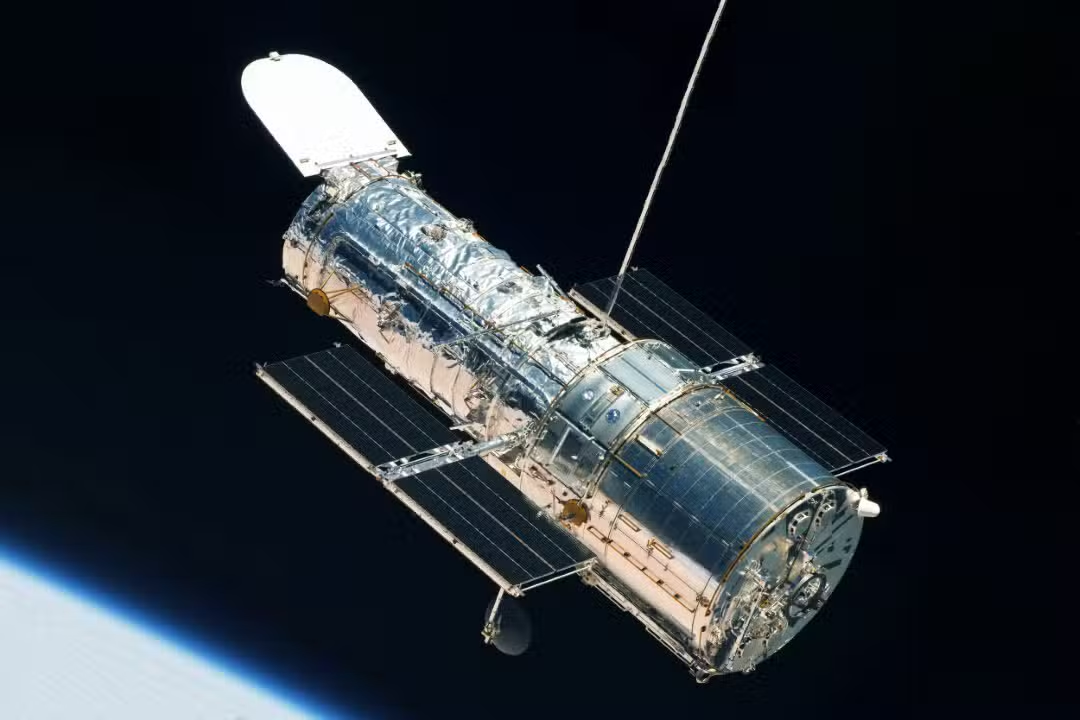
Telescópio Espacial Hubble, operated by NASA, released a new image on Wednesday (27). The reveal details the dwarf irregular galaxy ESO 490-017. Este celestial object, 12 thousand light years in diameter, is located approximately 23 million light years from Terra. The galaxy is located in the constellation Cão Maior.
Capturing this image is part of a broader observation program of Hubble. The main objective is to map and analyze the movement of galaxies and galaxy clusters through outer space. Esta initiative aims to deepen understanding of the uneven distribution of matter in the universe. The gravitational influence exerted by this matter drives the so-called “cosmic flow”. Esse phenomenon describes the displacement of large-scale structures throughout the observable universe, offering crucial insights into cosmic dynamics.
Details Descoberta of dwarf irregular galaxy ESO 490-017
The dwarf irregular galaxy ESO 490-017 shows notable features in the captured image. Devido’s low surface brightness manifests itself as a faint star cluster, a challenging aspect for astronomical observations. The galaxy appears positioned visually behind brighter stars.
Essas foreground stars are easily identifiable due to their distinct diffraction peaks in the photograph. The black background of the photographic record is dotted with numerous dots. The predominant colors are red, orange and beige, indicating the presence of more distant galaxies. Muitas of these galaxies exhibit a very distinct spiral structure, contrasting with the irregular nature of ESO 490-017. The data collected for this specific image of the galaxy ESO 490-017 is part of a broader program. Esse Hubble program is dedicated to mapping and detailed analysis of the movement of galaxies and their clusters through space, contributing to cosmological models.
- The ESO 490-017 image revealed the following visual features:
- The galaxy appears as a faint star cluster due to its low surface brightness.
- Ela appears positioned behind brighter stars in the foreground.
- Estrelas in the foreground are identifiable by diffraction peaks.
- The background of the photographic record displays dots in red, orange and beige colors.
- Muitas distant galaxies, visible in the background, have a spiral structure.
Cosmic Mapeamento by Telescópio Espacial Hubble
Telescópio Espacial Hubble continues to be an essential tool for modern astronomy, even after decades of operation. Sua’s ability to capture high-resolution images of distant celestial objects enables significant advances in understanding the universe. The observing program that generated the image of ESO 490-017 is a clear example of this ongoing effort. Ele focuses on the dynamics of galaxies, seeking to understand how they interact and move on a large scale.
Analyzing the motion of galaxies and clusters provides crucial data for testing and refining theories about cosmic evolution. Hubble observations have allowed scientists to document the expansion of the universe, the age of distant objects and the presence of supermassive black holes in galactic centers. Cada new image, like that of ESO 490-017, adds a piece to the cosmological puzzle. Ela expands the catalog of known objects and helps fill gaps in knowledge about the formation and fate of universal structures. The longevity and stability of Hubble operations guarantee a robust database for long-term studies, essential for space science.
Influência of matter in the dynamics of cosmic flow
Informações scientific principles underlie the study of the distribution of matter in the universe. Matter is not uniformly distributed, a fact that has profound implications for cosmic dynamics. It is the gravitational influence exerted by this matter that drives the so-called “cosmic flow”. The term Este describes the displacement of large-scale structures throughout the universe. Compreender the cosmic flow is fundamental to unraveling how galaxies group together and form the largest collections of matter in the universe.
Observations of galaxies like ESO 490-017, even if faint and irregular, are vital for mapping this distribution. Cada galaxy contributes its mass to the local gravitational field, influencing the movement of other structures. Studying cosmic flow helps scientists model the evolution of the universe since Big Bang. Ele allows us to understand how agglomerations of matter developed over billions of years. Dark matter, an invisible form of matter that does not interact with light, plays a significant role in these gravitational dynamics. Embora cannot be observed directly, its presence is inferred by its gravitational influence on galaxies and clusters, affecting the cosmic flow.
Colaboração Webb and Hubble in star formation
A recent paper published in the journal *Nature Astronomy* offers extraordinary insight. The study details the formation of stars and the impact of these processes on the evolution of galaxies. Cientistas used images collected by the James Webb (JWST) and Hubble space telescopes. Ambos telescopes are from NASA, in partnership with Agência Espacial Europeia (ESA). Essa collaboration allowed us to observe unprecedented details of huge star clusters.
Esses clusters are often hidden in dense clouds of gas and cosmic dust. The Webb’s infrared capability complements the Hubble’s optical and ultraviolet vision. Juntos, they can penetrate these clouds, revealing the crucial early stages of star formation. Combining data from both telescopes provides a more complete understanding of how stars are born and how these events shape the environment and structure of their host galaxies. The formation of stars in “stellar nurseries” is a fundamental process. Ela influences the chemical composition, morphology and growth rate of galaxies over time. Esta joint research exemplifies the synergy between space missions, expanding the frontiers of astronomical knowledge.