

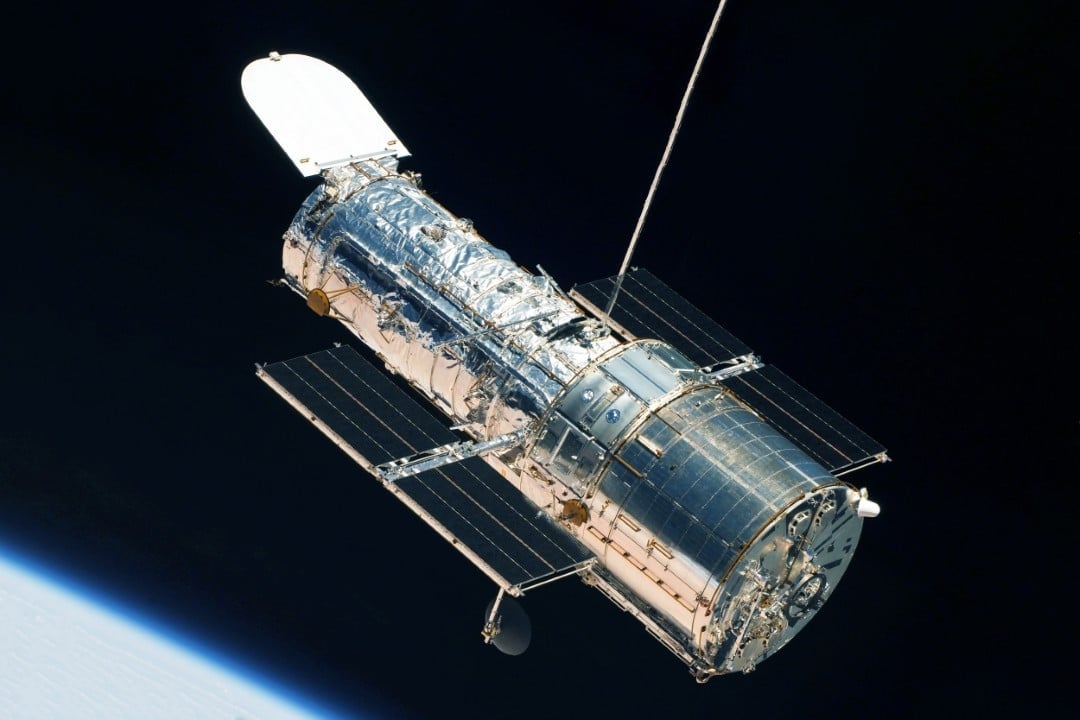
Telescópio Espacial Hubble has captured a new image of the dwarf irregular galaxy ESO 490-017, located 23 million light-years from Terra. The equipment operated by NASA captured the celestial object measuring 12 thousand light years in diameter in the constellation Cão Maior. The observation is part of a program focused on mapping the movement of spatial structures. Scientists use the orbiting observatory’s high-precision lenses to catalog the physical properties of smaller galactic systems.
The project seeks to understand the uneven distribution of matter in the universe and its long-distance gravitational effects. The data collected helps astronomers analyze the cosmic flow, a phenomenon that dictates the displacement of entire galactic clusters. The initiative provides essential information for modeling large-scale cosmic dynamics. The continuous recording of these movements allows us to test the limits of current theories of modern astrophysics.
Características visuals and astronomical observation challenges
ESO 490-017 exhibits extremely low surface brightness in recent captures. Essa characteristic makes the galaxy resemble a faint star cluster, making direct analysis by traditional optical instruments difficult. The object is visually positioned behind much brighter stars located in the foreground. Astronomers need to isolate the light from these nearby stars to study the dwarf galaxy’s irregular structure accurately. The lack of a defined core or spiral arms classifies the system as an irregular formation.
The frontal stars have diffraction peaks evident in the photographs released by space agencies. Esse optical effect occurs due to the interaction of light with the internal supports of the space telescope during the long exposure time. The background of the image reveals a large number of luminous points in shades of red, orange and beige. Essas colors indicate the presence of galaxies much older and more distant from our solar system. The redshift of the light proves the accelerated expansion of the space fabric.
Diferente from the disorganized form of ESO 490-017, many of these background galaxies have a well-defined spiral structure. Visual contrast helps researchers calibrate distance and luminosity measuring instruments. The photographic record serves as a dual-use tool for astronomical science. Ele documents the main object and maps the deep field of the observable universe in the same direction. The longevity of the equipment guarantees the construction of an invaluable historical archive.
Dinâmica of the cosmic flow and influence of dark matter
Spatial mapping conducted by Hubble investigates the driving force behind the movement of galaxies. Visible and invisible matter does not have a uniform distribution throughout outer space. Essa asymmetry generates complex gravitational fields that pull cosmic structures in specific directions over billions of years. The continuous displacement resulting from this mutual attraction is called cosmic flow. The cruising speed of galaxies reveals the magnitude of the forces involved in the process.
Compreender this flow requires the systematic observation of thousands of galaxies at different distances and viewing angles. Cada celestial object, regardless of its size, contributes a portion of mass to the total gravitational attraction of its region. ESO 490-017 serves as a local reference point for measuring these invisible currents that cut through the cosmos. Scientists use the galaxy’s speed and direction to calculate the force exerted by neighboring massive clusters.
Dark matter acts as the main invisible component in this complex gravitational equation. The material does not emit, absorb or reflect light, making direct detection by conventional telescopes based on Terra or in space impossible. Astronomers infer the presence and amount of dark matter by observing how it distorts space and accelerates surrounding galaxies. Modeling the cosmic flow directly depends on accurately mapping these concentrations of invisible mass. The behavior of ESO 490-017 offers clues about the density of dark material in the constellation Cão Maior.
Elementos identified in the mission’s photographic record
The detailed analysis of the image captured by Hubble allowed the cataloging of several distinct spatial components. The researchers separated the elements by proximity, temperature and visual composition to facilitate the study.
- The main galaxy appears as a faint star cluster due to low light output.
- Bright Estrelas of Via Láctea occupy the foreground of the photographic composition.
- Picos diffraction marks the most intense light sources closest to the lens.
- Galáxias distant spirals make up the background in reddish and orange tones.
- The contrast in shapes highlights the evolutionary difference between the recorded celestial objects.
The visual separation of these elements facilitates data processing work in NASA laboratories. Imaging algorithms filter light interference to isolate frequencies emitted exclusively by the dwarf galaxy. Esse digital processing guarantees the precision of photometric measurements necessary for the study of spatial movement. The refinement of filtering techniques represents an important methodological advance for observational astronomy.
Sinergia among space telescopes in cosmological research
The exploration of the universe takes on new contours with the simultaneous operation of different cutting-edge orbital observatories. A recent study published in the journal Nature Astronomy demonstrated the practical potential of this integrated approach. The research brought together data from the Hubble and the James Webb telescope to investigate the mechanics of star formation. The work included direct technical collaboration between NASA and Agência Espacial Europeia. Joining forces maximizes the scientific return on billion-dollar investments in space technology.
Stellar nurseries are often hidden by dense layers of cold gas and impenetrable cosmic dust. Hubble captures images in visible and ultraviolet light, mapping the outer edges of these gigantic interstellar clouds. James Webb uses state-of-the-art infrared sensors capable of penetrating dust and recording the heat of newborn stars. The combination of these two bands of the electromagnetic spectrum provides an unprecedented three-dimensional view of the clusters. Astronomers can observe the stellar life cycle since the initial gravitational collapse.
The birth of new stars irreversibly alters the chemical composition and physical structure of their host galaxies. The intense radiation emitted by young stars pushes the surrounding gas and regulates the rate of formation of future stellar generations. Continuous monitoring of these dynamic processes allows scientists to reconstruct the evolutionary timeline of the universe since Big Bang. The complementarity of space instruments ensures the continuity of astronomical discoveries in the coming decades. The observation of ESO 490-017 cements Hubble’s role as an indispensable tool for science.