

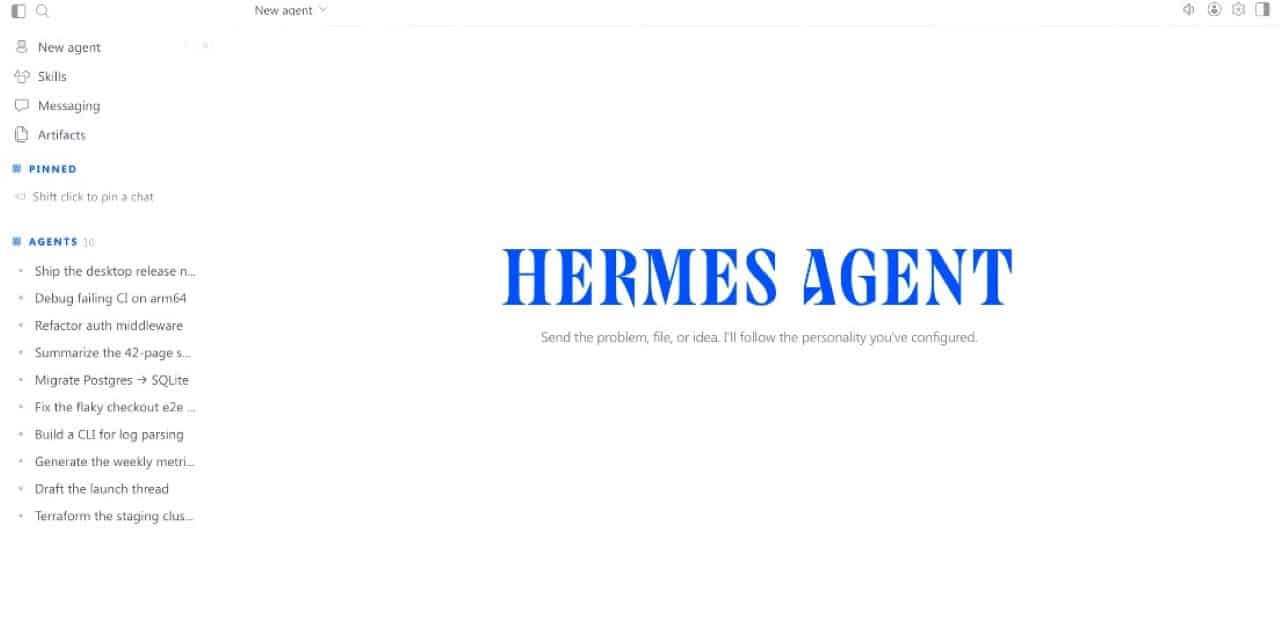
Nous Research released the public preview version of Hermes Desktop this Tuesday. The native application allows you to manage the Hermes Agent autonomous agent through a graphical interface. Usuários from Windows 10/11, macOS 12 and Linux distributions now have a more affordable option to run the system.
Hermes Agent has gained recent attention for its continuous learning capability. Ele builds skills from interactions and maintains persistent memory of projects. Antes, the configuration required advanced technical knowledge, which limited access.
Native App unifies experience across different platforms
Hermes Desktop runs locally and maintains all the functionality of the main agent. Ele integrates the same core used in the CLI version and the gateway. Nous Research highlights compatibility with Windows, macOS and Linux as the central point of the new tool.
- The application supports Telegram, Discord, Slack, WhatsApp, Signal, Email and CLI
- Usuários switch between platforms without losing context or accumulated memory
- The graphical interface makes it easy to monitor actions in real time
Installation takes place directly via the official website. On macOS, simply download the .dmg file. Para Windows, the .exe executable is available. No Linux, the option via terminal remains as an alternative.
Recursos majors expand agent autonomy
The Hermes Desktop includes several capabilities that make the agent more practical on a daily basis. The permanent memory function allows the system to learn from previous tasks and generate skills automatically. Isso creates a profile that is increasingly aligned with the user over time.
Outra feature is natural language scheduling. The user can request reports, backups or briefings at specific times. The system performs these tasks even when the computer is in minimal use.
The delegation feature creates independent subagents. Cada operates with its own conversations, terminal and Python RPC scripts. Essa approach avoids excessive context consumption and organizes complex flows.
Isolated Sandbox ensures safety in experiments
The testing environment on Hermes Desktop offers five backends: local, Docker, SSH, Singularity and Modal. The implementation uses container hardening and namespace separation. Isso reduces risks when running code or automation.
The agent also browses the web, operates browsers, generates images and reads text. Todas these tools work integrated into the interface.
Modelos AI and gateway options
Users choose template providers directly in the app. Nous Research recommends Nous Portal, which offers Free, Plus, Super, and Ultra plans. Paid versions include monthly credits and access to over 300 updated templates.
Outros services like OpenAI, Anthropic, and local endpoints are also supported. Configuration occurs visually, without the need to edit files manually in most cases.
Como Hermes Agent differentiates itself from other solutions
Muitos autonomous agents are restricted to specific environments such as IDEs or isolated chatbots. The Hermes Agent operates in a transversal manner. Ele maintains a single memory that expands regardless of the platform used.
Essa approach allows the system to evolve with the user. Quanto the more interactions occur, the greater the ability to anticipate needs and solve problems autonomously.
The launch of the desktop app reduces the initial technical barrier. Antes, installation and maintenance required familiarity with server environments and command lines. Agora, the focus can be more on practical use.
Integrações and expected use cases
Profissionais developers can connect the agent to repositories and workflows. Equipes automation systems find value in the ability to schedule repetitive tasks. Advanced Usuários explores the creation of pipelines with multiple subagents.
Nous Research maintains the project as open source under the MIT license. The community is already contributing to improvements to the interface and accessibility features.
Hermes Desktop represents a step towards making autonomous agents more accessible. The combination of a user-friendly interface and advanced learning capabilities should appeal to both developers and end users looking for AI-based productivity tools.