

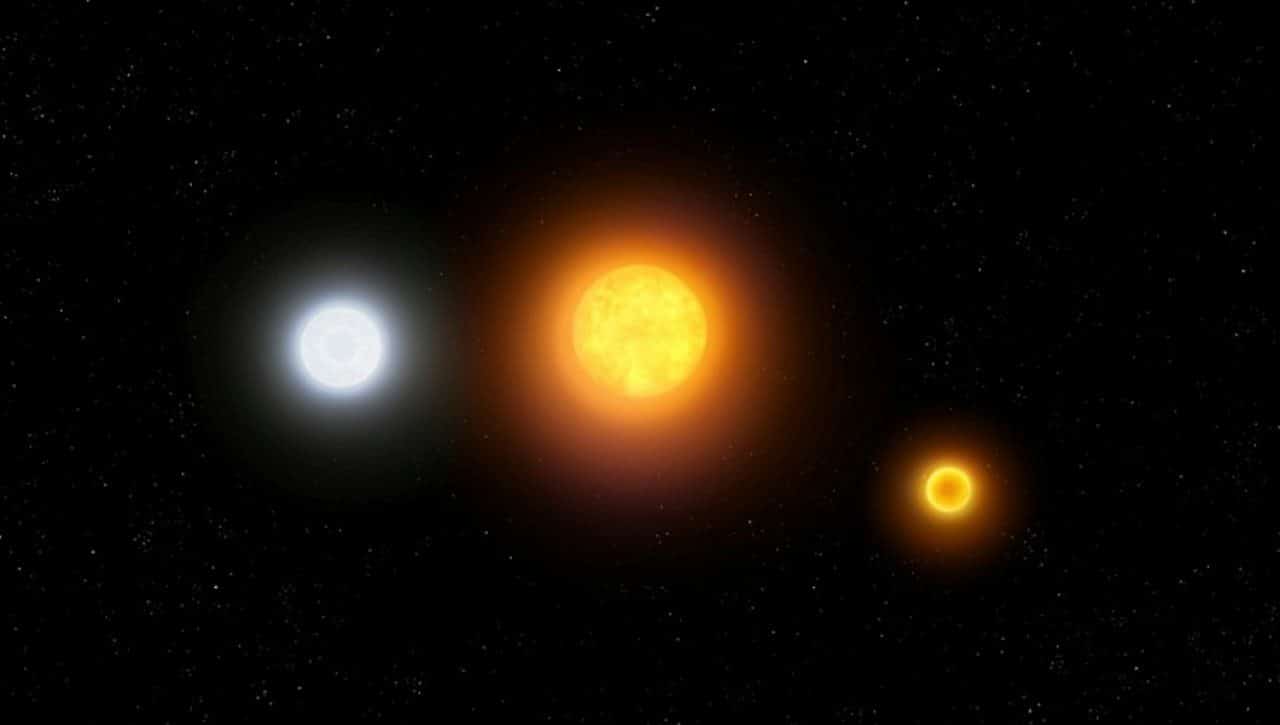
Astrônomos identified a triple star system where the three stars eclipse each other from Terra’s point of view. NASA’s TESS mission recorded the phenomenon at object TIC 295741342, located 3,080 light years away. The system brings together two stars similar to Sol in an internal binary and a third, larger star that orbits them.
Precise alignment allows eclipses to occur in a threefold fashion. Isso makes the case one of the most studied among known triple systems.
Internal Binária has stars almost identical to Sol
Duas main stars form the central pair of the system. Elas have a mass and size close to Sol and orbit each other in 4.75 days. With each cycle, one passes in front of the other and causes a drop in the total observed brightness.
Essas stars are of the main sequence type. Seus internal eclipses generate the characteristic “shoulders” pattern in the light curve captured by TESS.
The outer star, with 1.7 solar masses and 10.6 times the radius of Sol, completes one revolution around the binary every 412.8 days. Quando is positioned in front of the pair, the eclipse deepens and forms the “head” of the pattern.
- The two stars in the binary contribute about 2.7% and 2.3% of the total light at the wavelength observed by TESS.
- The giant star accounts for approximately 95% of the system’s brightness.
- The coplanar alignment is almost perfect, with very low mutual inclination.
- The system is 3,080 light years from Terra.
Curva Light Reveals Head and Shoulders Pattern
The TESS satellite monitored brightness over time in different sectors. The data shows repeated drops that follow a specific sequence. Primeiro eclipse occurs between the two inner stars. Depois the external giant covers both at the same time.
Essa configuration produces the “head and shoulders” shape of the inverted curve. The entire event was clearly recorded on the mission’s Setor 33.
NASA astronomer Brian Powell of Centro of Voos Espaciais Goddard analyzed the data. Ele highlighted that few triple systems exhibit such precise alignment in such a wide configuration.
Formação due to protostellar disk fragmentation
Astrônomos believe that the three stars emerged from the same disk of gas and dust. The disk fragmented and gave rise to the companions. Depois inward orbital migration occurred.
Essa formation pathway explains coplanar alignment. In other triple systems, the outer star is often captured at a different angle.
The process of disk fragmentation is not rare. Centenas of similar cases were cataloged thanks to Kepler and TESS. But few receive the level of detail applied to TIC 295741342.
Modelo combines light, speeds and stellar evolution
Pesquisadores used 48 radial velocity spectra collected over four years. The data comes from the TRES telescope. Spectrophotodynamic modeling integrated light curves, eclipse times, spectral energy distribution and velocities.
Dois scenarios proved to be compatible. In one, the giantess climbs the giant red branch. In the other, it is in the horizontal branch and will go to the giant asymptotic branch.
In both cases, the outer star should fill Roche’s lobe in the future. Isso could lead to stable mass transfer to the binary or to common envelope evolution, with possible material ejection or melting.
Próximo external eclipse predicted for September
Calculations indicate that the next eclipse of the giant star over the binary should occur on September 1, 2026. Observadores has a window of approximately three days to record the complete event.
Novos data can refine system parameters. The alignment allows for precise measurements of radii, masses and orbits.
The system offers a rare opportunity for real-time studies of stellar evolution. Astrônomos plan continued monitoring over the next few years.