

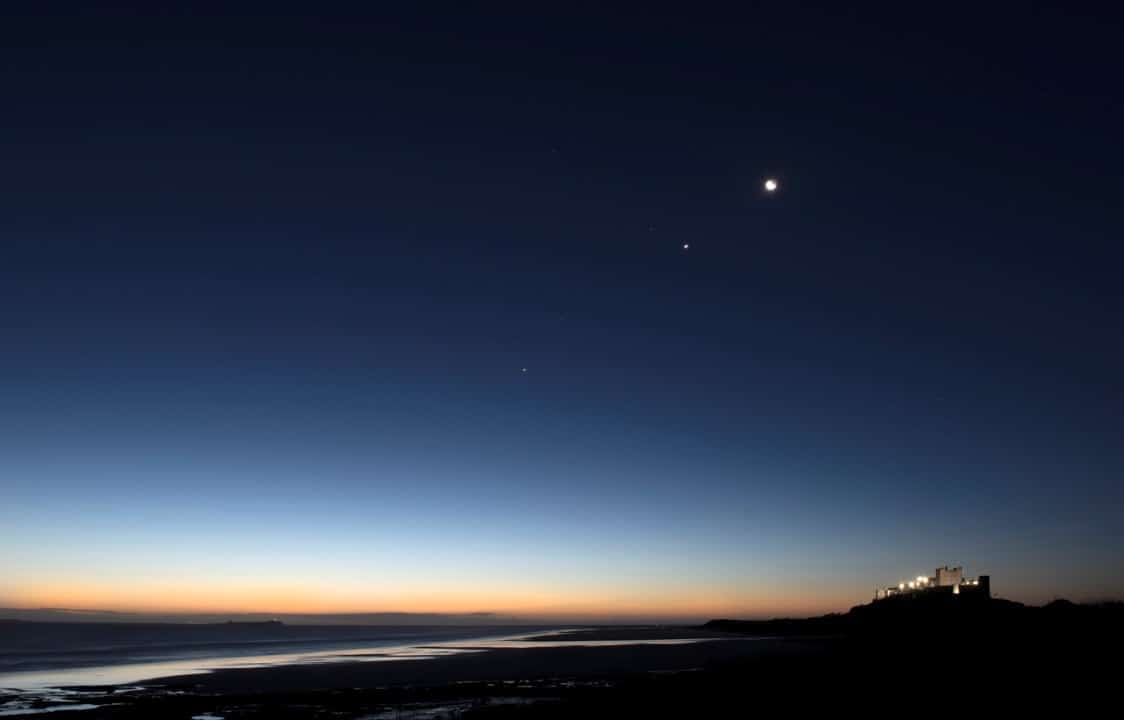
A rare conjunction between Vênus and Júpiter will take place on June 9th. The two brightest planets in the sky will come closer together until they are just 1.6° apart. Qualquer person will be able to observe the phenomenon with the naked eye at dusk, looking west-northwest.
The event takes place at a favorable time. Basta observe between 45 minutes and two hours after sunset. The planets will be at a height equivalent to one or two clenched fists above the horizon. Moradores from large cities can also see the spectacle if they find a patch of open sky.
Planetas have been approaching for weeks in the western sky
Vênus and Júpiter have been gradually getting closer since the end of May. On May 28, the distance between them was 11.5°. On June 9, this separation drops to 1.6°, little more than the width of a little finger at arm’s length.
The conjunction will be visible throughout Brasil. The pair of planets will appear in the twilight, with Vênus slightly ahead of Júpiter from Terra’s point of view. Mercúrio also participates in the show, positioned about 13° to the right and below the duo.
- Vênus shines with greater intensity because of the reflective clouds
- Júpiter appears right next to it, with also high magnitude
- Mercúrio requires binoculars for easier viewing
- The trio is concentrated in the west-northwest region of the sky
Última conjunction occurred in 2025 at dawn
The previous conjunction between Vênus and Júpiter took place on August 11, 2025. Naquela occasion, the meeting took place at dawn, which limited the audience. Desta instead, the dusk time allows many more people to follow the phenomenon.
The next opportunity after June 2026 will only come on August 25, 2027. Porém, the planets will be very close to Sol, which should make observation difficult. The most accessible visible reunion is scheduled for November 10, 2028, again at dawn.
Simple Observação reveals details of the solar system
Qualquer person can follow the event without equipment. Both planets are bright enough to stand out even in urban skies. Binóculos helps frame the two bodies in the same field of view and allows us to see some of Júpiter’s moons.
Small Telescópios show the cloud bands on the gas giant and the gibbous phase of Vênus. Mesmo thus, the natural spectacle gains more impact when seen with just the eyes. The slowness of the movement throughout the days helps to perceive the orbits in action.
The apparent movement results from the combination between the planets’ orbits and the displacement of Terra. Vênus, closer to Sol, moves faster in the sky. Júpiter, distant, has a slower speed and ends up approaching the western horizon.
Mercúrio completes the planetary trio in the twilight
Mercúrio appears as an additional attraction. The minor planet shines at zero magnitude, about 12° to 13° to the right and below Vênus and Júpiter. Sua viewing requires an unobstructed northwest horizon, but binoculars make the task easier.
The planetary trio remains visible for several days. Entre June 7th and 10th, the distance between Vênus and Júpiter is below 2.5°. Isso allows you to track the position change night after night.
Rising Lua joins the show in mid-June
The phenomenon does not end on June 10th. Nos June 16th and 17th, a thin 2.5-day crescent Lua aligns with the three planets. The alignment forms another stunning scene in the western sky.
Astrônomos amateurs record the event with cell phones. A photo taken on June 1st with an iPhone 13, using an exposure of around 3.4 seconds, has already captured the planets in good quality. Beautiful Paisagens in the foreground enrich the images.
The conjunction illustrates the orbital ballet of the solar system. Vênus moves quickly, Júpiter moves more slowly, and Terra determines the viewpoint that allows visual alignment. The event transforms the twilight sky into a spectacle accessible to everyone.
Dicas practices to take advantage of conjunction
Escolha a location with a clear view to the west-northwest. Evite excessive light pollution, but the phenomenon resists well in city skies. Chegue in advance to adapt the eyes to the dark.
Observe at different times within the 45-minute to two-hour window after sunset. The height of the planets changes as time passes. Compare their position on consecutive nights to notice movement.