

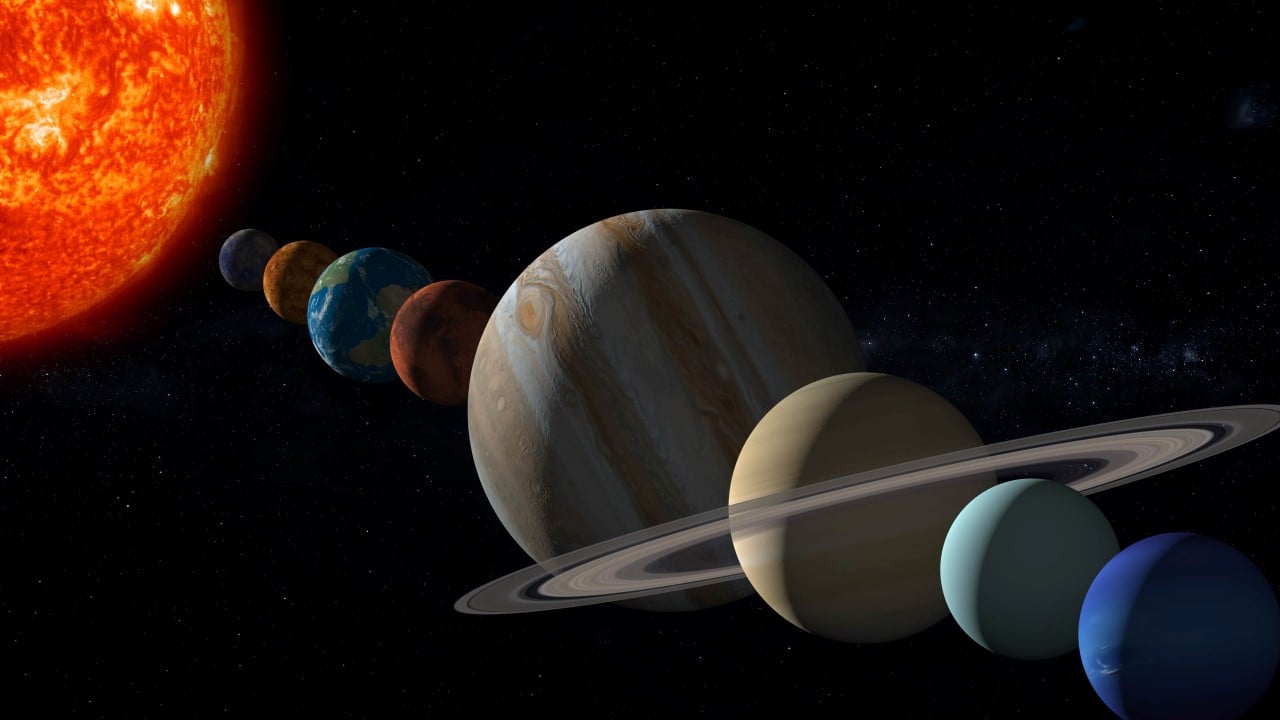
Scientists have raised the possibility that an additional giant planet was part of the Solar System in its early stages of development.
For a long time, the view prevailed that, after the initial phase of agglomeration, the Solar System would have quickly entered a stable phase, but more recent computer simulations reveal a much more turbulent and unstable picture.
Imagine the environment billions of years ago: instead of a serene arrangement, the forming Solar System resembled an intense cosmic congestion, marked by frequent shocks, abrupt migrations of planets and celestial bodies being launched to greater distances. Currently, several researchers consider that this initial period was dominated by instabilities, with gas giants changing their positions, entire worlds being removed and moons experiencing episodes of collision and recomposition.
How the young Solar System was formed
It all began with a vast slowly rotating cloud of gas and dust that, under the action of its own gravity, collapsed and formed the still growing Sun, accompanied by a surrounding disk of material. Within this disk, smaller particles collided and progressively aggregated, creating the planets, moons, asteroids and comets known today.
For a long time it was believed that, after this initial stage, the system would have stabilized quickly, however contemporary models describe a very dynamic environment full of turbulence. Soon after the emergence of the giant planets, their orbits underwent significant variations during a phase of great instability, in which trajectories constantly changed and several bodies were displaced or eliminated.
What does the Nice model say about the migration of giants
One of the most accepted explanations for this period of turmoil is the Nice model, which details how Jupiter, Saturn, Uranus and Neptune may have moved from their initial positions. As these massive planets interacted gravitationally with the waste disk and with each other, small changes in their orbits expanded and generated disorder throughout their surroundings.
In this scenario, gas giants pushed smaller objects to distant regions, modified the routes of comets and caused a real turmoil between planets and their satellites. Moons in the process of formation could be ripped from their orbits, thrown into interstellar space or destroyed in violent impacts, generating a large amount of icy and rocky fragments.

Was there an extra gas giant in the young Solar System?
Among the most intriguing assumptions is the chance that an additional gas giant existed, a fifth planet with a mass similar to that of Uranus or Neptune. In several simulations, the inclusion of this extra body brings the final orbits of the giants closer to the currently observed configuration, which makes the idea particularly relevant for scholars.
In these calculations, however, this planet does not remain close to the Sun: it ends up being thrown out in an intense gravitational encounter with Jupiter or Saturn. Such a world would turn into a wandering planet, wandering the galaxy without a host star, and some researchers indicate that this could shed light on aspects of the Kuiper belt, the Oort cloud and certain peculiarities in the orbits of today’s giants.
How giant moons survived so much instability
This time of turbulence raises an important question: what happened to the moons that circled Jupiter, Saturn, Uranus and Neptune as the giants changed their positions? In several simulations, the probability of these satellites maintaining stable orbits is reduced, as close approaches between giant planets can completely disorganize entire lunar systems.
For scientists, several moons have gone through cycles of destruction and recomposition, especially in the vicinity of planets such as Uranus and Saturn. The moon Miranda, for example, with its gigantic cliffs and very distinct terrain, is often mentioned as evidence of a violent history, in which ancient moons would have collided, formed clouds of debris and then regrouped into new bodies.
What evidence points to a turbulent young Solar System
The evidence that the Solar System had a more chaotic origin than previously assumed comes from multiple areas that reinforce each other. Experts combine information from space missions, observations from powerful telescopes, meteorite analyzes and numerical simulations to reconstruct this ancient scenario and evaluate different possible configurations.
Among the most debated evidence are the near orbital resonance between Jupiter and Saturn, the sharp tilt of Uranus’ axis and the distribution of objects in the Kuiper belt. To organize these clues, it is customary to highlight main categories of observational and modeling data:
- Detailed mapping of moons and planets carried out by probes, which reveals surfaces marked by scars and geological clues.
- Examination of craters, faults, and relief configurations that indicate large-scale impacts and phases of high activity.
- Investigation of meteorites and comets, which preserve primordial material and allow understanding the initial composition.
- Long-term simulations of the orbits and belts of smaller bodies, testing migration and instability hypotheses.
What we still need to understand about the formation of the young Solar System
Despite all these clues, great uncertainty remains about this initial phase full of rapid transformations and unexpected events. The possible presence of a lost gas giant remains a hypothesis supported primarily by models, with considerable doubts regarding its exact mass, initial trajectory and even whether it actually existed or whether it merely serves as a useful mathematical tool.
Future missions that will closely investigate the icy moons of Jupiter and Uranus, combined with observations of wandering planets and planetary systems around other stars, should provide new elements for this narrative. As simulations gain more precision and observational data accumulates, understanding the Solar System’s turbulent childhood must be based less and less on conjecture and more on hard facts, bringing what seemed like science fiction closer to astronomical reality.